That Prus' mother drove us from her home in Sriracha to Suvarnabhumi Airport is nothing special in itself. However, given that I had just spent a week with the family, who didn't know me before we met and perhaps still only have a vague idea of who I am, her offer to drive us was quite touching.
"She loves you," Prus assured me as she drove away.
He grabbed my hand and, apart from the security check and boarding the plane, didn't let go until about two hours later when we arrived in Udon Thani.
There, as the sun set over the Isaan region, we stood in the airport parking lot, inspecting what seemed to be the only remaining rental car in the entire city. Well, Prus inspected it; I filmed him doing it for posterity.
It was almost dark when we set off in the ten-year-old Toyota pickup, which quite obviously belonged to some random guy who needed to earn a little extra money. And yet, it was somehow the perfect vehicle for a road trip through the "Texas of Thailand"—at least provided none of the motorcycles, tuk-tuks, or motorcycles attached to food trucks that snaked their way into town on the poorly paved roads forced us off the road on our way to the hotel.
I don't remember exactly when we held hands again, but I do remember doing it on the way back from a nearby restaurant to our hotel, which was unusually appealing for Isaan, but also didn't serve typical Isaan dishes.
Several of the prostitutes on the street, who apparently formed the red-light district of Udon Thani, tried to lure us into their establishments despite everything.
As Prus and I set off on Wednesday morning to Talee Bua Daeng (also known as the Red Lotus Sea) in Udon Thani, exactly seven years after my friend Dora and I had been there, I wondered if the old saying about the regenerative capacity of all cells in the body was true.
The weather was dreadful, so we decided to postpone our visit until the next day – this place desperately needs blue skies. On the drive back to town, while discussing possible alternative plans for the day, the number seven came up in an anecdote about a mythical serpent.
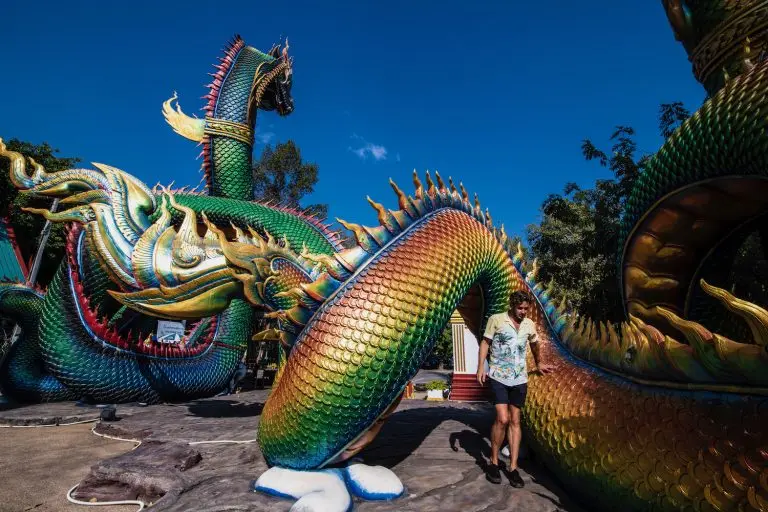
“The king of the Naga protected Buddha from a storm for seven days and seven nights,” he explained when I asked him why images of the snake were so ubiquitous throughout Thailand (and especially in Isaan).
We would see a lot. After a stop at a popular shrine of merit around midday, we planned to end the day on the Mekong River in Nong Khai, where once a year "fireballs" in the form of Naga rise from the water.
(Spoiler alert: This day is not February 2nd, at least not in 2022.)
The journey from the city center to Kham Chanot took about 90 minutes. Along the road, vendors selling Naga-inspired Grathong offerings tried to beckon devout Buddhists with serpentine wrist movements.
Together with the fiery red blossoms that fell from the flame trees above us and the seemingly endless row of stalls, their fluid movement lent the entire scene an unreal atmosphere, as if we had stumbled into a Thai horror film. I almost expected to find a ghost sitting beneath one of the yellow salas I saw every few hundred meters on either side of the Thanon, but no creature of any kind was making use of the shelter they offered.
Or perhaps not. “The Naga exist in another dimension,” he explained, without really elaborating, as we crossed the winding footbridge to the main shrine of Kham Chanot, perched on a densely forested mangrove island. The stench of the mud that keeps it from sinking into the surrounding swamp was almost as unbearable as the relentless heat.
On my way out after Prus had offered his sacrifice, I noticed a young dancer (she couldn't have been older than six or seven) performing in full makeup under a tent where at least two dozen Naga figures looked menacing. She knelt down, picked up a few marigold petals from under her feet, threw them into the air, and continued her performance without interrupting a beat.
On the way to Nong Khai, past shallow lakes (one of which I believe was the Red Lotus Sea), we got to talking about the future. Prus and I disappeared from the blissful present for what felt like seven years; I have no idea if all the cells in our bodies regenerated during our conversation about Brazil, Mexico, the absentmindedness of US immigration officials, Santa Barbara, and the Bubba Gump Shrimp Company.
But in Nong Khai, in the shadow of a giant two-headed Naga statue on the banks of the mighty Mekong, I prayed that the seven days and seven nights we would still spend together would not be the end of our journey.
When I woke up on Thursday morning and the cloud cover was still there, I resigned myself to the idea that Prus and I would probably not see the Red Lotus Sea together.
At least not now. “We can come back when I return with the nine-headed Naga,” he said, referring to a hypothetical return to Kham Chanot to settle the karma of his wish, provided it were to come true.
Despite this tranquility, or perhaps because of it, countless Bua Daeng teased us as we sailed along the southern end of the lake on our way to Roi Et. After a brief, breathtaking encounter with the flowers – we climbed onto a rusty, barely floating fisherman's shed to view them from the water – we continued our journey through an idyllic, but not particularly breathtaking, landscape.
This breathless feeling happened every time we tried to overtake another vehicle on the bumpy road. It was especially thrilling when a truck loaded with meter-high sugarcane stalks was in front of us and we sped past it at top speed. We barely managed to avoid half a dozen motorcycles coming towards us in the right lane before we swerved back to the left and found another huge truck blocking our way, forcing us to repeat the whole process.
Sometimes, between the roar of the tires on the potholes below and the hesitant start-up of the old engine, I wondered if we would even make it. Regularly rising plumes of smoke from freshly burned fields further intensified my doubts, especially when I realized that the accompanying smell might have another source.
“I think there’s a MSG factory nearby,” Prus said as we finally reached a stretch of open road, and took my hand in his. It was a romantic gesture, but a horrible thought: the manufacturing process of something like monosodium glutamate. What terrible stuff!
We made a brief lunch stop in a small town whose name I've forgotten. The only impressive thing about it were the yellow-decorated archways that rose above the unremarkable intersections, paying homage to the king. While the heat of the chili peppers in the larb numbed my taste buds, my eyes were able to appreciate the delicacies in their own way.
“Have you ever noticed,” I asked Prus, who was taking a bite of the sauce-covered Gai Yang stuck to sticky rice, “how pale and pink the tomatoes in the Som Tam are?” Their color matched their taste, which complemented the rest of the papaya salad so perfectly, as if it had been prepared in a supercomputer rather than with a mortar and pestle.
As we continued our journey, with country-pop hits and sentimental love songs overlaying the organic music of a road trip through the Isaan region, I noticed a slight oddity in the air.
And the earth itself: wherever I looked, there were eucalyptus trees, as if we were in Queensland instead of Kalasin, were it not for the emaciated cows. Their skin was wrinkled and taut from the raindrops of a short, heavy downpour that probably shouldn't have fallen here at this time of year.
When we reached Phra Maha Chedi Chai Mongkol, a massive pagoda complex on the eastern edge of Roi Et province, I wasn't sure what to make of it. The splendor of the ivory and gold seemed all the more majestic because of the stark landscape above which it stood. The intricately decorated interior of the main chedi, which, like so many in Thailand, supposedly houses a genuine relic of the Buddha (presumably Gautama), only reinforced this impression.
“It’s like a temple from a video game,” Prus said, his gaze following the surreal spiral staircase that led to the top of the tower just before we climbed it together. I almost expected the Zelda theme song to start playing. Naga, as always, was omnipresent, adorning the railings on both sides.
Even when we reached Roi Et and looked down from the surprisingly tall Roi Et Tower onto the surprisingly beautiful cityscape (by Isaan standards), we couldn't escape Naga's presence. The serpent had encircled a Buddha image northwest of the large moat surrounding the tower – just as Naga himself, according to legend, had protected the Buddha for seven days and seven nights.
It was the same feeling of security I felt when night fell and Prus, who couldn't find a place for us to eat our Khanom Pang Sang Kaya at the night market, folded down the back of the truck as if we were two teenagers in the Texas desert.
As we dipped our cubes of green bread into creamy pandan pudding, and the lights of the now-illuminated Roi Et tower flickered down upon us, I wondered what I had done to deserve such a deep romance, and whether in a few years I might have to return to Kham Chanot and offer my own sacrifice alongside Prus when he offered his.
On a short stretch of the surprisingly wide and smooth road between Roi Et and Ubon Ratchathani, the salas, which appeared every few hundred meters, shone turquoise instead of their usual mustard yellow. The rice paddies along this stretch were also vibrant and bright green instead of withered and straw-colored, though I'm not sure if these two facts are related.
Aside from these details, the unremarkable landscape on either side of Highway 23 could, of course, have been in Missouri, though I can't recall exactly which part of the state it reminded me of. I was distracted: Prus, who had been drinking the heavily unregulated Thai version of Red Bull (supposedly the original) to combat his morning fatigue, was showing me a YouTube video about a Thai-American couple who had opened their own food truck selling Thai street food in my former hometown of Austin, Texas.
"She's growing her own grapefruit!" Prus exclaimed enthusiastically as the cameraman focused on the basil plants in the woman's garden. "I want to grow my own grapefruit in America, too."
As we approached our destination of Ubon, signs of civilization quickly appeared, although the trees were still no taller than medium-sized houses. I lost count of the countless Gai Yang stalls lining the left side of the highway as the speed limit decreased; the loss of chicken lives was immeasurable.
"That's creepy," remarked Prus, referring not to the dead birds, but to the vehicle that drove past in the other lane. "An ambulance without any sound."
One thing in Ubon Ratchathani, at least in my memory, hasn't changed since my first trip in 2017: there's no defining feature, no landmark, let alone a unified city center. This felt particularly strange compared to the meticulously maintained Roi Et, which is perhaps the most beautiful city in Isaan. Ubon is simply… Ubon, which means "lotus" in Thai.
The last time I was here, it was so oppressively hot that I spent most of my time indoors. On the first day, after cycling from my inconveniently located hotel along the river to Wat Thung Sri Muang and back up to Wat Phra That Nong Bua, I retreated to the freezer compartment of my room to watch the sunset. This sunset was the color of the juice left over after eating Som Tam, but a bit more hazy because the air conditioning fogged up the windows.
When Prus and I got out of our rental car this time at Wat Phra That Nong Bua, there was a slight chill in the air despite the bright sunshine. He said he wasn't sure whether he wanted to take off his shoes to go into the stupa; he was worried the floor might be cold.
At the northeastern end of the compound, where the chedi rises, two Naga twins ascended in attack formation. Prus knelt before them to offer a sacrifice, but frustrated by the missing numbers on the Kau Chin lottery poetry sticks, he gave up. "How can this be right?" he wondered, and packed them away again, thus (presumably) abandoning his request.
Next, we began our journey to Sam Phan Bok, which was still submerged in the Mekong River on my last visit. Although its name translates to "three thousand holes," it is colloquially known as the Grand Canyon of Thailand.
The nearly two-hour drive was exciting, not least because we were literally fighting against the sun. If we did everything right (or our Kau Chin did, so to speak), we would enjoy the last 20–30 minutes in the best light. I would finally take the perfect photo I had been waiting for for over five years.
It was certainly exciting for me. I had little more to do than check the time and our position and stare out the window at the stalls selling fresh pruthra, Thai dates. And to think about the tattered Thai flags fluttering above almost every stall: how strange a flag is, how primitive the gesture of raising one!
Prus was clearly still tired; I halfheartedly sang along to karaoke versions of Katy Perry's "Teenage Dream" and other mid-2010s pop hits, hoping my humiliation would keep him awake. (If you're reading this now, it worked.)
As we approached Sam Phan Bok's parking lot, Prus turned left off the road, where another eucalyptus grove rose up. He let me pick a leaf, rubbed it in my hand, and inhaled the released oil. I wasn't sure if he needed it to wake up properly or if he simply loved the scent, but the smile on his face made the question irrelevant.
Although we technically arrived before sunset, a problem with Google Maps forced us to take a 15-minute walk that would have been unnecessary with clear navigation. By the time we reached the first rock formations, which were neither a gorge nor particularly impressive, it was already almost dark.
“Let’s do a tour next time,” Prus remarked casually as we returned to the truck and looked at faded photos advertising these tours. To be honest, they weren’t all that different (and certainly not better) than the ones I’d taken myself, despite the less-than-ideal lighting conditions.
The idea of an organized tour was anathema to me as a travel blogger, but the prospect of sharing my disappointment with someone was equally tempting. On the way back to the city, I kept Prus awake by repeatedly slipping into a British accent and then dropping it again.
“You sound like Adele,” he laughed after a particularly affected monologue. For a moment, I considered adding one of her songs to my list for future serenades. But they're all about breakups; I didn't want to tempt Naga, given Prus's previous carefree attitude.
The rustling of the leaves in the Ubon parking lot on Saturday morning almost had an autumnal sound. I'm slowly getting used to the cool mornings here in Isaan, which is dangerous in a hot country like Thailand.
“Do you remember how we almost didn’t get here?” I asked Prus as we drove from the parking lot towards the city center of Ubon to see a few more sights.
He glanced sideways at me as he turned around. "You mean, how you almost didn't get here?"
He was right: I had postponed my Isaan trip so that I could be with him in Sriracha after our week together in Kanchanaburi. Had he not agreed to accompany me on this second attempt, I probably wouldn't have gone alone.
After briefly showing Prus Wat Thung Si Muang – he wasn't as impressed now as I had been five years ago – we went to the huge golden statue near the city pillar of Ubon. That got him talking.
“Do you see how they’re holding Naga like a rope?” he asked, pointing to the surreal-looking creatures at the base of the ship. “They’re using it as a tool to achieve immortality.”
I pondered what it might mean as we sped out of the city and onto the highway towards Mukdahan, especially as we passed a procession of monks walking along the other side of the road. I'd once again played a karaoke-singing game for sleepy Prus; he drove me extra slowly past the procession so I could get a good photo, presumably as a reward for my efforts.
After Ariana Grande came Sinead O'Connor, whose controversy Prus was unaware of, although he recognized the song.
“Perhaps it was karma,” he speculated, as the men in their robes lay a dozen kilometers behind us. “So many Catholics must have cursed them afterward—it all fits together.”
Could that have been the reason why, when Prus woke up and stepped on the accelerator with frightening speed, we got into a trivial argument, which we nevertheless conducted as if our very existence depended on it?
“We have a lot of good karma,” I reassured Prus, who seemed intent on maintaining the suspense, as we drove into the parking lot of Wat Roi Phra Phuttabat Phu Manoram. One of the largest Buddha statues I have ever seen in Thailand towered high above us.
By the time the songthaew took us up the bushy hill to the foot of the Buddha, our sparring session was already over. There, unsurprisingly, stood a huge Naga statue in an attack position—or was it perhaps a defensive posture?—over the Mekong. Nevertheless, it was difficult not to interpret the red flags attached to the silvery, shimmering, tree-high bushes as instructive.
Before we climbed the Buddha, Prus suggested we buy a naga lantern and offer it as a sacrifice, presumably to atone for karmic failings that had led us into the argument. While we waited to make our offering—I held the lantern while Prus lit some incense sticks—I watched the temple helpers dispose of previous offerings: the lanterns were carefully placed in blue baskets, the smoking sticks swept into green buckets of water.
Once we reached the top, Prus and I climbed a metal staircase to touch the Buddha's fingers. I wondered if the fierce wind would blow us away, just as those below, who cared for us mortals, had destroyed our gifts.
No such tragedy occurred, at least not while we joined the long queue for the shuttle bus back to the parking lot. There, after a rather disappointing Som Tam lunch, we ate raw jujubes, which tasted like small, tart, but juicy apples; the tension continued to ease.
When we arrived at the foot of Wat That Phanom, a little upstream in picturesque Nakhon Phanom, the day's arguments seemed long forgotten. Prus was fascinated by the red accents on the stupa's magnificent golden decorations; I, on the other hand, listened intently to the chanting of the worshippers as they circumambulated it clockwise.
The mantra was written (and transcribed into English) at the entrance to the complex. Prus had suggested that I write my name and my family's name on a golden tablecloth so the monks could include it in their list of the blessed. He drew a square around it and wrote his first and last name on it in capital letters.
After a short walk to the Mekong, where the sight of the sandy beaches on the Laotian side completely surprised me, we headed west again. We quickly grabbed some food at the city's colorful fresh market before taking the scenic route back to our hotel. Hollyhocks were blooming in front of one of the houses; they were a perfect match for the cold autumn wind that seemed to have followed us from Ubon.
I don't know if every cell in my body has regenerated in the seven years between my first and second visits to Udon Thani. In any case, the Lion King Hotel was considerably more run-down than I remembered, even though I hadn't stayed there again with the intention of writing a review. I thought a familiar environment—at least for my body—might help me better organize my feelings, if not my thoughts.
I vaguely remembered the main road to the south where the hotel was located, but otherwise the area was hardly familiar. It proved to be completely unknown territory for my last night in Isaan; I knew the (thankfully) manageable area just as little as Prus, who had never stayed there before.
As we lay in bed together, me finishing some work and him catching up on his manga, I began to think differently about regeneration. It's not something that happens automatically, even after seven years, but a process that you can consciously initiate at any time.
My still-young love for Prus had surely already gone through many life cycles when our plane took off south the next morning; it would undoubtedly die and be reborn a dozen more times before we had to say goodbye, provided we don't find a way to ensure that we never have to.
Should Prus and I actually return to Isaan together to offer Naga his final sacrifice—be it in seven months, seven years, or seven decades—I doubt we'll ever spend the night in the Lion King again. But I sincerely hope our affection for each other is fresh, genuine, and heartfelt, and that his mother still loves me, at least enough to drive us to the airport one more time.
Other frequently asked questions about visiting Isaan
Which places should one visit in Isaan?
Isaan is a vast travel destination encompassing nearly two dozen provinces; it's almost a country in its own right. Among the most popular attractions are the Red Lotus Sea near Udon Thani, Khao Yai National Park near Korat, and Sam Phan Bok (also known as the "Grand Canyon of Thailand") near Ubon Ratchathani. The numerous meanders of the Mekong River are also major draws in Isaan.
What is Isaan known for?
Isaan is considered by tourists to be the most authentic part of Thailand, but also the one with the worst infrastructure, requiring slow and thoughtful exploration. Thais know Isaan as the poorest part of their country, but also as the one with the best food, especially the papaya salad Som Tam. The Isaan language, as well as the unique culture and music of the Isaan people, are also well-known among Thais.
Is Udon Thani worth a visit?
The city of Udon Thani itself isn't particularly worth seeing; it's not even my favorite city in Isaan, let alone in Thailand. The province of Udon Thani, however, is an ideal base for exploring the Isaan region. After visiting the riverside town of Nong Khai and the picturesque Red Lotus Sea, you can travel south to Roi Et and Korat or east to Nakhon Phanom.




Community
Comments 0
Start the conversation.