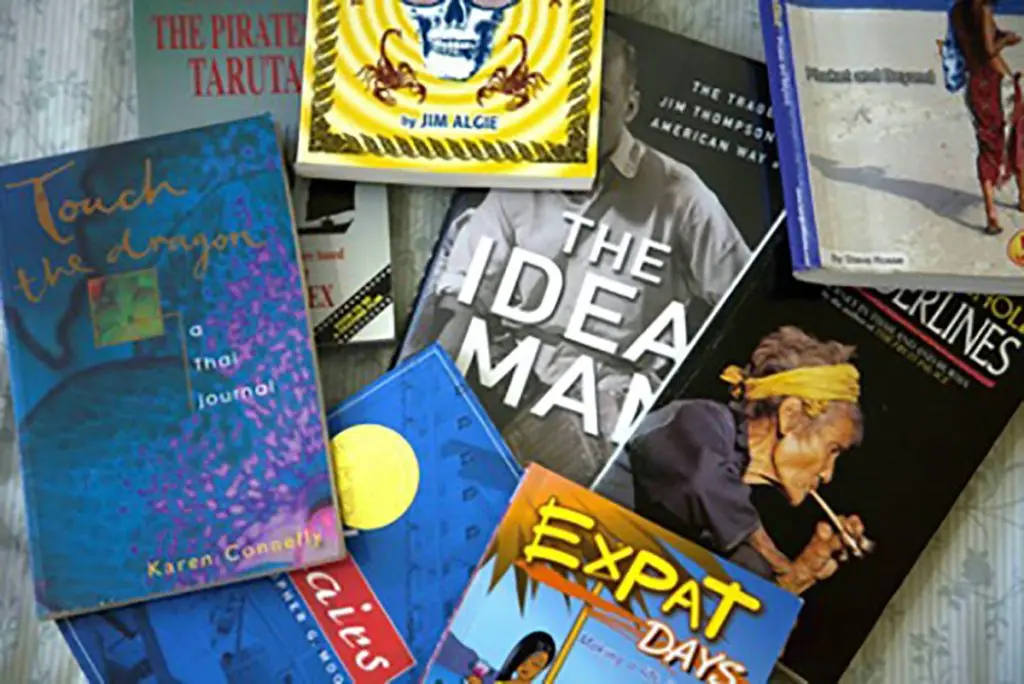
While we wait for Covid-19 to finally disappear, the blog's long-time correspondent, John Borthwick, takes a journey back to Thailand using some of the best writing about the kingdom.
Thailand has been celebrated in many literary genres, from fiction and fantasy to poetry, nonfiction, and science fiction. Let's embark on a virtual journey through some of these genres.
From a Thai perspective
"Jasmine Nights" is an enchanting and poignant novel by Thai author and composer S.P. Somtow. His semi-autobiographical adventure is considered a classic of 1960s Thai coming-of-age stories. Set in the time capsule of his aristocratic family ("our remote little island kingdom on Sukhumvit Road"), the story teems with eccentric aunts, suitors, princes, and a pet chameleon. And then there's sex, politics, and a healthy dose of comedy.
Pira Sudham writes acclaimed novels and short stories about everyday life in Thailand—not bars, spas, wannabe celebrities, or luxury hotels—mostly in the poor rural regions of Isaan in northeastern Thailand. His best-known work, "Monsoon Country," tells the story of a farmer's son who goes to Bangkok and later studies abroad on a scholarship—a parallel to Sudham's own life story. His short story collection, "It is the People," is also highly recommended.
Thailand's revered royal poet Sunthorn Phu (1786–1855) led a life filled with romance, scandal, and exile, all of which are reflected in his works. Known as the "People's Poet of Thailand," he has been compared to Shakespeare due to the breadth and national significance of his writings. His poetic saga, "Phra Aphai Mani," recounts the romantic adventures of a Byronic hero in ancient Siam. Koh Samed is the setting for a tale of a lovesick mermaid and an exiled prince, commemorated today by the statues of the lovers on the island's Sai Kaew Beach. Not far from Samed, in Klaeng, Ranong Province, lies the Sunthorn Phu Memorial Park.
A fictional land of smiles
Former Hong Kong lawyer John Burdett has written six bestselling crime novels set in Thailand, featuring his eccentric Thai police officer Sonchai Jitpleecheep. The novels are largely set in Bangkok, a city of dirty politics, bizarre murders, and sometimes equally bizarre sex scenes. They are full of wonderfully eccentric characters, lustful spirits, and pitch-black humor. Start with "Bangkok 8" and keep reading.
Burdett's cast of characters, both good and evil, is more nuanced than the dime-novel ladies and private detectives in Christopher G. Moore's extensive Bangkok novels. His crime novels, such as the popular "Killing Smile" trilogy, are set in a city that seems to consist mainly of bars and red-light districts. Alternatively, his short story collection "Chairs" is recommended.
“Thailand is the Italy of Asia. Great food, beautiful women, rampant corruption, and utter dysfunction,” says Jake Needham, author of six gripping, intelligent thrillers set in Thailand. “The Big Mango,” “A World of Trouble,” and “Killing Plato” are perfect novels for anyone stuck at the airport. His well-crafted plots are infused with international politics, big money, and the intricate structures of pan-Asian corruption. (The Wall Street Journal Asianotes: “Mr. Needham seems to know more about it than one should.”) Numerous sharp dialogues and a consistently fast pace characterize the novels. Needham’s work is far superior to most foreign-written Thailand novels, which are typically rated PG: detectives, women, guns, and thugs.
Bestselling author and master of Scandinavian crime fiction, Jo Nesbø, wrote a Bangkok thriller back in 1998, which wasn't translated into English until much later. In "The Cockroaches," his Oslo police detective Harry Hole investigates the murder of the Norwegian ambassador in Bangkok, who was found dead in a run-down motel. Go-go bars, temples, and opium dens form the now-clichéd settings for Harry's hunt.
Paolo Bacigalupi's "The Windup Girl" is a cyberpunk science fiction story about genetic theft, the machinations of agribusiness corporations, and a beautiful, almost human woman, the titular "Windup Girl." They all clash in a post-apocalyptic Bangkok of the future, where heavily armed government agencies wage war against each other. Imagine William Gibson's "Neuromancer" meeting "Blade Runner"—amidst a genetically engineered famine…
Alex Garland's 1996 novel "The Beach" needs little introduction. It was adapted into a Hollywood film in 2000, which in turn triggered a wave of devastating tourism to the once-paradisiacal Maya Bay on Koh Phi Phi Leh. On an island of some arbitrary nature (in the Gulf of Thailand, but it could be anywhere), a group of backpackers witnesses their wild paradise descend into tropical slum as events spiral out of control, become psychotic, and ultimately, everything collapses. The novel has been aptly dubbed "Lord of the Flies for Generation X."
Angela Savage's novel "Behind the Night Bazaar" partially subverts the common cliché of male adventurers (or their victims) in Thailand by featuring at least one female protagonist and setting the story in Chiang Mai rather than Bangkok. Savage's private investigator is a thirty-something Australian woman facing the sometimes comical challenge of "working undercover in an environment where she can do anything but blend in." This environment is, of course, a world of murder, corrupt police, and exploitation.
When Jack Reynolds' novel "A Woman from Bangkok" was published in 1956, the Asian Wall Street Journal lauded it as "one of the ten best novels about Asia." High praise indeed for the story of a naive Western man who encounters an unscrupulous foreign seductress. "Unrequited love" is a familiar literary motif that continues to appear in many Thai-influenced pulp novels written by foreigners, not to mention real life—which partly explains the enduring popularity of this captivating novel.
In "Private Dancer," Irish crime veteran Stephen Leather (or at least his tragic young protagonist Pete) wanders the same alleys of Bangkok, sheds the same tears, and learns none of the same lessons as Jack Reynolds' naive hero 50 years earlier. But in the 21st century, everything in Bangkok's bar scene is harsher and far darker. Poor, lovestruck Pete sinks ever deeper into obsession with a smooth but faithless femme fatale. "Slow Learner" could be both his epitaph and Leather's alternative book title.
I personally
Canadian poet, novelist, and travel writer Karen Connelly knows Thailand and its language far better than most non-Thai authors. She completely transcends the cliché of "Thailand = eroticism + exoticism" by looking and living far beyond the glitzy demimonde. Read her skillful, youthful account of her exchange year in "Touch the Dragon: A Thai Journal." Her much later book, "Burmese Lessons: A True Love Story," is an unflinching, candid account of her journey and love affair in the jungles of northern Thailand, amidst exiled Burmese resistance groups.
To return to a decidedly lighter topic: The cautionary anecdotes of Australian expat and humorist Neil Hutchison about foreigners who look for love in the wrong Thai bars—and sometimes find it anyway—should be required reading for all men between puberty and senility traveling to Thailand. Hutchison shares his own hard-won observations about farangs (foreigners) who feel completely lost in the Thai world in ironic titles such as "A Fool in Paradise" and "Money Number One: The Pattaya Singles' Survival Guide."
The journalistic explorations of Scottish-Canadian expat Jim Algie in "Bizarre Thailand" are not as racy as the book's sensational title ("Stories of Crime, Sex, and Black Magic") might suggest. It's brimming with obscure local knowledge about fertility shrines, renegade monks, and the still widespread Thai belief in superstition and magic. And it's funny, too. In a similar vein, but with a stronger focus on character development, two excellent books by fellow expat author (and acclaimed biographer of Jim Morrison), American Jerry Hopkins, are also highly recommended: "Bangkok Babylon" and "Thailand Confidential."
In his travelogue "Borderlines," the renowned English writer Charles Nicholl travels north, to the Golden Triangle and then to Burma, in search of rebels, jade, opium dealers, insights, and an elusive Thai friend named Katai: "Sometimes I think that not only has Katai 'eluded' me, but Thailand itself, the whole strange journey. I never really knew where I was going, never reached my destination. Perhaps the law of travel is that simple. You never arrive. There is only the road and what it reveals along the way." Does that sound familiar?
The Kingdom of Non-Fiction Books
"The Ideal Man: The Tragedy of Jim Thompson and American Warfare" by Joshua Kurlantzick is a captivating biography of the legendary Jim Thompson, the so-called "Silk King." Thompson's eventful career encompassed the roles of soldier, spy, bon vivant, and entrepreneur—and ultimately, his disappearance without a trace. The book's subtitle points to the broader context of military and political developments in Southeast Asia. The result is an insightful portrait of one of the country's most fascinating foreign figures against the backdrop of Thailand's turbulent post-World War II political landscape.
The unauthorized 2006 biography of the late King Bhumibol Adulyadej, "The King Never Smiles," by journalist Paul M. Handley, is banned in Thailand but readily available in Cambodia. The author takes an unflinching look at the career of King Rama IX, the world's longest-reigning monarch (from 1946 to 2016). It is an unconventional examination of the foundations and achievements of the king's rule and Thailand's evolving democracy.
During your stay in the region, Thailand's neighboring country of Laos offers similarly fascinating reading material. The investigative travelogues of journalist Christopher Kremmer, who successfully uncovered the fate of the last king of Laos, Sisavang Vatthana, who disappeared in 1975, are highly recommended: "In the Footsteps of the Elephant Kings" and "The Bamboo Palace: The Discovery of the Lost Dynasty of Laos".
Some of the titles mentioned above are out of print, but most are available online or as ebooks. A scholarly exploration of the topic is offered by "Imagining Siam: A travels' literary guide to Thailand" by Dr. Caron Eastgate Dann.




Community
Comments 0
Start the conversation.