The approach to Phuket was so gray that I couldn't tell which direction the plane was coming from. In the dim light of the first Wednesday of 2022, all the island's landmarks appeared uniform and anonymous, as if the entire scene were a giant 3D Rorschach test.
I tried not to think about it anymore. My friend Allano, who had picked me up from his hometown on the mainland, had a taste in music that made it easy. In the background, a strange remix of "Rocket Man" was playing, featuring Dua Lipa and a rather unflattering digital imitation of Elton John's voice.
Instead, it dawned on me that we were driving in the wrong direction. "Sarasin Bridge – 11 km," I read on the sign pointing to Phang Nga, our actual destination. We turned off.
I was of course in southern Thailand to visit Allano and his family, and just as I had done with the emptiness that reigned where once there had been a great, beautiful sky, I ignored all the misgivings I felt.
“We had to postpone it,” Allano’s sister Irin told me when I asked her how her wedding had gone, which was only a few months away when I last saw her at the end of 2019. That may have sounded like a silly question if you’ve experienced the coronavirus pandemic firsthand; it seems less silly when you consider that Thailand barely had a wave of infections in 2020.
Irin, for her part, didn't elaborate, but she answered the unspoken question that was nagging at me. "We're going to Kathu now to meet Doppler," she said, referring to her fiancé, whom I hadn't yet met. "That's why we didn't go straight back to Raan Jeh Nong."
She was referring, of course, to the restaurant owned by her and Allano's mother, a highly respected figure in her village of Kalai. She refers to herself as my Thai mother, a claim she made when we first met in November 2017, a few months after I had met Allano in Bangkok.
J'Nong, as everyone calls her, was as always overjoyed to see me when the three of us finally arrived at her house, about five hours after my plane had landed. By then, the monochrome sky had transformed into a milky blue, dotted with clouds like whipped cream spurting from a can.
She was overjoyed when the evening ended. Undoubtedly because I had thanked her for the delicious sukiyaki meal. Her staff had then prepared American cocktails using the alcohol that Allano, Irin, and I had bought at the colorful "Super Cheap" supermarket in Phuket.
“Aroi maak maak,” she said sincerely as she took her first sip of margarita, having previously downed a mojito in record time. As always, she was understanding and didn't judge me when I decided to go home long before the party ended.
I felt all the worse when, almost immediately after unpacking my things in the small, palm-fringed bungalow that had once been the family's Airbnb, it became clear to me that I couldn't possibly stay there for more than one night. And not just because of the state of disrepair the house had fallen into during the nearly two-year ban on foreigners entering Thailand.
Allano had acquired a cat – or rather, three. And I am extremely allergic to cats.
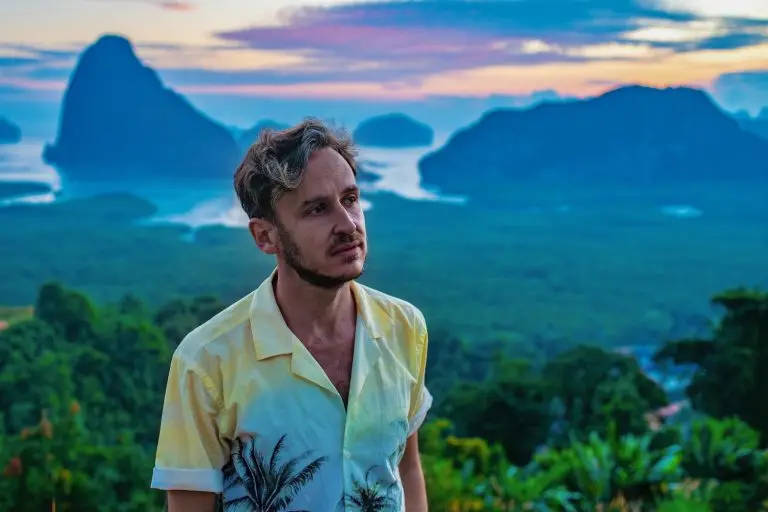
The next morning, after Allano had taken me to cross the sunrise over Phang Nga Bay from the Samet Nangshe viewpoint off my bucket list, I moved into the excessively luxurious Erawan Hotel in Khok Kloi, the town where he buys produce for J'Nong's restaurant at its fresh market.
All family members insisted they understood why I had made this decision, but I still felt ungrateful and guilty – and above all, sad.
I woke up on Friday and was mostly grateful to have slept well the night before. When I returned from dinner, I found one of the largest spiders I had ever seen under the foot of my bed; only after the hotel staff removed it did I discover its counterpart, which was actually on my duvet.
Although the Similan Islands had been on my bucket list for years, I wasn't particularly thrilled when I boarded the tourist bus. It arrived punctually at 7:20 a.m. and was empty – except for me, the driver, and four Russian tourists.
As the van sped north through the rubber and oil palm forests of the rural Phang Nga province towards Khao Lak National Park, it dawned on me. The sun was out, and I mean that literally: the ominous gray of 48 hours ago seemed as distant as the time before the pandemic.
Upon my arrival at Khao Lak Pier, the four Russians and about 30 other tourists of various nationalities joined in a free breakfast. Towards the end of breakfast, a young Thai man took a seat at the front of the outdoor area.
Behind him, the water directly in front of Dtaa Ruea glittered in perfect light. This was also the source of its stench, a mixture of swirling crude oil and the remains of fish carcasses from the nearby fish market.
“Thank you so much for coming to Thailand,” he emphasized after briefly introducing himself and explaining the itinerary. I found this encouraging, as the recent change in government policy made it clear that Thai officials saw things differently. I made a joke about one of them; only Arty (whose name I initially mistook for Aathit, meaning “sun”) responded, which I didn’t mind.
As Arty had predicted, the speedboat ride to Koh Miang (Island No. 4) took exactly one hour and 15 minutes. Although I was initially annoyed that everyone except me and the Russians wore masks for the entire boat trip, this annoyance was immediately forgotten when we arrived in the pristine bay.
Of the beaches I actually visited, the powdery sand and crystal-clear, turquoise water reminded me most of the islands of the Mergui Archipelago in Myanmar. The large boulders at the eastern end of the beach, however, evoked associations with the Seychelles (which I hadn't yet visited as of January 2022).
And yet, the sublime tranquility upon my arrival, before I fully grasped all the beauty that awaited me, reminded me of my time at the limestone cliffs of Pamukkale in Turkey in October of the year before last. (Although I'm aware it's not a beach; it evoked the same feeling in me as arriving at the Similan Islands.)
Surely this is exactly the kind of beach I had in mind when I assured a friend from Sardinia (which I found terribly overrated) last year that Thailand's beaches were generally better than those of her home island.
After a photoshoot amidst the aforementioned stones, I met Arty, who seemed surprised that I was traveling alone. But in a positive way, quite unlike how most Asians react.
“I also enjoy traveling alone,” he admitted, and judging by his expression, he seemed just as enthusiastic about the scenery as I was. “Well, when I’m not working, which felt like it was always the case until 2020.”
I learned that Arty, like me, had been working in the tourism industry since 2009. He initially worked for a large travel company in Phuket that offered diving tours to islands such as Koh Racha and Koh Haa, before moving to Wow Andaman, which allowed him to be closer to the village where he grew up and still lives.
He personally thanked me for the time I had spent in Thailand, but in private he struck a much more serious tone than in public.
“Because of the changed rules, we could lose another peak season,” he sighed, somewhere between despair and resignation. “Today the boats are full, but normally we have five or six. Now there are only two.”
"Do you believe that everything will ever be the same again?" he asked in conclusion. "Like it used to be?"
I nodded. "They will, if those in charge allow it."
In this brief, bittersweet moment of solidarity, I was reminded of an important truism: experience eliminates fear; perspective softens bitterness.
On the next two islands, Koh Similan itself (#8) and Koh Hin Pousar (#10), the focus shifted largely underwater.
Arty guided me and a few other fast snorkelers to a variety of marine life. Among them were a rainbow parrotfish, a sea cucumber, and a so-called "Black Nemo," which was smaller than expected and, at least through my fogged-up diving mask, indistinguishable from a normal clownfish.
And yet, in my efforts to appear neither weak – after all, there was a current in the bay – nor to let Arty's friendly, off-duty guidance go unnoticed, something strange happened. I finally got into the swing of snorkeling, something I hadn't felt motivated to do since my introductory dive (admittedly my only one so far) on the Great Barrier Reef ten years ago.
Before leaving Koh Similan, we had lunch right behind the main beach. A monitor lizard, similar to those found in Lumphini Park in Bangkok, was stalking among the picnic tables like a dog begging for scraps. Afterwards, we hiked up to the Beacon Rock viewpoint, where Arty told me some more interesting facts.
Despite the beauty of the bay far below, its coral reefs had apparently been badly damaged over the decades. "Indonesian fishermen used to come here," he explained, "and drive the fish to the reef with dynamite."
He also went to great lengths to show me a small waterfall that apparently flowed between two closely spaced boulders just behind the main beach. My eyesight was definitely too poor to see it; I simply took his word for it.
Our short trip to paradise – and undoubtedly to the most beautiful islands I've seen in Thailand so far – came to an end five hours (though it felt like only five minutes) after it began. As I opened my weather app to take a screenshot for my sister in freezing St. Louis, the text brought a smile to my face.
The Indian Ocean, it was stated, without providing any further geographical details.
Saturday morning was supposed to be uneventful. When Allano picked me up in the Erawan, I assumed he was simply driving me to Phuket for my three-day stopover and that I wouldn't see him again until I returned to Phang Nga the following week.
Instead, he brought me a J'Nong recipe, and as always, J'Nong himself had prepared a delicious meal for me. There were many of my favorite dishes from the past few days, but with one special request: Tom Kha Gai.
The company was unusual. A friend of J'Nong's, also named Nong, was likewise a cook and originally from Phang Nga, but currently living on Guam. With him were his daughter Am and his wife (or ex-wife – I didn't ask), who normally lived in the Thai province of Phattalung.
"This is my first trip home in three years," he explained excitedly, as he shoveled braised pork knuckle and spicy fish stew into his mouth. "No dietary restrictions."
On the one hand, I felt honored to meet J'Nong's friends. They were people she had known for decades; I was just a friend her son had met by chance a few years earlier under somewhat inglorious circumstances.
It did indeed seem strange that Allano and Irin were eating in the back with the staff, while I was dining with the man whose presence made him seem more like a foreign dignitary than an old friend.
Well, apart from the enthusiasm with which he literally photographed every single piece of food that came out – honestly, it almost reminded me of myself.
“I belong to the Instagram generation,” he joked, and his smile was as wide as the sugar-white beaches of the Similan Islands.
As he described the tempura-fried vegetables on his plate – Pak Lin Han, which are said to be found only on the beaches of Phang Nga province – he spoke with an enthusiasm reminiscent of someone who has found a rare Pokémon.
When we next arrived at the Home Cafe (stylized as the Chinese character 家), my enthusiasm was just as great as his. The cafe, owned by Allano's friend Pong and decorated with antiques and photos of his Hokkien Chinese ancestors, was more reminiscent of Penang than Phang Nga – in the best possible way.
And that was before Pong presented delicious dishes and desserts, the centerpiece of which was a centuries-old recipe for Aiyu, a delicate gelatin made from fig pectin.
As we ate and chatted in the house (which, despite its antique appearance, had actually been built only a year earlier), photographs of at least five generations of the Pong family gazed back at us.
“These dishes date back at least to their time,” he said, pointing to the woman at the very top, his great-great-grandmother. “So it’s a 170-year-old menu.”
I had the feeling the old woman was looking down at me, observing my reaction. Although the photos were colored and looked more like drawings than prints, they had something immediate about them – something human.
These people had already lived all the years I have ahead of me, had died and turned to ash before I was even born.
Pong's hospitality, it turned out, rivaled even J'Nong's. After several delicious dishes and three different aiyu variations (honey-lemon, watermelon, and peach), he brought out a bowl of rice with pork meatballs and fried garlic.
The other Nong just stopped her Instagramming and eating to ask me if I wanted some too.
“Im laaw jing,” I managed to reply in Thai, feeling pretty sure I was wrong.
Nong confirmed this to me. “‘Im jing jing’ would be more natural. I understood how you said it, but it sounded strange.”
Outside, the sun was almost directly overhead; the cool morning air, unusual for southern Thailand, had heated up to almost 40°C, so much so that we could feel it inside the house. Although I wasn't in a hurry to reach Phuket, I was worried that my hotel would think I had cancelled if I waited any longer.
Back at J'Nong Recipe, while I waited for Allano to get ready for our drive, I flipped through some of the photos I had taken throughout the day, as well as the several hundred I had previously taken in Thailand, all of which were stored on my computer. I had rediscovered my creative spark for the first time since leaving Italy at the end of September.
When Allano finally arrived about an hour later, my initial annoyance at his lateness vanished immediately. Irin and J'Nong would be joining us in the SUV; it was going to be a real family outing. To be honest, I felt a bit guilty about being driven all the way to the south of Phuket, even though Allano was the only one doing the driving.
I was incredibly grateful that everyone else came along, but somehow felt unworthy of the farewell ceremony, especially since I would be back in three days. I offered to take a taxi on the way back; I received no confirmation as to whether that would be necessary or not.
Our conversation during the drive was, to be sure, very friendly. It ranged from the freshness of the oranges in our car to my choice of a small hotel away from the beaches popular with Thai tourists, to the question of whether I had ever even eaten stink bean salad (which I hadn't). Allano laughed at the spitefulness of some of the negative Google reviews I had left for other businesses. Apparently, they sounded much more biting (and therefore much funnier) in Thai than in English.
When we reached Kata Beach, it was already dark, and although I did not regret the temporary farewell (the final farewell was still days away), I felt a kind of irresistible gratitude that fills former Catholics like myself with guilt to the point of submission.
“My Thai family,” I said in English and then in (probably incorrect) Thai, while hugging the three Sanguannams with the car engine running and the hazard lights on.
When I put my phone down in my bungalow, I had a text message from my American father. "Hope you're doing well in Thailand," it read modestly. "Just heading out to the hiking trail. Around -8°C!"
More frequently asked questions about visiting Phang Nga
When is the best time to visit Phang Nga Bay?
As in most parts of Thailand, Phang Nga province also experiences a dry season, which lasts roughly from November to March. The transitional months of October and April can also be pleasant, but it's worth noting that rain is still possible in October and April can become unbearably hot.
What is Phang Nga Bay known for?
Phang Nga Bay is best known for its karst cliffs, which rise dramatically from the crystal-clear waters. The most famous example is Koh Khao Phing Kan, also known as James Bond Island. The second best viewpoint is Samet Nangshe on the mainland.
How do you get to Phang Nga Bay?
Boat trips to Phang Nga Bay depart from both Phuket and the mainland of Phang Nga province, usually from various ports near the Samet Nangshe viewpoint. If you are staying in Phuket, you can generally arrange to be picked up from any beach; in Phang Nga, accommodation in Phang Nga Town or Khok Kloi is recommended.




Community
Comments 0
Start the conversation.