Today I took a taxi to Chiang Mai. After visiting an elephant "sanctuary" (spoiler alert: it was a zoo) north of Lampang this morning, it made sense from both a logistical and financial point of view to continue my journey by private car.
It felt great, until the fear set in: Chiang Mai is a city I've never quite understood. And something, probably the clouds that obscured the sky during what was supposed to be the dry season, told me that this time would be no different.
Nobody has forwarded the message to the owner of iLanna House, where I had stayed before and which I chose this time almost out of necessity.
“You can walk around the corner to the next hotel and take a songthaew from there,” he explained apologetically and without being asked, when I wanted to go up to Doi Suthep later that afternoon. “I’m sorry my daughter told you the taxi fare was so high. You only have to pay it if you need the air conditioning – you seem to be enjoying the fresh air.”
He was right: I would have bought one of the legendary red pickups from Lampang if that had been possible.
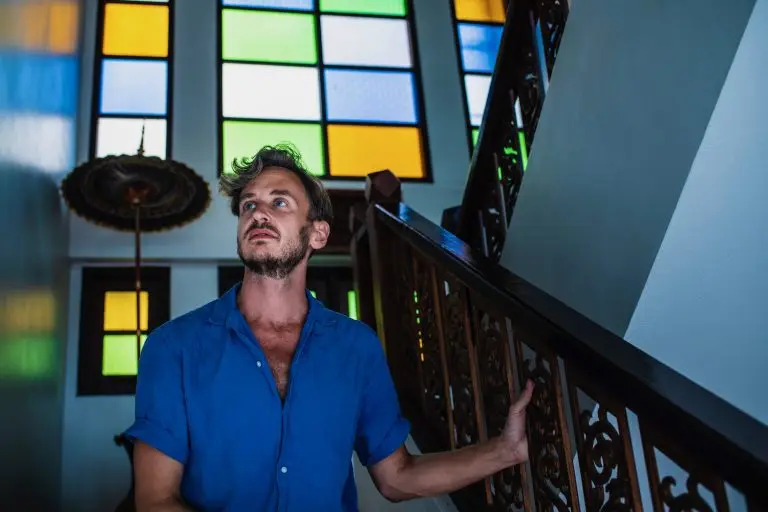
With this knowledge—or rather, with this memory, since it wasn't my first time in Chiang Mai—I spent the next 30 minutes photographing the hotel's breathtaking staircase (and photographing myself in it). The steps and banister were made of teak; Thai stained-glass windows created four distinctive hues when backlit.
This place undoubtedly offered me protection from my underlying worry that I would once again fail to fully understand Chiang Mai.
Just as I was finishing, the owner spoke up: "Should I turn on the lamp?"
“No,” I said firmly. “The natural light is perfect.”
What complicates my impression of Chiang Mai this time is the fact that the city is completely empty – presumably due to Covid-related reasons. Nevertheless, the first two people I saw on the street were farangs. More precisely, two Israelis who looked (but didn't smell) as if they had been hiking for days or weeks; they were wearing those hideous cargo pants that can be zipped off to make cargo shorts.
As I walked past them, I glanced at the Wat Methang parking lot, where three stray dogs lay at the feet of a group of local men. They were chatting and smoking, each with his feet propped up on a plastic chair opposite his seat. While this image—perhaps without the cigarettes—is what attracts foreigners to Chiang Mai, the former is much more in line with what we usually encounter.
When I left the hotel, all the nearby restaurants had already closed, so I had no choice but to eat at a place specifically for tourists. The Khao Soi was delicious, as was the Chinese Singaporean, whose sturdy thighs and buttocks could have cracked the chicken bones I was sucking on after finishing the spicy curry broth.
With a slightly full stomach, I made my way back to the west side of the old city wall, where, as the hotel owner had told me, a line of songthaews was waiting for me. I hesitated, and not just because I hadn't tried to haggle the price out of pity for the driver: his expression told me he hadn't charged the full fare in a long time. What difference did 200 baht make, apart from a 33% surcharge?
No, I realized that the clouds still hadn't cleared on my journey there. It seemed unlikely that I'd be able to take the photo of Doi Suthep I'd been waiting for for years: the shimmering gold of the famous temple pagoda standing out against the clear, cobalt blue sky. Third time's the charm, and in this case, it wasn't going to happen.
I set off anyway, and while the pickup truck rattled westward toward the mountains, I made the mistake of checking the Google weather forecast: apparently, it wasn't just going to be cloudy today, but also rainy tomorrow. So much for the "dry season"! Not to mention the thick blanket of snow from Monlapit that covered the entire north; I'd already seen it when I landed in Lampang 48 hours earlier.
The good news was that my immersion in the subject made the time fly by. When I looked up, the bustling (in the sense of aesthetics, not customers) street vendors made it clear that we were almost at the temple. Somewhat reluctantly, I got out of bed and climbed the famous Naga Stairway, adorned with two images of the jeweled Phayanak, one on each side.
That damned snake again! I remembered seeing it both in Phuket and on Koh Pha Ngan.
As during the journey, I kept my head down for most of the hundreds of steps leading to the summit; I didn't take any breaks along the way, which amused the panting and wheezing elderly ladies on either side of me.
Both of these factors contributed to me feeling almost dizzy upon reaching the summit: the sky was blue and virtually cloudless; the 14th-century stupa and the richly decorated, gilded screens surrounding it on both sides shone in the extremely bright sunlight.
I wasn't sure how it had come about meteorologically, but I was grateful: it allowed me to put aside my nagging notion – that I simply don't particularly like Chiang Mai and probably never will – even though I still wonder if I can ever get rid of it completely.
I realize how this might sound, especially if you've never read my original blog or my stories about the unforeseen disappointments I experienced in Mexico City, Taiwan, and amidst the lavender fields of Hokkaido. It's a very simple reaction of mine: I only change my mindset once I've achieved what I want, not the other way around.
This is the exact opposite of the suggestion Sheryl Crow once made (who, incidentally, taught music at my primary school a few years before her career took off). I'm going to enjoy the sunshine and only then appreciate what I have.
The rest of the day was rather mixed. As the driver descended the mountain and walked through Rajapruek Royal Park up to Wat Doi Kham, clouds had gathered again. The standing Buddha looked considerably less imposing in person than in the drone footage advertised online. Even when I returned to the city to see the illuminated Wat Phra Singh, the thick cloud cover had long since dashed any hope of a sunset – or anything resembling one.
And yet, as I walked back to the iLanna House and stopped briefly for my second khao soi of the day (this one was better, albeit without bones), a hopeful curiosity washed over me. The oddly positioned prostitutes who approached me right in front of the guesthouse entrance left a slightly unpleasant aftertaste just before I drifted off to sleep, but they couldn't completely spoil my good mood: Chiang Mai was beginning to make at least a little sense to me, almost a decade after my first trip here.
I didn't want to jinx it the next morning, so I went outside around 7 a.m. without checking the weather forecast. To my surprise, though not exactly my delight, patches of blue sky appeared.
But as I approached Wat Phra Singh—well, as close as one can get to a place only about five minutes from where I sleep—a feeling of joy washed over me. The clouds seemed to be parting near the eastern horizon; the rising sun shone brightly through the gaps. When I reached the temple, its gold gleaming, the light warmed my face in a way I can only describe as heavenly.
“Excuse me,” said the monk, whose path was blocked by my tripod, in English, and smiled. I imagined he would have used a different adjective to describe me.
“Khoo thoot,” I said to him in Thai, sending him a respectful wai.
He too seemed unfazed as the daily royal anthem blared from all the loudspeakers in the area; he went about his business, as did I, showing disinterest but no disrespect. I, on the other hand, was fascinated by how closely the contrast of the stupa against the sky resembled what I had seen the previous afternoon in Doi Suthep.
And, predictably, my thought process was once again: I love Chiang Mai, but only if Chiang Mai shows me love first.
Despite my racing heart, there was a palpable chill in the air. It was the first time I'd ever experienced anything like it in Chiang Mai. Previously, I'd only ever been cold outdoors once in Thailand, and that was on Doi Inthanon, the kingdom's highest mountain.
As I walked west, the clouds seemed to follow me, intensifying the cold and my nervousness. But when I reached the Tha Phae Gate, I experienced the same good fortune that had accompanied me on the grounds of Wat Phra Singh: sunbeams broke through the clouds at the very moment the gate's famous doves took flight from the ground.
Standing at the city gate, I realized that until my first trip here in 2012—the year the world was supposed to end—I had never been there, nor even in this part of Chiang Mai, along the eastern edge of the old city just before the Mae Ping River. The world didn't end; rather, it was my sense of adventure, with which I had explored Chiang Mai at that time, that ended.
“Birdseed?” asked the old saleswoman with a desperate look. Apparently, only three Thai Muslim women had bought anything that morning – before the pandemic, she wouldn't have been able to meet the demand.
I shook my head, but gave her a green 20-baht note anyway. "I wish there was a way to buy things out of pity without feeling pity," I thought, sighed, and strolled westward through the alleys and small streets toward Wat Chedi Luang, the massive, crumbling monolith in the geographical center of Chiang Mai's old city.
I always find it difficult to imagine the structure in its full splendor. Even now, it is of gigantic proportions; the idea that something so enormous could have been built six or seven hundred years ago and at least partially survived to this day is beyond my comprehension.
This time I visited the Chedi in the right light, at least. On my last visit in 2017, I made the mistake of photographing it against the light. While this resulted in one of my absolute favorite photos of Chiang Mai – and perhaps even of all Thailand – it's still something special to do things right intentionally, rather than by chance.
I continued my march towards the sun, my destination Wat Suan Dok (one of the last major temples on my Chiang Mai wish list). It wasn't exactly a march; that's not quite the right word. Although I wasn't exactly dancing or strutting either.
It was more that, as the perfect light flooded every nook and cranny, I felt for the first time – I finally felt – that there might be a grain of truth to the urban legend that Chiang Mai is the most beautiful (or at least the most Instagrammable) city in Thailand.
As I was almost back at Wat Phra Singh, I noticed a young man sitting on the ground at the intersection. At first, I thought he was a beggar; only when I stopped and started talking to him did I realize he was an artist – and a rather talented one at that.
“How much does this cost?” I asked him in English, holding out a postcard with an ink drawing of the Doi Inthanon pagodas.
He smiled, clearly hoping I would agree regardless of his answer. “100 baht,” he announced proudly. While this was significantly more than the usual price for such a souvenir in Chiang Mai, it was far less than what one should have paid for such a carefully crafted piece.
I was happy to comply with his request. His confidence in his art and his demand for a fair price – which was closer to his actual value than what the local market demanded for his products – deserved recognition.
We chatted briefly about how long he'd been doing it (only a few months) and whether he still went to school (he did), although I didn't want to distract him from selling, even though the turnout was low shortly after 9 a.m., even considering the small number of foreigners currently in Chiang Mai.
“Good luck, Khun Choop Chao,” I smiled and said goodbye to him, carefully placing his artwork in my bag. “I’ll tell all my friends where they can find you.”
On my first visit to Chiang Mai, I didn't speak any Thai, which lent the names of all the temples I learned a certain mystique, almost otherworldly quality. My Thai is considerably worse than it used to be, but I can now usually deduce the meaning of place names. Wat Suan Dok, about a 20-minute walk from Chiang Mai's western city gate, is the Temple of the "Flower Garden."
I mean, it's actually true. Kue Na, the Lanna king who had the temple built in the late 14th century, had a flower garden on the site where the temple now stands. At that time, it was located within its own walled settlement. Today, only the jeweled flowers near the top of the temple's golden main stupa remain, rising high above the dozens of white tombstones that extend northward from it.
After my wonderful morning in the city center and a short break in my room to relax, I made my way here to visit the temple (which has been at the top of my list of things I absolutely want to see since my last visit to Chiang Mai), but also to think: The day had started so well and so far beyond my expectations that I didn't know what to do with myself for the rest of the day.
That was actually a lie.
I basically had two options. The easier one would have been to travel far east of the city to the Mae Ping River. I imagined how the beauty of the sunset and the subsequent illumination would compensate for the eerie silence there. The more difficult one would have been to take a songthaew up Doi Suthep and then – passing far by – the temple to reach a mountain village where supposedly the most beautiful Thai cherry blossoms grow.
On my way back from Wat Suan Dok and back within the city walls, I was determined to take the easy route. This seemed a particularly logical choice, as I felt rather sluggish after my lunch (a northern Thai meal clearly intended for several people), even without considering the superbly mixed Thai whiskey cocktail with which I washed it down.
Even the coffee didn't give me much of a boost. "Americano, please," I said to the middle-aged woman serving at the stand—I had initially mistaken the older Buddhist man praying with a kind of rosary at one of the shop's two tables for my source of caffeine. "Chuay mai sai naamtaan."
Before I knew it, I had a perfectly mixed, ice-cold Americano in my hand and was staring at my delicious, simple task: Should I head to the river at 3 or 4 o'clock? It wasn't until the voice of a young man belting out Lady Gaga's "Bad Romance" drifted over from somewhere inside the Wat Phra Singh complex across the street that a spontaneous idea came to me.
“Nakrian,” laughed the barista, dismissing the silliness as nonsense, since students were behind it.
I found it downright inspiring – the self-confidence and spontaneity, not Lady Gaga, whom I find unbearable. With that, I headed to the next songthaew stand. Well, after a quick stop in my room, where I changed into a shirt I'd bought especially for this occasion.
To be honest, the journey was quite chaotic. The driver only charged 500 baht for the trip; as it turned out, he had misunderstood me. We did eventually arrive (albeit via a muddy and very bumpy mountain road); the cherry blossoms were completely faded, their pink petals (they were Himalayan sakura, not Japanese Somei Yoshino) literally lying on the ground as if a bomb had scattered everything.
This didn't seem to bother the locals. "You're so lucky to be able to witness this," a young woman and her extremely attractive boyfriend told me in excellent English. "Aren't they both gorgeous?"
I bit my tongue—I didn't want to spoil her fun; after all, I'd been to Japan during cherry blossom season in 2021, but she almost certainly hadn't. Instead, I smiled and agreed. In my dignified silence, I had a realization: I was once again in the midst of a kind of "Suan Dok" (traditional Thai festival), and although many flowers here had already faded, there was something sublime about the experience. (Most Thais seemed to understand that the season, which officially lasts until mid-February, had essentially ended a month earlier.)
A local Karen (that's what they're actually called) seemed less than amused as he watched me and about half a dozen Thais running around the grounds. The land belonged to members of his community, but was open to the public (apparently free of charge). I suspect we were all a bit of a nuisance in our own way.
Could it have been that Kue Na observed the early revelers at Wat Suan Dok in this way, at a time when the place that would eventually become his most enduring Wat might actually have still been a Dok (or at least the appearance of a Suan)?
The taxi that took me to Chiang Mai airport was somewhat more comfortable than the one that brought me here from Lampang. This one, which I ordered via Grab because of the short distance, had red leather seats and a much younger and more talkative driver.
"You're going to Bangkok?" he asked knowingly. "On business?"
I replied to him in Thai that the trip was for relaxation. I'm now at a loss for words to explain the intricacies of my professional work.
The streets were soaked with rain that should have fallen 24 hours earlier – rain that should have ruined half my trip, but ultimately only marred the last evening. My driver and I chatted about the rain and the welcome relief it brought to the otherwise sweltering city during these winter months.
"I love the rain," he told me in Thai. "Very beautiful, very pleasant."
I once again concealed my true feelings from him, but not only because I lacked the words to describe everything. I wanted to let him have his morning, even though under other circumstances his joy would have spoiled my own.
More frequently asked questions about visiting Chiang Mai
Is Chiang Mai worth a visit?
Chiang Mai is definitely worth a visit, but don't expect it to change your life. While the temples of the old city, Doi Suthep, and the many waterfalls in the surrounding area are charming, the city is often overcrowded and overpriced compared to the rest of Thailand.
Why do people love Chiang Mai?
In my opinion, people love Chiang Mai more for its past than its present. Twenty to thirty years ago, Chiang Mai seemed like an undiscovered paradise of temples and jungle, a gateway to the "real" Thailand. Today, so many people have understood the message that a new Chiang Mai is urgently needed.
Why should you avoid Chiang Mai?
I would avoid Chiang Mai if you have very high expectations that it will define your Northern Thailand experience, or if you are a digital nomad who is so easily persuaded by hearsay that you want to move there sight unseen. However, if you visit Chiang Mai along with other Northern Thai cities like Chiang Rai and Lampang, I believe your chances of a successful stay are significantly better.




Community
Comments 0
Start the conversation.