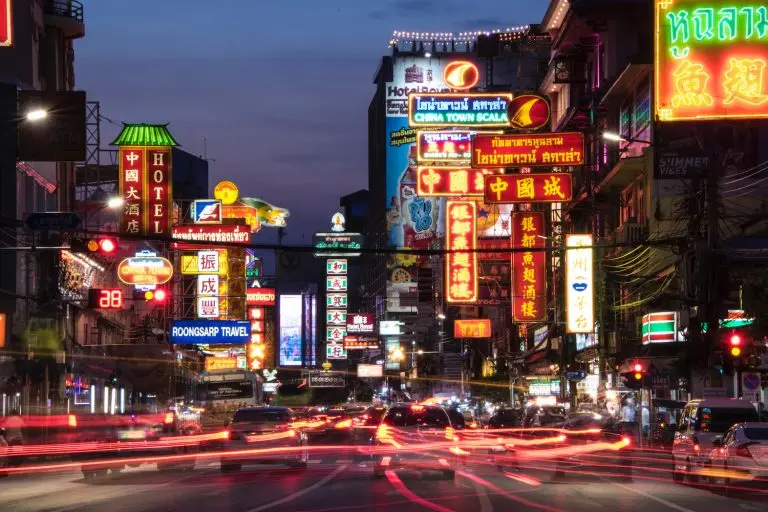
Taxis in Bangkok are among the things that stress me out most about the Thai capital. I've always avoided Bangkok taxis like the plague, ever since the early 2010s when I was backpacking on Khao San Road.
Theoretically, public transport in Bangkok became somewhat more bearable with the introduction of Grab Taxi. However, this also brought new difficulties and frustrations, which I will discuss in more detail in a few paragraphs.
Whether you are curious about transfer options at Bangkok Airport or simply want to prepare for the nightmare of driving in Bangkok, you've come to the right place.
My story with Bangkok taxis
Since my first visit to Thailand, I've almost always been ripped off by taxi drivers in Bangkok. I still vividly remember one ride in August 2010 when I wanted to get from Khao San Road to Thong Lor. All but one driver refused to take me. The one who finally did not only wanted less than 500 baht, but despite the exorbitant price, he also dropped me off at the wrong place. Naturally, I took the SkyTrain back as far as I could; driven by rage, I walked the rest of the way.
I'm disillusioned, but optimistic, and I've given Bangkok taxis plenty of opportunities to prove me wrong. But each time, they've only made me more reluctant to hail one – except in absolute emergencies. The good news for anyone planning a long-distance trip: you have significantly more room for negotiation when taking a taxi from Bangkok to Pattaya than when traveling within the city limits.
The most important things you should know about taxis in Bangkok
Taxis in Bangkok are legally required to use the taximeter.
Of course, they often refuse this legal obligation, which says as much about their character as it does about the importance of the rule of law in Thailand. But I digress. Whether you take a taxi at Bangkok Airport from one of the kiosks in the basement of Suvarnabhumi Airport, or hail one day or night along Silom or Sukhumvit Road, there's a good chance you'll have to pay a fixed fare, especially if you're a foreigner and/or don't speak Thai. (And that's assuming the driver even takes you to your destination—refusal, while also illegal, happens all the time!)
Tuk-tuks are guaranteed to be a rip-off.
Many foreigners mistakenly assume that tuk-tuks are cheaper than taxis. While these kitschy auto-rickshaws are indeed an affordable mode of transport for locals, especially outside the city center, foreigners who want to use a tuk-tuk almost always pay a premium, often double or triple what even an unlicensed taxi would cost. Take, for example, the journey from Khao San Road to Yaowarat, also known as Chinatown. While a taxi, with or without a meter, costs 50 to 100 baht, a tuk-tuk will set you back at least 200 baht—and that's only if you can haggle at all. Well… good luck with that, I suppose?
Bangkok's taxi drivers can be malicious or stupid, but rarely both.
I can't even count how many times I've taken a taxi (or another private vehicle – more on that later) from Bangkok airport into the city because the driver took a wrong turn. (Which in Bangkok, except in the middle of the night, can easily add an hour or even more to the journey.) The good news is: I've rarely experienced taxi drivers in Bangkok intentionally extending the journey – after all, they have lives too. The sad conclusion, of course, is that many of them simply aren't very bright.
Motorcycle taxis are fast, easy, and deadly.
When I moved to Bangkok in early 2017, I lived on Soi Suan Phlu 8, about a kilometer from the nearest BTS and MRT stations. I'm neither lazy nor weak, but I also don't like walking around the city sweating. A popular solution among locals and expats was the motorbike taxi, which only took a few minutes and cost no more than 30 baht. I did this for about a year until I saw a body with a sheet over it on Sathorn Road. Luckily, I didn't know the deceased, but when I learned the cause of death—a motorbike taxi accident—I vowed never to use motorbike taxis again.
Official taxi ranks offer only minimal protection.
I already mentioned the taxi ranks at Suvarnabhumi Airport, which are supposed to ensure that (licensed) taxi drivers use the meter and don't overcharge you. Frankly, their success rate is around 50% – and that's high by Bangkok standards. Unfortunately, the "official" taxi ranks in the city, whether in shopping malls like Siam Paragon and CentralWorld or in luxury hotels, are even less reliable. Not only was I refused a ride or had the meter not used, but several drivers even tried to drop me off on the side of the road because the traffic was heavier than expected!
No, a grave is not a gift from heaven.
When Uber withdrew from Thailand (and the rest of Southeast Asia) a few years ago, many of my Southeast Asian friends assured me that all the service's problems (such as long wait times and incompetent drivers) would be a thing of the past. Unfortunately, Grab Taxi Thailand proved to be even worse than Uber in this regard. I often waited 15 to 20 minutes or more for my car, and in at least 25% of cases, the driver got lost—either on the way to my location or on the way to places in Bangkok that literally everyone knows, even foreigners.
The bad news (which shouldn't surprise anyone who's spent any significant time in Bangkok): there's no truly good taxi app for Bangkok in sight. Those who aren't as perfectionistic as I am, or simply don't have a fixed schedule, might be willing to put up with Grab's minor inconveniences in order to pay by credit card and ensure the driver knows the exact destination in Thailand. However, for those who want to arrive on time and don't want to call a taxi before they've even put their shoes on, Grab is probably not the right choice.
The sad truth about traffic in Bangkok
Just a few months after moving to Bangkok, I had to make a sobering decision. Less because of the high taxi fares, but more because of the stress caused by taxis and Grab vehicles, I decided that I would probably avoid places I couldn't reach by a combination of public transport and walking. (The good news is that more and more places are becoming connected by Bangkok's BTS and MRT systems.) Nevertheless, because of this strict but necessary approach, I missed out on some personal and professional opportunities.
Assuming the master plan for Bangkok's rail network is implemented before the city disappears beneath the waves, it might one day actually be a realistic possibility for living a fulfilling life in Thailand's "City of Angels." But right now, the fact that it's the only way to avoid losing one's mind (at least in my experience) is a sad testament to the current state of Bangkok's public transportation: it's utter chaos, and it's only going to get much worse before any lasting improvement. That's the truth, and I'm not going to apologize for saying it!
More frequently asked questions about taxis in Bangkok
Are taxis expensive in Bangkok?
Taxis in Bangkok are generally not expensive – most journeys within the city center cost no more than 100–200 THB. The problem is that many taxi drivers refuse to use the meter or have fake meters in their vehicles. This increases the price many times over, no matter where in the city you go.
How do you pay for taxis in Bangkok?
Most taxis in Bangkok only accept cash. However, if you use Grab or another app like LINE Taxi, the fare (and any applicable fees) will be automatically charged to your registered credit card.
Which is the best taxi app in Bangkok?
If you want to use a car at all, even a private one, Grab is probably the best ride-sharing app in Bangkok. If you prefer taxi drivers (who, let's be honest, know the city much better than Grab drivers), an app like LINE Taxi is probably the better choice.
Conclusion
The bad news? Taxis in Bangkok are a nightmare, even if they're probably a bit better than they were ten years ago. The even worse news? Innovations like Uber (and later Grab), while seemingly clever solutions, only complicate matters and lead to unrealistic expectations for both travelers and locals. If you want to feel comfortable and relaxed in Bangkok (and don't mind long walks, often in sweltering heat and humidity), then do what I do: Limit yourself—with a few exceptions—to places you can reach by train or on foot.




Community
Comments 0
Start the conversation.