I asked myself many questions on Tuesday morning.
Was there still time for coffee and a croissant? I checked my phone: it was 6 a.m.; the receptionist had told me the night before that the car would pick me up at 6:30. I went to the French bakery and discovered that they had not only imported European bread and pastries, but also completely lacked any punctuality. My transport finally arrived after 7 a.m. My stomach growled as I got in.
Am I underdressed? I was wearing a short-sleeved shirt that was too big for me, over my too-short shorts from last summer, and Havaianas flip-flops. On the other hand, the breeze blowing through the back of the songthaew made it seem much colder than it actually was; the sun would be rising soon.
Can I get something to eat now? The driver had told us we would leave at 8:30, even though he had given us a note saying 7:30; while I was standing in line behind some other travelers in a local shop to buy a bag of sad-looking baguettes, he herded us all to the pier, where we had to descend two dozen shabby-looking concrete steps.
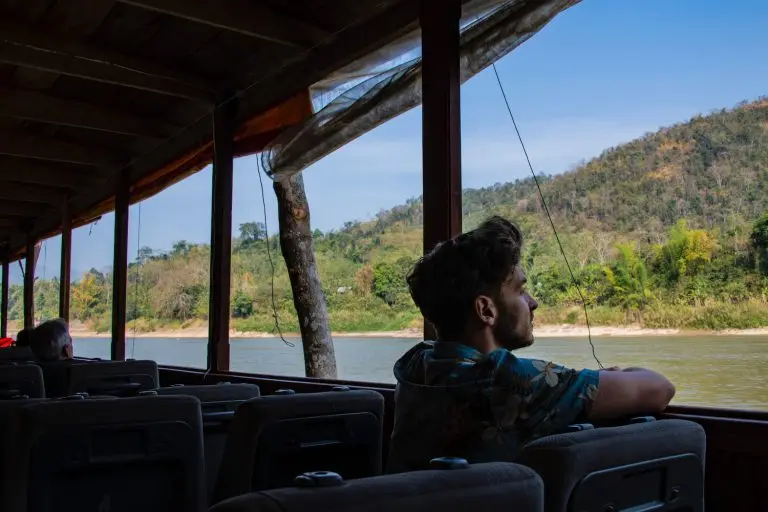
What on earth was I thinking? No sooner had I boarded the ship – which actually departed punctually at 8:30 – than I began to doubt my decision to travel back to Thailand this way. It was dirty and cramped; the seats were padded (and moldy) and clearly came from old cars; although tourists and locals alike were polite and courteous, a group of mainland Chinese (presumably laborers in the country to exploit its resources) were shouting so loudly that I could barely hear the music videos blaring from their cheap cell phones.
Is it too late to change my mind? I frantically searched for flight options – there was one from Luang Prabang to Don Mueang for the same price as the outbound flight. But unfortunately, we had to leave.
On the flight from Thailand to Laos, the plane malfunctioned shortly before the scheduled departure; it looked as if we wouldn't even make it to takeoff.
One more question. Should I maybe just stay here?
After landing in Luang Prabang, having received the green light in Bangkok, I was honestly less than thrilled. Despite traveling during the dry season, the Mekong bend where the city is located was covered in a thick layer of condensation. In addition to the delayed arrival, there was a huge queue for visa control, and then I had to join a separate queue for immigration control in the north.
On the other hand, the thick cloud cover had its advantages. It didn't matter that sunset was only minutes away when I checked in and freshened up; there wouldn't be a sunset anyway. In fact, the main subject I wanted to photograph that evening (the city's famous night market, the only place I could still remember from my trip 14 years earlier)... well, it didn't open until after dark.
As I stood at the foot of Phou Si Hill, setting up my tripod, I tried to recall my previous visit, which had taken place just a few weeks after my bold step that had inspired me to start my first travel blog. Where had I stayed back then?
I knew I was traveling with Kale and Amber, a couple from Arkansas who had also taught English in a Chinese-speaking country; we had arrived at about the same time of day, but after a two-day overland journey from Vietnam rather than a short flight.
Kale wants to save money, Amber had told me once, emotionlessly. I suspected she might have agreed to the flight from Hanoi if I had pressed her further. The journey had been arduous, even for my robust 25-year-old body; Laos was undergoing profound change, so much so that I'm surprised it still seems as poor today as it did then.
But apart from that? No, I didn't remember anything. Well, except for the fact that the city's famous "fruit shakes" had given me the worst food poisoning of my life.
“No,” I smiled, shook my head and waved to each of the young women who offered me one as I made my way back to my hotel at the end of the evening.
As I watched the alms ceremony the next morning, I was painfully aware of how little I had absorbed from the past few days in Luang Prabang. I remembered absolutely nothing of the procession, even though I had convinced myself all these years that I had seen it. Walking along Sakkaline Road and past Wat Sensoukharam, I wondered if I had just been lying to myself about the significance of those days.
"Rice for the monks?" a woman asked me as I walked slowly along, imagining the procession. I simply smiled at her and took out my camera; she smiled back, obviously she understood. It was still dark enough to see stars; hadn't it been bright last time? At least the stars meant it wouldn't be cloudy today.
Before I could think about it any longer, I noticed orange flashes out of the far right corner of my eye, shining brightly despite the dim light on the horizon. The monks had started to move.
First, I tried photographing it with my 100mm lens at its widest aperture (f/2.8); even at ISO 640, it was too dark for sharp images. So I switched to my 35mm lens and took long exposures—I liked the idea of the orange smoke rising from under the temple—using a remote shutter release. The idea was that after a few shots, there would be enough light to get closer and take sharper pictures.
And so it happened, although everything was over so quickly that even the last monks had disappeared by the time I finally had all the photos I wanted. I sat down in the bakery (which I couldn't visit the next day because I was waiting for the boat). I felt as if I had just come out of church.
I felt like I'd already had a full day of experiences, even though it was only just before 7 a.m. In fact, three more major items were still on my list: climbing Phou Si Hill; visiting Kuang Si Waterfall and its famous butterfly garden; and crossing the Mekong River to climb one of the temples on the north bank, from which I hoped to enjoy a panoramic view of Luang Prabang.
Phou Si, which I never actually climbed after ascending the third of six steps and passing the imposing Naga statue, was disappointing. The trees directly below the summit were so dense that there was hardly any view. On the descent, there was a second Naga statue and half a dozen Buddha images; I found all of these more interesting than any panorama.
“It was beautiful,” I explained to the receptionist in the butterfly garden when he asked me for my opinion of Kuang Si, “but quite similar to many other Southeast Asian waterfalls I’ve seen.” He nodded and then tried to sell me a ticket package that included a piece of apple pie his family (he was Dutch) had baked fresh that day.
I also tried to tell him how much I had loved butterflies as a child and how much I was looking forward to visiting the garden, but he mostly dismissed that as well.
I imagined them fluttering around me as I climbed the rickety steps leading up to Wat Chompet. Its viewpoint was at least as overgrown as the one at Phou Si. That's not to say I couldn't see anything at all—it was really just the river itself that was obscured—but I did wonder if the trip had been worthwhile.
(Luckily, the husband of the woman who had told me the price of 20,000 kip for the temple entrance ticket had his own boat, so I was able to cross the river again without having to walk the 2 km back to the main pier.)
Like my days in Luang Prabang itself, the journey by slow boat – once it had picked up speed – was relatively peaceful. Eventually, the Chinese workers fell asleep; the sun was so high and hot in the sky that it seemed absurd to me to think I had ever been cold.
I'm not sure if it was just the gliding of the old wooden boat across the murky surface of the Mekong, or perhaps the two large Beerlao I'd drunk, but the trip to Pak Beng flew by. It was peaceful, even sublime. I'd be lying if I said I wished it would never end, but I was the first to stand up when we docked and the first foreigner to disembark.
“I really wanted to do this before it’s too late,” said a Brit named Mitch, shortly after we left on the second day. We were lucky and got a better boat, one that didn’t have the Chinese workers on board.
I asked him to clarify his statement. He seemed to be about my age; did he mean that middle-aged people like us might soon no longer be able to travel so frugally? Was he planning to start a family or pursue a career with less free time?
“The dams,” he explained. “You know, the controversial hydroelectric power plants. They’ll be going online soon; soon everything will be flooded. I reckon the boats won’t be able to sail then either.”
Suddenly, as I looked back on the cynicism I had been lost in the morning before, I felt almost ashamed. An opportunity had presented itself that might not even exist in a year, and all I could feel was anger; I could only adopt the perspective of entitlement.
I certainly wasn't like that in 2010.
Mitch, who told me shortly after our conversation that he wasn't active on social media, wasn't the only person I came into contact with that day. There were Simone and Ali (both from Switzerland; the German and French parts, respectively) and an incredibly handsome Cantabrian whose name I unfortunately couldn't remember. He had told me his name, but I was too tired to hear it and too proud to ask him to repeat it.
I gave Simone and the Spaniard my website names, but didn't insist on exchanging Instagram accounts, let alone adding each other on Facebook, which would have been the only option 14 years ago. Admittedly, I'm still in touch with Kale and Amber (who are no longer together), but our digital connection is superfluous. We haven't spoken in years.
After crossing the border with our friends this year, we squeezed into a rickety shared bus that got us to Chiang Rai in considerably less time than Google Maps indicated. There was something liberating about how brief and distant our goodbyes were at Bus Station No. 1. I assumed at least one of them would use my blog for advice, but none of us acted as if we'd ever see each other again or even actively try to get in touch. There were only good wishes and quick hugs.
For a moment, I thought about writing to Kale and/or Amber and telling them about this experience. I remembered that we had talked about doing it together back then, before I succumbed to the aforementioned illness.
No, I smiled to myself and went out into the darkness to my hotel.
When I woke up on Friday morning, I found that many of my questions had been answered – and I don't mean the petty questions I had asked while waiting for the slow boat crossing from Laos to Thailand, or the finer details of my trip to Luang Prabang in 2010.
The previous evening, I had watched the sunset behind the enormous Guan Yin statue at Wat Huay Pla Kang. It was my third visit there, but the first outside of the rainy season. Finally, I saw the burning orb disappear behind the distant hills as I gazed out of the window of the ninth level of the nine-story pagoda, right next to the Lady Buddha (as some mistakenly call her).
I thought back to my initial skepticism, not just about whether I should even embark on the Mekong sailing trip, but whether I would have made this journey north at all. It would have been so easy to stay in my capital city comfort zone for another week until my flight to Krabi; perhaps I would have even canceled my twelve-day island tour and flown back to the US after spending five weeks away from all the people I care about, just to wander around Bangkok as if I still lived there.
As I obsessively captured the setting sun and the snippets of color it left behind – much like I had been in a frenzy watching the alms ceremony days before – I realized my answer: Try; strive; pretend; chase; run; try anything and hope that some of it sticks.
I should never cancel again—I shouldn't have even thought about giving up for a moment—because the answer to every question I ask is the same. I will never stop leaving my mark, finding my way, or telling my story, no matter how many marks I leave, how many paths I hack with my machete, or how many books I write. I will never stop—I can never stop.
And now I set off again, like the slow boat that sets off every morning and struggles upstream against the current.




Community
Comments 0
Start the conversation.