Toulouse–Blagnac (France) – October 5, 2017 (travelindex.com) – Fear of flying? Not me. I'm more of an aircraft enthusiast and enjoy using technical terms like propeller, airframe, fuselage, and fly-by-wire. Linen, wood, and wires – that's what the Wright brothers' rickety flying machine, called the "Flyer," consisted of. But on that cold December day in 1903, it took off from Kitty Hawk, North Carolina, and flew a distance of 67 meters (a shorter distance than the wingspan of the new Airbus A350) for 12 seconds.
After an unforgettable flight from Bangkok to Frankfurt aboard Thai Airways' A380 superjumbo in Royal Silk Class, THAI's business class. "Soft as silk" in every respect: from the seamless service and in-flight entertainment to the delicious cuisine, excellent wine selection, and spacious, fully lie-flat seat.
Thai Airways' A380 fleet consists of six double-decker A380s. TG operates them on key routes from Bangkok to Tokyo, Osaka, Hong Kong, London, Paris, and Frankfurt. Our next flight is to Toulouse. Lufthansa (LH) offers a 1 hour 20 minute flight aboard the Airbus A320, the best-selling narrow-body aircraft. An A320 lands on some runway somewhere on the planet every two seconds.
Shortly after landing at Toulouse-Blagnac Airport (TLS), I spot a huge, white aircraft to starboard that looks like a guppy. It's the Beluga, the whale-shaped super-transporter, specially built to transport the oversized A380 parts from the Airbus factories in the UK, Spain, and Germany to Toulouse, France, for final assembly.
Toulouse, on the banks of the Garonne River, is France's aviation capital, a center for telecommunications research, and a university city nicknamed "La Ville Rose" (The Pink City) because of its pink and orange bricks. France's fourth-largest city pulsates with innovation and joie de vivre. Squares are filled with cafés and restaurants, Gothic churches abound, student life is vibrant, and exquisite restaurants serve everything from foie gras and truffles to fine wines.
This is a whirlwind trip. After the city tour, however, we have free time, which the Thai journalists greatly appreciate, as they head straight to Hermès, Louis Vuitton, and the Galeries Lafayette department store. The obligatory shopping spree...
The next day, under a cobalt blue sky – Airbus headquarters. The company, formerly Sud Aviation and Aérospatiale, was founded in 1970. Today, it is a European multinational corporation that develops, manufactures, and sells civil and military aerospace products worldwide. Employees: 55,000 worldwide. Suppliers: 7,700. Airbus's comprehensive product range includes highly successful aircraft families with 100 to over 600 seats. From the smallest aircraft, the A300, to the largest, the A380. This also includes the new, technologically advanced, twin-engine Airbus A350 XWB, a medium-sized long-range passenger aircraft.
Vanessa Gerencseri, A350 Marketing Manager: “The A350 XWB will shape the future of air travel. We currently have 848 orders from airlines in the Americas, Europe, Asia & Pacific, and Africa & the Middle East. 84 aircraft are already in service with 12 airlines and have completed over 46,000 flights and carried 11 million passengers,” says Gerencseri. She adds: “The A350 XWB is powered by two state-of-the-art Rolls-Royce Trent XWB engines – the most efficient large engines in the world.”
Here are some facts about the new A350 XWB. First of all, "XWB" stands for Extra Wide Body. Airbus' Airspace cabin brand offers more space, a higher ceiling, and the largest overhead bins. It also features enhanced comfort in Business and Economy Class, as well as a new innovation: "cabin mood lighting" to reduce jet lag. Furthermore, the A350 boasts 25 percent lower fuel consumption and the lowest noise level of any twin-engine aircraft. It also features the world's largest carbon fiber wing panel, made of 53 percent composite materials, which makes the aircraft exceptionally lightweight. Also worth mentioning are the A350's distinctive winglets, which reduce drag, saving fuel while simultaneously lowering noise and carbon dioxide emissions. The aerodynamics are inspired by nature, specifically the flight of the eagle.
Joaquin Toro-Prieto, Head of Market Analysis & Communications, explains: “Passenger demand will continue to rise, requiring over 35,000 new aircraft by 2036. The market value is US$5.3 trillion.” He adds: “We have a long-standing partnership with THAI. The first order was placed in 1977 for the original Airbus A300 B4. In 2004, six A380 double-deckers were ordered.” Toro-Prieto further explains: “Thai currently operates an Airbus fleet of 48 aircraft: 20 A320s (THAI Smile), 17 A330s, six A380s, and five new A350 XWBs.”
Onward we go. From marketing to assembly. The newest Airbus Final Assembly Line (FAL) at Toulouse Airport. In the enormous hangars, as large as 300 tennis courts, the massive Airbus aircraft are assembled, including the precise joining of the fuselage and wings. I notice that everything is XXL, super-sized, spotlessly clean, and incredibly quiet. Safety is the top priority here. Bright yellow warning signs indicate FOD (Foreign Object Discharge) or "Do Not Drop Stuff On The Factory Floor!" This optimized aircraft assembly process for the A350, designed for eco-efficiency, allows teams to work in parallel and reduces the time from the start of final assembly to aircraft delivery by 30 percent.
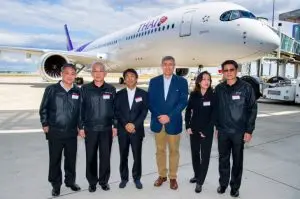
The final day, the day of the ferry flight. The Airbus delivery center. Like a luxurious first-class lounge with catering and a viewing platform. Outside on the tarmac, THAI's gleaming new sixth A350 XWB, bearing the royal name PHU PHA MAN and the registration HS-THB ("Hotel Sierra – Tango, Hotel, Bravo"), stands ready for its flight to Suvarnabhumi (BKK). On the eleven-hour flight to Thailand, Khun Khun Itt Sirisawat, THAI's chief technical pilot for the A330/350, will take command of the ferry flight. "Most pilots who fly the A350 are also thrilled. The cockpit is more spacious and offers plenty of room. It's currently the most beautiful cockpit in the world compared to other aircraft," says Captain Sirisawat.
THAI's A350 XWB offers an outstanding two-class service. Royal Silk Class features 32 Business Class seats in a 1-2-1 configuration with four seats side-by-side. The 53 cm wide seats recline 180 degrees, allowing for easy boarding and deplaning without disturbing other passengers. Each seat is equipped with a 40 cm touchscreen with Wi-Fi and the latest in-flight entertainment system. Economy Class offers 289 seats in a 3-3-3 configuration with nine seats side-by-side, a generous 81 cm seat pitch, and 46 cm seat width. The in-flight entertainment system features a 28 cm touchscreen and Wi-Fi. Both Business and Economy Class passengers enjoy wider, more comfortable seats with increased legroom. By the way, Airbus has a rear-mounted external camera, but Boeing doesn't. Who needs in-flight entertainment when you can watch the world below in real time? And in HD!
Currently, THAI offers the following routes with the Airbus A350: Bangkok-Chiang Mai, Bangkok-Frankfurt, Bangkok-Milan, Bangkok-Rome, Bangkok-Singapore, Bangkok-Brisbane and Bangkok-Phuket-Frankfurt.
Even if you are not an airplane enthusiast, the next time you see a large, long and elegant passenger plane on an airport runway – especially with that cool raccoon mask as a windscreen and those unique, eagle-like wingtips – you should definitely take a look.
Yes, it's the new Airbus A350 XWB-900. Get your boarding pass and look forward to a great flight experience.
by John K. Lindgren, travel writer




Community
Comments 0
Start the conversation.