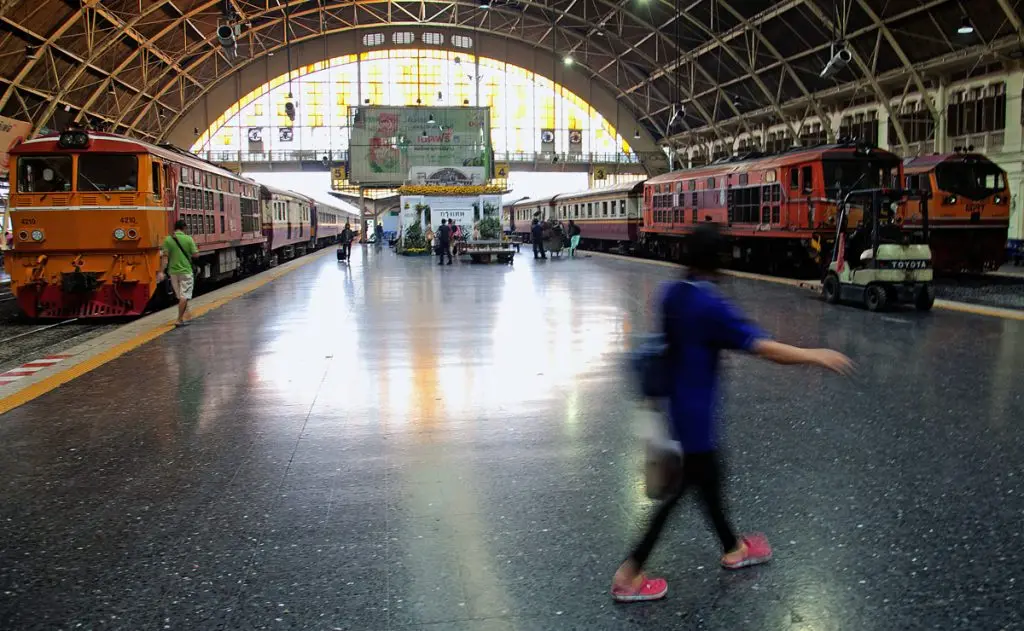
Platform and trains at Hualamphong main train station, Bangkok. January 2018. Copyright John Borthwick
Bangkok's imposing Hualamphong Station forms the heart of the national railway network, stretching from Nong Khai to Hat Yai and beyond. With its Italianate facade and vast vaulted roof, the station was built in 1916 by the modernization-minded King Rama V and evokes the golden age of steam trains. Hualamphong lends your journey a touch of celebratory farewell. It's best to visit the station soon, before the "renovation" begins. In the meantime, here are some impressions of rail travel in Thailand.
Guest author John Borthwick embarks on a train journey through the kingdom.
Bangkok–Chiang Mai Express. The overnight express to Chiang Mai is Thailand's classic train journey. Board for the 750 km trip and prepare for a night of dancing (literally) on the narrow-gauge, one-meter track. A smartly dressed conductor from the national railway will check your ticket, and then a catering staff member will take your meal orders. The carriages (formerly Japan Rail) are a bit worn, but clean. Settle into a reserved berth and drift off to sleep to the melody of the train's thumping steel wheels on the rails. You'll wake up in Chiang Mai in time for breakfast. This service is so popular with foreign visitors that it could also be called the "Farang Express."
Thailand 2007. John Borthwick
Eastern & Oriental Express. On this rolling work of art, you can live out your dreams of a "retro Raj" (and you should) on a four-day luxury train journey between Bangkok and Singapore (or vice versa). Standing on the open-air observation deck at the rear of the train and watching Thailand and Malaysia, green and full of temples, glide by from sunrise to sunset is one of the most beautiful perspectives in the entire country of rails. Admittedly, it's exquisite and expensive.
Talat Rom Hoop (“Umbrella Market to Close”) on both sides of the S-Bahn line.
The Mae Khlong Railway. Thailand's shortest railway line, the 67-kilometer Mae Khlong Railway between Bangkok's Wong Wian Yai and Samut Songkhram, ends in the middle of a bustling local market. Thais call the place Talat Rohm Hoop – Umbrella Market – but foreigners know it better as the Risk Market. Why? The tracks run right through the middle of the crowded marketplace. The morning train, a two-car electric train, arrives with a loud blast of its horn. Vendors hurry to retract their awnings ("umbrellas") at the last second. Like the Red Sea before Moses, the market parts in front of the train, which rattles past just centimeters from your face. Truly risky marketing.
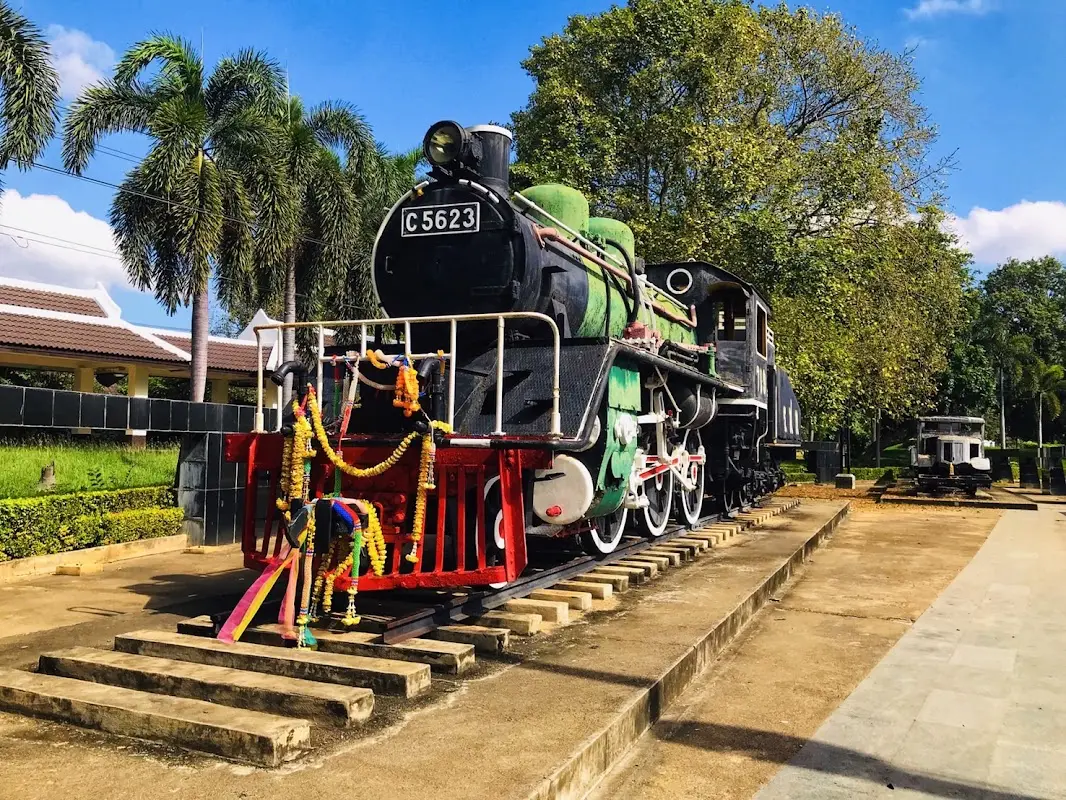
Historic steam locomotive symbol and warning sign in Wang Duan, the narrowest point of the Thai peninsula (10.96 km). Copyright John Borthwick
The Kanchanaburi "Death Railway." Located 80 km west of Bangkok in Kanchanaburi, the railway is a reminder of the infamous Burma-Siam Railway of World War II. Tourists visit to see the "Bridge on the River Kwai" (made famous by the 1956 film of the same name), although the current bridge is not the original structure. The name "Death Railway" speaks volumes. Let us remember those who lost their lives during the construction of the line – over 80,000 Thai and other Asian laborers, as well as 12,600 Allied prisoners of war.
Ticket inspector on a train, Hua Hin station. January 2018. Copyright John Borthwick
Bangkok-Vientiane Line. This train takes you across northeastern Thailand, offering views of the Isaan region. However, the route doesn't go all the way to Vientiane. In Nong Khai, passengers cross the Thai-Laotian border bridge over the Mekong River and transfer to a connecting train that terminates in Thanaleng, 20 km before the Laotian capital. This overnight journey offers more comfort than the Bangkok-Chiang Mai Line: new carriages, improved dining options, and seats with power outlets.
"Luggage compartment" sign at Hua Hin train station. January 2018. Copyright John Borthwick
Bangkok – Hua Hin – Surat Thani. On your journey south, you'll pass through Hua Hin, 200 km from Bangkok. In the 1920s, when the railway line to British Malaya was built, the train station was Hua Hin's most important building. On the platform, visit the historic Royal Waiting Room, which resembles a cross between a Buddhist temple and a ticket office. The journey continues – you have to look closely – to the tiny town of Wang Duan on the Gulf of Thailand, south of Prachuap Khiri Khan. This place, where trains rarely stop and don't whistle, has a unique feature, as evidenced by a sign: the narrow passage between the Gulf and the border with Myanmar to the west is, as the sign proclaims, "the narrowest point in Thailand. 10.96 kilometers." A few hours later, you'll reach Surat Thani, the departure point for the ferry to Koh Samui.
The Suratani Express at Hua Hin station. January 9, 2018. Copyright John Borthwick
Text and photos © John Borthwick 2020
Community
Comments 0
Start the conversation.