Award-winning travel writer John Borthwick reflects on his Mekong River cruise from Laos to northern Thailand with Pandaw Cruises.
“We believe children are old enough for school when they can reach over their head and touch their opposite ear,” says the young Laotian teacher in the village of Ban Phar Leib on a remote stretch of the Mekong.
A group of healthy Laotian children gathered in front of their two-room schoolhouse to sing their national anthem to us with great enthusiasm. After we had distributed pencils and notebooks (but no sweets) to the grinning children, they led us back to the riverbank where our ship, the Champa Pandaw, was waiting.
We're embarking on a 10-day Mekong River cruise from Vientiane, the capital of Laos, to northern Thailand – a 1000 km journey. The Champa is a luxurious modern interpretation of the classic Irrawaddy flotilla steamer: entirely made of teak and brass, with air conditioning, private bathrooms, and gin and tonics.
The Mekong, Asia's "great mud river," plunges from the sky to the earth, from Tibet to the South China Sea, flowing 4,300 km through six countries. In the middle section of its journey, the 700 km passage through inland Laos, whirlpools and reefs give way to calm, sunny stretches and finally to narrow gorges and labyrinths of sandbanks.
We often go ashore; our first visit is to the former French administrative city of Pak Lai. A flag with a hammer and sickle serves as a reminder of the local system of government. The Lao People's Democratic Republic (the country's official name) embodies a wondrous, multifaceted paradox – a democratic communist one-party capitalism.
The next day, as we rounded a bend in the river, the enormous new Sayaburi Dam blocked our path. Laos, apart from the Mekong, a resource-poor country, has two dams under construction and seven more planned. The power plant, nicknamed the "Battery of Southeast Asia," will sell 95 percent of its electricity to neighboring Thailand. We slipped into a lock on the side of the dam and climbed what was essentially a water staircase.
The Mekong is a flowing road, the eternal main artery of Southeast Asian trade and migration. Our captain, 62-year-old Xieng Souk, reads the river's bends like a palm reader reads a palm. He eschews all electronics and relies solely on his eyes, which for 40 years have studied every branching tributary, every sandbank, and every shallow in the river.
The ship's 23 passengers are roughly equally divided between Britons, Americans, Australians, Swiss, and French. On land, we visit schools (some sadly without teachers), small temples, markets, and local weavers. It's a world by the water, characterized by wood smoke, bamboo, and thatched roofs, but also by satellite dishes and mobile phones.
We wake up on a surprisingly cold morning to thick fog hanging over the river. 300 km north of Vientiane, we reach the tourist center of Luang Prabang. With its 32 temples, this treasure trove of Buddhism, French heritage, and Laotian royal history is one of the best-preserved colonial cities in Asia. At dawn, monks walk through the UNESCO-protected streets, accepting food offerings from believers wishing to do good. A few hours later, international hipster baristas in the trendy cafes on those same streets are serving lattes at international prices to backpackers.
The gold-roofed temples of Luang Prabang glitter in the soft light of the leisurely gliding boats. We're staying for two nights and have plenty to do. I'm fascinated by the Royal Palace, built in 1904, which now houses the National Museum. Where else can you see a photograph of the laughing Ho Chi Minh and the last Laotian king, Sisavangvattana, dancing with two women?
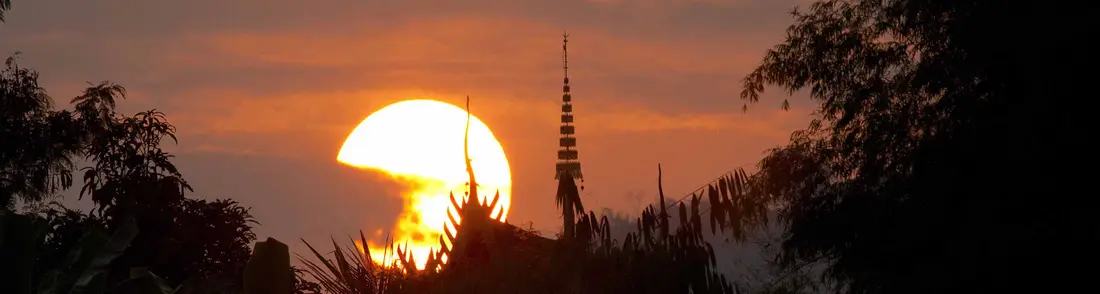
Aside from the gilded, 400-year-old Wat Xieng Thong temple, for me the most beautiful spiritual excursion in the city is finding a café on the riverbank and enjoying the sunset over the Mekong with a cold Beer Lao and fresh satay skewers. The most unusual excursion is looking across the street at a massage parlor that is a UNESCO World Heritage Site.
"I have reception!" someone shouts. We rush to our devices. In a remote area, where presumably no one has lived for millennia, we suddenly receive emails, upload data, and are bombarded with news about the terrible world out there – and then, just as suddenly, the signal mercifully cuts out.
The next day, Thailand appears on the western shore, recognizable—of all things—by a miniature Dutch-style windmill. On the opposite Laotian bank, thousands of hectares of banana plantations stretch out, destined for export to China. We approach the Chinese special economic zone, a vast concession area in Laos, where the dominant "economic activity" is a casino complex for commuters and gamblers.
There are no more villages. We land at the border port of Ban Houay Xai not for the casino, but for immigration control to get our exit stamp from Laos. Then, on the other side of the river in Chiang Khong, Thailand, it's time to say goodbye to our trusty ship, the Champa, and disembark in the once infamous Golden Triangle.
The old opium barons and Kuomintang smugglers are long gone. The Golden Triangle on the Mekong, where Myanmar, Laos, and northern Thailand meet, was once notorious as a hub for smugglers and con artists. Today, at least on the Thai side, cabbages have replaced poppies, shipping and tourism are the legitimate sources of income, and a giant golden Buddha towers over the scene. Nearby, the impressive Opium Museum serves as a reminder of the region's turbulent past.
This Mekong riverbank, from the "triangle" at Sop Ruak down to the river cities of Chiang Khong and Chiang Sean, is one of the most rewarding regions of Thailand for visitors seeking authenticity. Here you will find Thailand in its most natural setting.
To get there, fly from Bangkok to Chiang Rai. Visit the city's extraordinary "White Temple," the crystal-clear, almost fairytale-like Wat Rong Khun, and then head east to the Mekong River. Among the best accommodations on the river is the Anantara Golden Triangle Resort, whose renowned Elephant Camp sets standards for the ethical treatment of elephants. Further south, near Chiang Saen, are the idyllic chalets of the Rai Saeng Arun Resort, situated directly on the Mekong.
LAO READING RECOMMENDATION: A Great Place to Have a War by Joshua Kulantzick; Stalking the Elephant Kings and The Bamboo Palace by Christopher Kremmer.
The author was a guest of Pandaw Cruises and the Tourism Authority of Thailand. The story first appeared in The Weekend Australian.




Community
Comments 0
Start the conversation.