Chants drifted from Wat Traimit, the so-called "Marble Temple," which towers high above Bangkok's Chinatown, but not a single worshipper was there to hear them. The sky to the west was black, like that new shade of black scientists had recently developed. You know, the one that absorbs 99.9% of visible light.
And yet I remained undeterred: I had decided to visit Thailand during the rainy season – and to go all out. Not even a torrential downpour like a black hole could stop me.
That's not to say I was on an important mission, at least not at that time. My photo expedition through a part of the city I know very well was just a teaser, not to mention my refusal to give in to my jet lag (I had only arrived the day before).
Even the rain that the sky eventually produced didn't live up to its promise. The downpour lasted only a few minutes, which I spent under a sturdy awning, fiddling with my camera settings.
On the contrary, I was even more thrilled to see the neon lights of Yaowarat Road reflected in the increasingly mirror-smooth asphalt.
However, when mosquitoes started biting my ankles (in my daze I had forgotten to apply the DEET I had bought as a condition for my trip during dengue season), I wondered if I had really thought my decision through.
The next morning, as I had to kill time until my departure at 11 a.m. from Don Mueang to Loei in rural northeast Thailand, my doubts intensified.
I had considered the general concept of visiting the remote northeastern province without working out many details (because how difficult could it be to explore such a place?); it was only a few hours before my departure that I realized I had made a mistake (among other mistakes) by booking a hotel in the town of Loei itself.
As I left my hotel to go to my car—a hotel where I've stayed so many times I've lost count—I noticed a sign at reception. "Hotel closes for renovations on August 1," it read, with no further information. "Thank you for your business." (Note: For the person writing this, today is July 23.)
The good news is that the journey to Bangkok's somewhat neglected airport was significantly faster than usual, which gave me the opportunity to adjust my travel plans.
Instead of staying in one place and driving for up to 12 hours a day to reach the two destinations that had inspired me to embark on this journey in the first place (more on that in a moment), I decided to drive a figure eight counter-clockwise through the region, spending the night roughly at the apex of each figure eight.
I was surprised when I picked up my Toyota, a local model, at Loei Airport (“It’s a brand new car,” the agent had assured me – which wasn’t true), how immediately I was enveloped by the feeling of the place, even taking into account the expectations raised by the dramatic view of the lush, cloud-covered landscape from the plane.
At first, it was the locals behind their scarlet tents selling fuchsia rambutans. Then came the increasingly frequent "Elephant Crossing" signs. And finally, one noticed how deep red the clay soil was – almost violet.
From Wat Somdet Phu Ruea, where monks had painted a boulder that was barely clinging to the slope on which the temple was built with garish gold paint, the sky looked as if it might open at any moment, even though not a single drop had fallen.
As I made my way south to the Dan Sai district, where I planned to visit a museum dedicated to the Phi Ta Kon festival (a festival I had just missed), I realized that the brightly painted wooden masks were reminiscent of the Namahage from the Akita prefecture in Japan.
(The two have little in common semantically, of course. Phi Ta Kon is a Buddhist festival honoring ancestors; the Namahage are meant to educate naughty children to improve their behavior.)
It was now about 3 p.m., and soon the rambutan trees had given way to dragon fruit; the ground cover on my way to the province of Phetchabun (which separates Loei from Chaiyaphum) was so thick that I could no longer see any soil at all.
In the end, it took me almost five more hours to reach my remote motel, which honestly made me doubt whether my change of plans had really been a good idea. On the other hand, I was far too exhausted from the journey (and especially from the lingering jet lag) to dwell on it too much.
The previous evening, on my way to Chaiyaphum, I had noticed signs for the Dok Krachiao Festival in the last light of dusk, but I tried to ignore them.
It was too late for me to enter either of the two national parks where the so-called Siamese tulips (which are actually a type of ginger) grew wild; I would have the entire first half of the day to enjoy them.
This, of course, confirmed that my last-minute change of plans had been wise. It was only a 40-minute drive from my hotel to Pa Hin Ngam, the first of the two parks I wanted to visit. Had I stayed in Loei City instead, the journey would have taken at least five hours.
Upon my arrival at the park entrance, several things surprised me. Firstly, that a car with locals (Thailand is, as is well known, a country notorious for its unpunctuality and delays) had gotten there before me; and secondly, that the security guard had actually started letting people in a few minutes before 6 a.m.
When I got out of my vehicle, I was surprised that the air temperature matched the misty, mysterious landscape. It actually felt cold, and perhaps not just by Thai standards.
As the five of us (and the car behind, in which three people the age of my parents were sitting) boarded a tram painted in Krachiao colors that went to the flower fields, I nevertheless tried not to think about it any further.
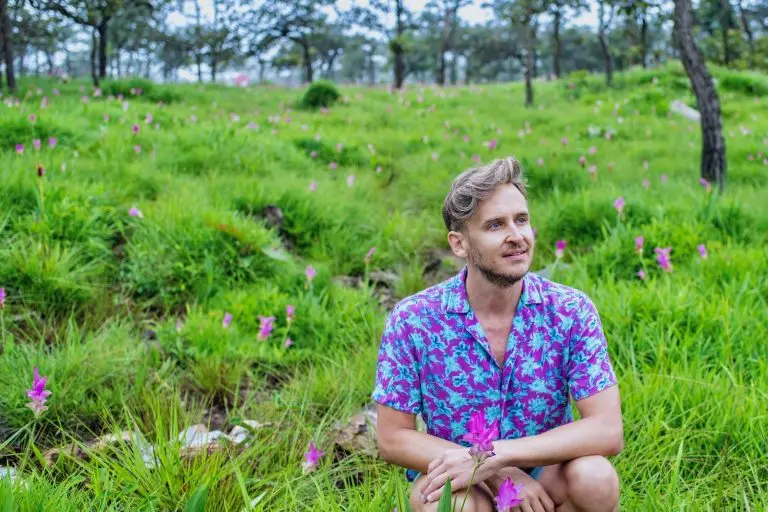
As the flowers slowly became visible, I did wonder if the polo shirt I'd bought especially for the occasion (a solid purple-pink) might have been the wrong size. It wasn't a big deal—I had a patterned pink-purple shirt in my bag as a backup—but it did distract me from the goosebumps on my leg, so for me, it was a success.
As I got out of the vehicle, I noticed the soil as well as the flowers sprouting from it. Unlike the colorful clay up in Loei, this soil was a deep blackish-brown; its strong smell was intoxicating.
The only thing I didn't like about the place was the confusing signage. Although one way was indicated to me (in both Thai and English), everyone else (who were all Thai) was going in the opposite direction.
All of that paled in comparison, of course, the moment I found myself on a wooden boardwalk leading right through a dense field of wildflowers – Scarlet's walk through the proverbial violets. Oddly enough, the second place I visited Krachiao (Sai Thong National Park), while generally more rural and less developed, had similar problems with signage.
(In the latter case, however, it was even funnier when a sign informed me that the third of three pastures was a whopping 300 km away, almost as far as Bangkok).
As was the case 24 hours earlier, I had to dedicate most of the afternoon to continuing my journey: Chiang Khan, the city on the river where I had spent the night, was about five hours away.
On the other hand, the heavy rain outside my car (the clouds finally made good on their threats, albeit a whole day later) meant that I wasn't afraid of missing out on anything; I was grateful to be locked up.
Chiang Khan itself made a strange impression. Visually, it was reminiscent of both the nearby Thai city of Nong Khai and the not-so-nearby city of Luang Prabang in Laos; this was understandable, if only because the Mekong River meanders through all three places.
The situation here was somehow sadder. There were dozens of guesthouses and hotels; although I understood that the rainy season inevitably meant fewer visitors, I found it hard to imagine what critical mass of tourists would be needed to bring the city's pedestrian zone to life.
The looks on the faces of the people guarding the empty accommodations ranged from curiosity to contempt and seemed to confirm this.
I walked all the way west from my accommodation (which was at the easternmost end of town) to the only highly rated restaurant that was still open shortly after 4 pm; after my meal of fried larb and tom yam soup with locally caught catfish, I made my way back slowly enough that it was already getting dark when I arrived 'home'.
Just before I went back inside, I noticed a single local person dressed in a Phi Ta Kon costume with a tip jar in front of him (the gender of the spirit was not apparent from the nature of his movements, which was probably intentional).
I dropped in a 20-baht note; he danced exuberantly to the distorted music blaring from his phone, seemingly posing for my camera. It was an artificial scene, but somehow also authentic.
When I emerged from the hotel after the first truly restful night of my trip, I was surprised by how persistent the rain was: less than a downpour, more than just a drizzle. Even the image of Naga winding her way down the steps to the water seemed to have had enough.
My main question was whether the morning alms procession would even take place. The hotel owner, who visited me across the hall at breakfast to inquire about my well-being, seemed certain it would. "But you should finish eating now – they'll be here any minute."
And indeed, the monks, many of whom carried rainbow umbrellas that lent the scene an almost surreal air, made their rounds. This ceremony wasn't as elaborate as the daily one in Luang Prabang; but it also didn't seem as contrived.
Their persistence – that of the monks, mind you – ultimately gave me a glimpse of the kind of energy I would have to muster for my day: to visit the Chiang Khan Skywalk, even though the weather severely affected the view and the Skywalk itself (which was made of glass) was closed.
I stopped at the so-called "Black Thai" cultural village and found not a single Thai woman (neither black nor any other color), but an angry street dog that seemed ready to attack me if I stayed even a second longer than I should.
These were, of course, just stopovers. I was actually on my way to the second place that had inspired me to visit this part of Thailand in the first place. Or rather: to the second place.
During my trip through Isaan in 2022, which was my most extensive trip to date, my now-husband and I spent a lot of time in the province of Udon Thani and visited almost all the places on our respective lists.
Well, with one exception: the so-called “Blue Temple” (named after its roof, which is actually turquoise) in Wat Pa Phu Khon.
Unfortunately, like so many of Thailand's seemingly most impressive places (I'm thinking in particular of Wat Thang Sai in Prachuap Khiri Khan province), it's only truly impressive from a drone's perspective. Or at least it would be, if drone flights weren't prohibited.
And I could only assume that this ban would be enforced – assuming I had a drone – given how insistent the temple staff were that I cover my (barely visible) knees with unsightly linen trousers that were at least half a dozen sizes too big for me.
I may sound bitter, but I'm not: My trip, as almost always, was more than the sum of its parts; the figure-eight I traveled through northeastern Thailand literally symbolizes infinity. Nevertheless, I returned to Bangkok relieved (I hadn't even checked out).
That only changed when the sign reminded me of the sad reality that awaited me at my hotel. And a casual remark highlighted the human consequences that would soon follow.
“Some of the staff,” replied the receptionist (who was by far the nicest person I had met during my many stays at this hotel) when I asked him if the company would ensure that everyone would be employed at other hotels in the chain during the renovation. “But not me.”
A few weeks before my trip, I read one of the countless opinion pieces about how predictably turbulent Donald Trump's second term had been, and came across something rare in this journalism: an actual definition of fascism.
One of its most important pillars is an imagined past, which in almost all cases is imagined as much better than it actually was in the present.
I was thinking about this as I made my way through the narrow side street of Silom to the laundromat, and how my idea of the 15 years I have now spent exploring Bangkok might differ from the reality of what I have actually experienced.
The reality is that I left Bangkok very happy in June 2019, and I probably could have left a year earlier and been just as happy.
But at the end of almost every trip since then, I look back from the emptiness of the entry checkpoint at Suvarnabhumi through rose-tinted glasses and become (sometimes for hours, sometimes for days or even weeks) obsessed with the fantasy of returning there one day.
Therefore, the terrible morning on my penultimate day in Thailand was in some ways a blessing: half a dozen minor inconveniences slowly grew into a panic attack which, even if I hadn't almost been hit by a bus speeding at full speed over a "protected" pedestrian crossing, might have prompted me to leave a whole day earlier.
It was a small step towards overcoming the fascism in my own mind, so that I wouldn't look back too wistfully on the Siamese tulips, or the not-quite-so-blue-roofed temple of Udon Thani, or my rainy night under the neon lights of Chinatown.
As I sat in my room on what was probably my last afternoon in Bangkok, enjoying a view that no one but construction workers and cleaning staff would likely see for at least another year, I saw things as they really were: The sky in the west was once again a black hole, but attractive shades of gray hovered above the eastern horizon.




Community
Comments 0
Start the conversation.