It was difficult to feel enthusiastic about Lampang as the propeller plane, arriving from Suvarnabhumi, began its descent. The city – the entire province, perhaps even all of Thailand – was shrouded in a thick blanket of smog, that persistent winter smog which has become an annual phenomenon in recent years.
The atmosphere at the airport was also somber, even though the building had been designed with great attention to detail and featured intricate wood carvings reflecting the local Lanna culture. The mandatory Covid registration (which, as is common in many parts of Thailand, is merely a short online form whose information is never verified) further exacerbated the negative mood.
I was surprised when I stepped out of the arrivals hall and found that the songthaew driver knew exactly where my guesthouse was. "Riverside," he confirmed, the only word he said in English. "Haa-sip baht."
My accommodation was charming – just as I expected. Years ago (and in some cases decades), foreigners and wealthy Thais bought up old teakwood houses along the rivers in the city centers of northern Thailand and transformed them into some of the most charming and authentic accommodations in the kingdom, and perhaps even the world. So, no surprise there.
What surprised me, especially during this phase of my life as a traveler, was how immediately – and how unconsciously – the city captivated me with its unique beauty.
At 4:30 I was on my way to Wat Pong Sanuk Hua temple, which was actually the starting point for all the other sights I wanted to visit before my arrival. The plan was to have crossed the river and arrive there shortly after 5:00 so that I could tick off two or three more points before sunset.
Instead, I found myself at Wat Koh Walukaram, a sprawling and diverse temple that, as I later learned, has no Google reviews. Three boisterous (but harmless) puppies greeted me on the grounds, which were deserted except for a man reading a book next to the bell tower. A laminated sign (in English) hung on the tower: "Climb the stairs to take a photo."
I went there, but only after walking between the teak houses to the western end of the complex. There, an instrumental version of Eric Clapton's "Wonderful Tonight" blared from a loudspeaker—from a toilet that, while clean, had clearly not been used in some time. Orange monks' robes hung on lines to dry in the dazzling evening sun; I didn't see a single monk wearing one.
"Good luck," it said (again in English) above the gate leading to the road that became the bridge I should have crossed 30 minutes earlier. Apparently, I needed a bit of luck to tick anything off my bucket list in Lampang, and the many details captivated me for the admittedly short remainder of Monday.
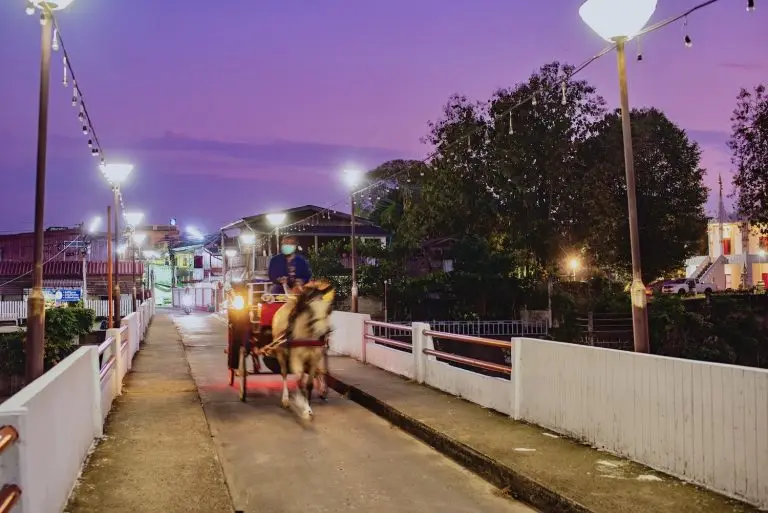
In fact, the bridge itself took up a good 15 minutes of my time, much to the amusement of the motorcyclists and their passengers (few pedestrians used this crossing) who whizzed past me while I gazed in wonder at the bridge. Below me, along the Wang River, lined with bougainvillea and esperanza trees, at least three elderly men were fishing, although all seemed more preoccupied with smoking their hand-rolled cigarettes than catching anything.
When I reached Wat Pong Sanuk Hua, which apparently won a UNESCO award in 2008, it had almost been forgotten. A pity, because like my first temple, which I discovered rather by chance, it was completely empty. At the same time, its sheer size and wealth of detail were absolutely impressive, which makes perfect sense given the award. It was more of a citadel than a single temple, its centerpiece a particularly imposing golden stupa perched atop a platform of stone and brick.
I didn't learn much about the temple – there were no information panels, presumably not part of the UNESCO requirements – except that it was about 1300 years old. As on the other side of the river, there were about a dozen monks' robes hanging there, but apart from the lazy stray dog lying at the foot of the only open-air Buddha statue, there were no other signs of animal life.
On my way back south, having postponed the rest of my bucket list until Tuesday (or a trip in the distant future), I got stuck on the motorcycle bridge again. It was a beautiful but treacherous stop, as I wanted to experience both the moonrise and the sunset. I ultimately opted for the sunset, since the moon is notoriously difficult to photograph (at least against a non-moon-shaped foreground) without extensive Photoshop work.
Just as I had set up my tripod to calmly capture the magenta sky glowing above the mirror-like waters of the Wang River, one of Lampang's famous horse-drawn carriages clattered past. It was an unexpected, blurry moment—a flash—much like the first (and to this day only) geisha I saw strolling through Kyoto's Gion district at night.
I took it quickly and blurry; as I write this, I have no idea if the photo will be usable. Perhaps the pinkish glow of the twilight will mask the many technical flaws I imagine.
On my way to dinner, I kept getting lost in details, in this case in a large silk shop on Thipchang Road. The meticulous arrangement of their handmade garments behind the immaculate shop windows of their teak building; the pride with which they displayed their sewing machines in the studio next to the boutique; the scent of rose and jasmine oil wafting through the air, though perhaps not directly from the shop itself.
Outside Aroy One Baht, the quaint restaurant recommended by the owner of my guesthouse, a huge queue snaked around the corner. It was almost 7 p.m. – that's what happens when the magic of a city completely throws you off balance.
The good news: I got a table almost without waiting; there was an English menu, which saved me the trouble of reading the Thai one. The bad news? My waiter (if you can even call the grumpy young man that) refused to answer my questions about local dishes; in the end, I ordered a spicy fried pine mushroom salad, a fish soup with herbs, and a prawn omelet, which turned out to be fish cakes.
Alcohol sales were also prohibited. "Koh-vid seep gaaw," the waiter grumbled, tapping the spot on the slip of paper where I had written "beer exchange." Luckily, I had completely forgotten about the pandemic.
I went to bed with a full stomach, surrounded by the buzzing of a whole orchestra of insects, frogs, and toads. About an hour before sunrise, a few eager roosters joined in – they never stopped crowing; the river awoke hours before the city.
So my early start was at least partially in vain. "The driver won't arrive until 8," the receptionist explained shortly after 7 a.m. as she handed me the breakfast menu. "Avoid the biggest crowds. Relax."
Although I couldn't see how relaxing now would reduce my stress later, the fact that the coffee in the guesthouse was real – Nescafé is a crime against humanity – reassured me so much that I didn't dwell on it any further.
While I waited for my khaaw tom omelet—frankly, to see exactly how those two dishes would go together—a notification popped up on my phone. “Government considers reintroducing ‘Test & Go’,” the headline read, referring to Thailand’s short-lived, no-quarantine entry program (through which I had entered the kingdom). Finally, the Thai government had accepted reality—I sincerely hoped others would follow suit.
When my driver arrived shortly after 8 a.m., his haste clearly indicated that his lateness was unintentional. His unkempt appearance, baggy pink clothing, and matted hair reinforced this impression.
Nevertheless, I tried to see the positive side (even though it was difficult from an external perspective – it was a gloomy morning, especially since it was still the dry season). The idyllic landscape we drove through – half-fallow farmland, scrubby jungle, and mist-shrouded hills – had a calming effect on me.
(The bumpy ride in the songthaew up the mountain where the stupas of Wat Chalermprakiat stand had the exact opposite effect.)
That's a good thing: you don't want to be too relaxed when you arrive at a place you've been wanting to visit for years. Especially not if all eight other people on your Covid checklist come down during your ascent.
“Welcome to the Sky Pagoda,” the sign read, and the only sound I heard as I stood before it was the soft tinkling of a distant wind chime.
This site, which despite its ancient appearance was only erected in 2004 to commemorate the bicentenary of Rama IV's reign, is divided into two main areas. The first area comprises the only stupa accessible on foot, from whose platform one has a beautiful view of about half of the other stupas. The second area is a small Buddha hall with around two dozen statues of varying sizes. The view here is somewhat less impressive (or at least less striking), but the aforementioned clanging and tinkling is more pronounced and insistent.
It was strange, waiting amidst the Buddha statues for the cloudy sky to clear. Every now and then I felt the ground tremble and thought someone else had arrived, but it was just me.
About an hour later, when I finally got downstairs, I saw others; to my delight, almost all of them weren't wearing masks. The famous Thai smile is so much less distinctive—practically invisible—when covered by a piece of fabric.
Whether with or without a mask, what I also love about the North is the sincerity of the "Sawasdee" shouts that people make to you as you walk by, and the fact that they laugh just as hysterically as you do when you praise your terrible Thai (and you then hit back in terrible Thai).
When I reached the bottom, the sky had completely cleared, and I noticed that all the frangipani trees were bare except for their pods and a few blossoms that had not yet fallen.
When I returned to town from the Sky Pagoda, I realized that my relationship with the Italian owner of my guesthouse was somewhat strained. This struck me as odd, since I had previously always praised her effusively for her breathtaking property.
My afternoon program included a number of random tourist attractions – a ceramics factory, a historic house and at least one temple – and a somewhat (and surprisingly) more difficult task: a proper Lampang meal after my pan-Thai mishmash at Aroy One Baht the previous evening.
At the Dhanabadee Ceramics Museum, which tells the story of the famous "Chicken Bowl" by a local Chinese-Thai immigrant, I distractedly searched my phone for a culinary key to understanding.
Instead, the website revealed an even sadder truth. Not only were most of the recommended restaurants closed due to Covid-19; I had also apparently missed Lampang's most famous temple (which, for some inexplicable reason, is almost half an hour outside the modern city center) because I had explored the city center on my own.
As I crossed the bridge into Kaelang's old town, such a destination seemed entirely superfluous. What had I explored in almost 24 hours if not an ancient city?
This is not to say that I grew tired of the ornate wooden houses after seeing hundreds of their stilts or stained-glass windows in blue, yellow, green, and red. Nor is it to say that I didn't incidentally become aware of important details, such as the legend of the liberator Chao Nan Thip Chang, as I wandered among the stupas, stone pillars, and traditional North Korean roadside shelters.
The bad news: Since I hadn't found a suitable restaurant for dinner, my plan B (back to the Aroy One Baht) was apparently obsolete. The restaurant was sealed off as if after a natural disaster, and an apology note ("Temporarily closed on Tuesdays") was stuck to the tarpaulin that served as the entrance.
The good news? This forced me to return to my hotel, where the owner was surprised when I decided to order a Campari Orange.
“I only learned to love its bitter taste last year,” I explained, and briefly recounted my recent trip to her home country the previous summer. “Before that, I was a die-hard Aperol drinker.”
Our belated meeting, which was also relatively short, gave my two days in Lampang a special significance. Time also passed more quickly than I had expected when I decided against a three-day stay.
That more than made up for the somewhat uncomfortable atmosphere in the restaurant I finally found; the staff's overzealousness there seemed almost desperate. The Nampriknum, however, was good.
Given that it is 2022 and Thailand's past mistreatment of elephants is well documented, I did not even consider the possibility that the elephant sanctuary in Lampang might be a zoo.
And yet, the two pachyderms that greeted me upon my arrival were chained. The one on the left, whose right eye had a cataract, stood in a pile of its own urine. The one on the right seemed younger, in better overall condition, and, I presume, cleaner, but it too exuded a similar sadness.
I thought back to my encounter with the owner of my guesthouse and the good relationship that eventually developed, and wondered how someone who seemed to have so much life experience could, in good conscience, recommend such a place. And then it dawned on me: Thirty years in Thailand had made her a true Thai woman.
Moral relativism is not one of the many complications that my diverse travel preferences and wanderlust have caused me.
As I stared at the scene before me in silent horror, a little girl (presumably the daughter of the younger mahout, who was wearing overalls in the same color as my short-sleeved shirt) was distractedly playing a video game.
"Double murder!" the computer voice congratulated her in her ignorance. "Triple murder!"
Selfishly, I kept my distance from the animals, even though I so longed to be close to them, to offer them at least a brief comfort. But no solidarity – I couldn't reconcile that with my conscience: I had, after all, decided to watch the spectacle.
It was a horrific spectacle, ostensibly about bathing and feeding, but in reality a celebration of servitude in its original form – an unpleasant end to two otherwise beautiful days.
As I left, I stopped once more at the enclosure of the two elephants who had welcomed me at the center – well, as warmly as a slave can welcome you into his master's house. They seemed to be communicating with each other by slapping their trunks and swishing their tails while standing chained up.
I wish I could have understood it.
More frequently asked questions about visiting Lampang
Is a day trip to Lampang worthwhile?
Lampang is definitely worth at least a few nights if it fits into your Thailand itinerary. The charming, tranquil old town evokes a simpler, more authentic era, one that is long gone in Chiang Mai and slowly disappearing in Chiang Rai as well. Plus, it's affordable, the scenery is stunning, and the food is excellent.
How do I get from Chiang Mai to Lampang?
Buses run relatively regularly between Lampang and the Arcade bus station in Chiang Mai; trains between the two cities are somewhat less frequent. Depending on your negotiating skills, you can also negotiate a taxi ride (the journey takes less than two hours) for around 1,500 baht.
What is there to do in Lampang?
Like other cities in northern Thailand, Lampang boasts an old town full of temples, a beautiful river, and numerous exciting destinations. What I particularly like about Lampang? The city center can be explored entirely on foot, allowing you to discover all the sights and activities at your own pace.




Community
Comments 0
Start the conversation.