“This pier is much longer than it looked from the shore,” sighed my friend WeiLe, as we trudged across the floating plastic blocks that stretched beyond the mangrove swamp on the east side of Railay Beach. “It feels like we’ve been walking for an hour already.”
The speedboat in the distance seemed to be moving away rather than getting closer, like a mirage. Its silhouette almost disappeared on the horizon, which itself was blurred and smeared by the heat of the morning light.
At that moment, another boat appeared out of nowhere and stopped right next to us. An older Thai man (who had apparently been nearby the whole time) also suddenly made his presence known. "Go to Phi Phi," he said, pointing. "There, there!"
WeiLe, myself, and the twelve or so passengers behind us hurriedly boarded the ship, which was surprising considering how carelessly the staff on land had checked us all in. Within a minute or two, we were crammed inside, racing first towards the scorching sun and then southwards, out onto the open sea.
Our island-hopping trip through Thailand was finally about to begin in earnest. This made me more excited – and nervous – than one might expect given my previous travels in the kingdom.
You see, apart from one or two exceptions, I've never really done any island hopping in Thailand. While I've visited almost all the notable islands of the kingdom (including all but one of my stops on this trip), I've never traveled to them all in one go, at least not within the Andaman Sea.
The “exceptions” are rather weak: trips to the Trat archipelago (which is less an archipelago than a mother island and her children) in 2010 and 2015; and my 2022 trip to Koh Tao, Koh Pha Ngan and Koh Samui, which simply wasn't extensive enough to be multifaceted, although it proved enlightening for other reasons.
“I only came here for the weekend,” I laughed to WeiLe as I explained the circumstances of my last visit to Koh Phi Phi in 2017, which I had combined with two nights in Railay. “It was relaxed, although to be fair, it was after the high season, so it wasn’t quite as hectic as it is now.”
"Manic" is probably an understatement. From the moment we paid the grumpy security guard at Tonsai Pier the 50 baht per person, until our walk through the crowded town center on our way to the island's famous viewpoint (which now consists of three viewpoints and is no longer free), Phi Phi at times felt as crowded as Silom or Sukhumvit in Bangkok, only with even less space per person.
I finally reached viewpoint 2 (which used to be the only one before the superfluous viewpoints 1 and 3 – which alternately are too low and too high – were built, I suppose, during the pandemic) a few minutes before WeiLe.
In hindsight, I should have sat down – I had exerted myself so much that I became dizzy; there was no railing at the top, just a steep drop. Instead, I took the photos I had missed almost ten years earlier when I had arrived so early that the sun was not yet high enough to illuminate the water of Phi Phi's two bays in its sapphire and jade green hues, but instead bathed it in a disappointing gray-gold.
WeiLe, for his part, had wisely recognized viewpoint 1 for what it was and settled down there (there was nothing more one could do; the view was simply too short) to recharge his batteries before continuing his ascent. When he reached viewpoint 2, he didn't seem tired at all; his voice didn't sound tired either.
As in Railay during the previous period, our two days on Phi Phi (well, my two days on Phi Phi – I can't say how they affected WeiLe) were also about following an old plan with a new and improved sense of direction: I treated myself to a private longtail boat to visit Pileh Lagoon and Maya Bay; I took time to relax with a swim in the pool of a resort where I would never have spent money seven years earlier.
Back then, I had taken a boat from Tonsai back to Khlong Jilad Pier in Krabi Town, where I spent the night before rushing back to Bangkok. This time, however, I (with WeiLe) was on my way to a place neither of us had ever been before.
It may surprise you that until two Fridays ago I had never set foot on Koh Lanta; the island enjoys an almost legendary status among backpackers (who these days are mostly former backpackers) of my age, not to mention practically every other travel blogger I know.
The problem is that I never managed to get there when I was still a backpacker or a new blogger; it never seemed to fit in with my other island trips in Thailand, as these were almost all short and self-contained, unlike this trip which was strung together like pearls.
It is therefore fitting that this journey only really felt like island hopping upon my arrival in Lanta, rather than like exploring, lounging or any other comparable formulation.
(It's perhaps also somewhat fitting that I was ripped off by a songthaew driver at Saladan Pier. "Your hotel is far away," she emphasized, and pressured me to pay her 500 baht to climb onto the back of her pickup truck. That price is really fair!)
This – my feeling, not the deception – makes logical sense, especially in retrospect: Lanta was the third of five stops, the midpoint of the journey. But for many reasons, it also proved to be the emotional center of the trip.
Firstly, because while Lanta remains popular with backpackers, it's large enough that it doesn't feel crowded at all. Or like Thailand, at least not according to WeiLe.
“I almost feel like I’m back in Malaysia,” WeiLe laughed as he arrived at my resort on his motorbike (which was a few kilometers from his on Lanta’s main road, in the backpacker-friendly area between Long Beach and Khlong Kong Beach). He praised not only the conspicuously Muslim staff and the resort’s aesthetics, but also how unassuming both the beach and the sea were by Thai standards.
It was true: While the Phi Phi Islands in the distance lent the overall scene an unmistakable Thai touch, the details of the beach hardly differed from countless other beaches around the world, not just in Malaysia. We could have been anywhere. We could have been anywhere.
It was only when we set off on the motorbike that we began to see what I then considered to be the uniqueness of Lanta: wilder, more secluded coastlines like Kantiang Bay and Bamboo Beach on the first afternoon; Chinese shophouses and a bizarre lobster statue in Lanta's old town on the second morning.
The hospitality was also "unique." "I'm sorry," said the owner of the Fresh restaurant halfheartedly after the waiter brought me a dish of fried chicken and spring onions that bore absolutely no resemblance to the Penang duck curry I had ordered. "Unfortunately, we're out of lychees today."
But it was only when we were back on that beach, which could be anywhere, with bottles of Chang beer in hand and a friendly German couple we had just met who had decided to chat with us for the afternoon, that we realized the truth that I assumed my colleagues and other older millennials had known for over a decade.
Lanta is a canvas, not a painting. Her special quality lies not in what you find when exploring her, but in what you find within yourself.
If Lanta is a canvas waiting for your oil and watercolor paints, then Koh Mook is a Polaroid photo impatiently waiting to be admired. Or at least accepted.
“Have you noticed that the people here are a bit…grumpy?” asked WeiLe on our second of three days, although by then it already felt as if the number of days had been a mistake.
Mook was the island (at least among those I visited on this trip) that I had visited furthest away in the past: in 2012, when I first lived in Thailand and flew my sister in for her first trip abroad (and still is).
We had actually started on the neighboring island of Koh Kradan, but it was far too spartan for a girl like Stephanie at the time; she had discovered the five-star resort Koh Mook Sivalai and, well, the rest is history.
But in fact, due to this particularity of my story, I had no backstory to refer to: We had spent virtually all our time on the island either in our bungalow with a sea view or on the narrow sandbank on which the resort is located, and had not explored any other place at all.
“They’re quite grumpy,” I agreed, as the two of us – WeiLe and I – sat silently on a terrace waiting for our dinner, which we had ordered what felt like an eternity ago from a woman who seemed at least as distant as the staff at my non-resort (and according to WeiLe, at his hostel).
I wanted to attribute this to the increasing spread of tourism on the island and the fact that most people probably do not agree with it, although given the limitations of my previous experience, I could not draw this conclusion with certainty.
Despite the presence of locals, Mook was quite appealing from a purely tourist perspective – for the most part. Admittedly, my aforementioned accommodation, which wasn't a proper resort, was located in a stinking swamp rather than on a beach. Worse still, at low tide, the foul-smelling mud beneath the mangroves was exposed for hours, making the whole scene even more unpleasant than it already was.
But it was a little further away from the island's best beach (Charlie Beach, sometimes called Garnet Beach), where WeiLe and I experienced the sunset on the first evening, while so much marijuana smoke swirled around us that I at least got a slight buzz.
The next day, after a morning trip to Kradan (where, as I proudly announced to my sister, there were now even more luxury hotels than on Koh Mook itself – but the main beach with its swimming pool still felt just as secluded and dreamy), we tried to reach the famous Emerald Cave.
Unfortunately, the gangster-like park ranger, who charged us 200 baht each, didn't tell us that the entrance to the cave was blocked with jellyfish; none of us wanted to risk being stung by one to see what awaited us inside.
“He wasn’t grumpy,” I laughed as my Margherita pizza (which, admittedly, looked incredibly realistic) was brought to me by a smiling young woman. “He was simply a con man.”
WeiLe's chicken burger arrived shortly after (brought to him by the same girl, with the same smile). He agreed and turned to the elephant in the room, who was just leaving: "Perhaps we judged her too hastily?"
Looking back, I can say with certainty that the people we met on Koh Mook were the most unfriendly (or perhaps simply the least dishonest) we encountered during our island-hopping adventure in Thailand.
What I actually noticed as the sun set around us was that WeiLe suddenly seemed more like my little brother during the summer holidays than a friend on the other side of the world whom I only see about once a year.
We had of course traveled together before – in Vietnam and China, in his home country of Malaysia, and in Bangkok and Taipei when I lived there – but never for so long. Or, to be honest, never so peacefully.
"I don't know if it's because you're old now," teased WeiLe (who will be 33 in six months; I just turned 39), "or if it's simply because we're in a more relaxed phase. But it's so much more pleasant to be around you than it used to be!"
Speaking of getting older: Back in the 90s, Vanessa Williams strongly advised us to save the best for last. I've followed her advice on this journey, albeit unconsciously.
“I literally can’t remember it being this stunning,” I insisted to WeiLe, my mouth agape, as we strolled along the postcard-perfect Sunrise Beach towards the so-called North Point, which some Thais consider the Thai equivalent of the Maldives, as it barely rises from the sea.
I then explained to him how, at the beginning of 2015, I had gone on a whirlwind trip through the kingdom with Dora (another long-time travel friend of mine) (her first) and had actually been disappointed by both the beaches and the island itself.
“If you think this is fantastic,” said WeiLe (who had last been to Lipe just a few months earlier), as he dove into the crystal-clear water that made the waves off Koh Kradan look like the Chao Phraya River winding through Bangkok, “just wait until we go there tomorrow.”
He pointed towards Koh Adang, where a multi-peaked mountain rose above a pristine, pine-shaded beach.
The next morning, as I looked down towards North Point from Adang's lookout point, I tended to agree with him, if only because it was simply fantastic to see Lipe from a bird's-eye view.
“Do you see how great it looks, framed by this sago palm?” I asked WeiLe, who was taking photos at least as enthusiastically as I was, while most other people were simply relaxing and enjoying the moment.
Well, fairly normal. One of them, a pale German, said I was wearing the "wrong shoes," whatever that means. He wasn't thrilled when I told him I'd reached the summit ten minutes before him, even though I was wearing flip-flops and he was wearing expensive (and hideous) hiking boots.
Not that either of us was thinking about that person when we arrived at what I still simply call Pine Beach. Actually, I was just thinking about how strangely cold I felt, even though I was in the blazing sun and scorching heat.
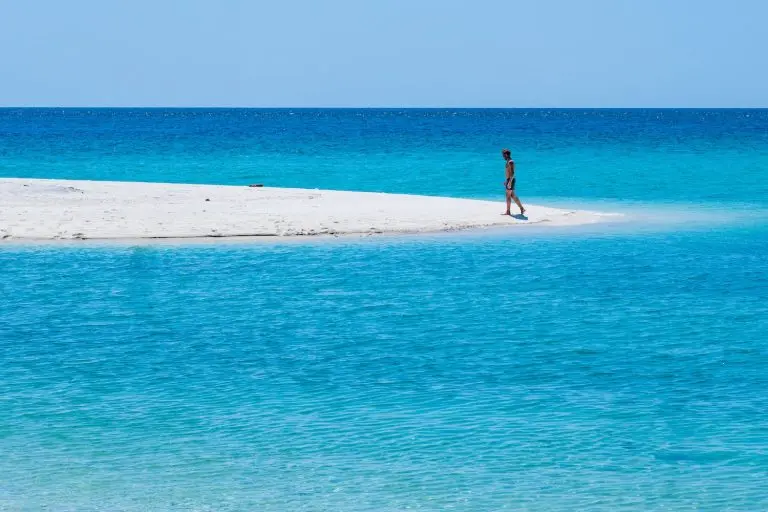
I felt almost feverish, I thought, even after I'd gotten out of the water. I tried to embody the "Birth of Venus" as I staged a self-portrait—walking from the sea onto another, Maldivian-like strip of sand nearby, a kind of baptism in the Andaman. In the end, I chalked it up to exhaustion from the hike.
When I finally fell asleep, my fever was so high that I had to sit under a hot shower for 30 minutes just to feel warm enough to go to bed. Luckily, before I got really sick, I was able to enjoy one last meal with WeiLe, who was taking the ferry to Langkawi the next morning – just as I was heading back to the Thai mainland by speedboat.
I was also grateful that among the many hallucinations supposedly caused by the fever, none showed me fixating on my impending separation from my dear friend, who at that time seemed to be an even more integral part of my “real life” than he had been in Lanta or even in Mook.
I was deeply saddened by the thought; in fact, until I became ill, I had simply been so busy that I had no energy to think about it.
The same thing proved true the next morning when we sat on Lipe's south-facing Pattaya Beach and I realized I had to be on board my boat within the next ten minutes, precisely when WeiLe had to begin his international check-in. There would be no time for tears or even a proper goodbye, just a quick and unceremonious farewell.
A hug lasting only a few seconds could of course not do justice to the almost two weeks of camaraderie and the essentially shared exploration, but we had to make do with it in this case.
A few days after the trip ended, I video chatted with WeiLe. It was the first time since then that we had seen each other in real time, which didn't seem strange to me at first, until the connection was established. Suddenly, my dear friend – my faithful companion for twelve days traveling, on the beach and on the high seas – was just a pixel and a frequency.
But I was very pleased to see how happy we both still felt, even though all the moments we had just experienced were now sad and only memories.
Together we wandered the once solitary paths of our memories in Railay and Phi Phi; in Lanta we created entirely new ones. We complained about the grumpiness of the locals and the ubiquitous jellyfish on Koh Mook, and fell so deeply in love with Lipe (or at least with me) that I felt sick. (Luckily, so much so that I didn't burst into tears in the end.)
“I wish everyone could feel that way,” WeiLe said, perfectly summing it up, although he admitted aloud that he doubted whether he had expressed it correctly. “Everything was perfect. Not in the sense of being ‘perfect’ perfect, but perfectly human.”
I wanted to add something, not to outdo or correct him, but to express my deep agreement in a constructive and complementary way. Instead, I simply listened and smiled, as subtly as Botticelli's Venus.




Community
Comments 0
Start the conversation.