Two weeks ago, as my plane was on its final approach to Chiang Mai, I noticed a strange object outside the window. An unidentified flying object, so to speak.
It was a small cube that flew through the air at least as fast as an airplane, moving forward without significant pitching or rolling. There was no discernible propulsion, no exhaust fumes, and no light. Just a box hurtling thousands of meters above the jungles of northern Thailand.
Hours later, standing within the old city walls, looking into the eyes of a fruit vendor with a sharp knife in his hand, I thought of that science fiction scene. His face was as leathery as his hands, which he didn't protect in the slightest as he sliced an entire papaya into pieces and then tipped them into a plastic bag with the edge of the blade – all in a matter of seconds.
He had no customers; he was apparently doing this in preparation. Oddly enough, if I had been hungry, I would almost certainly have chosen ma-la-goh; the particular gleam in his eyes suggested he knew this.
Perhaps he was the one controlling the box, I thought, the one giving all the commands.
I was on my way to Wat Phan Tao, which, as a brief internet search a few days earlier had revealed, was to be the most picturesque starting point for the ascent of the lanterns during the Yi Peng Festival that evening.
The air was cool by Thai standards, which almost reminded me of the Indian summer walk I had taken with my sister and her dogs the day before my departure.
It was the second Friday in October; since then I had been to Bhutan, Tibet, and mainland China. The autumn I would miss that evening, when the trees had just begun to change color, was now completely over.
I can't sugarcoat it: My first day back in Chiang Mai after almost three years was a disappointment. I learned shortly before nightfall that the festivities at Wat Phan Tao Yi Peng had been cancelled "because of Covid" (by a monk who – rather bizarrely in post-pandemic Thailand – wasn't wearing a mask).
Even worse, the rest of the city descended into chaos because of the other lantern festival, Loy Krathong.
Loy Krathong was of course the real reason why I postponed my Mae Hong Son Loop tour (which I originally planned to do in February) to November; it is the reason why I was in Chiang Mai at that time in the first place.
I spent the evening anxiously on the banks of the Ping River, which was almost too crowded to take decent photos, not to mention that local children were lighting fireworks so carelessly that they might as well have aimed at the spectators instead of "accidentally" almost hitting them.
Not to mention the foreign tourists who were there and who (as is always the case in Chiang Mai) are the very worst Western tourists.
You're probably familiar with this: people who visit the most clichéd travel destinations and do the most typical things there, but claim with conviction that they have been "off the beaten track", usually due to a changed attitude (or, at least in this case, a change of wardrobe, mostly in the form of elephant trousers).
As I moved away from the river and took the southern route – via the shadowy night bazaar of Chiang Mai – back to my quiet guesthouse near Wat Phra Singh, I realized that despite my outward silence, I should harbor more generous thoughts.
I ended up running one of the largest independent Thailand travel blogs. At least some of the people I looked at with such disdain as I walked by probably recognized me.
At that moment, a distant view pulled me from my thoughts. It was the fruit vendor with his van, who, to my surprise, was still working diligently hours after sunset, albeit several blocks away from his previous location.
To my surprise, he already had a bag of papaya ready for me when I ordered it; I kept my fingers crossed that it wasn't the one he had cut open at lunchtime.
Although I had walked almost 30,000 steps without a break, after traveling almost six weeks without interruption, I spent my first night in Chiang Mai restlessly. I tossed and turned under my duvet, which did little to compensate for the freezing air conditioning in the room.
Then the hallucinations started. I felt insects crawling all over me, but every time I pulled back the covers and examined the inside of the bed with my flashlight, I couldn't find a single ant, spider, or flea.
At some point I lost consciousness and only woke up a few hours later when my alarm clock blared at 5 a.m. To my horror, I saw in the shower that both my legs were completely covered in bite marks.
Before my planned trip to a lake just outside the city, where Yi Peng's visit had definitely not been cancelled, I decided to do some exploring during the day. More specifically, I visited Wat Sri Suphan, a temple made of sharp-edged metal fragments, located south of the old city wall in a neighborhood that probably no one else would ever visit.
As I completed the last 20 minutes of my walk, a monk approached me with a small card written in English. "Take a picture of this meditation," it read. "If you practice it daily, you will find peace."
It reminded me of the secret message the medical assistant delivered to Demi Moore's character in "The Substance"—seemingly under the guise of helping her, but ultimately sealing her fate. I didn't delete the photo; I never looked at it again.
Of course, my consciousness had already split into two sides long ago, even if it wasn't about youth versus age. I've written about this in other essays (especially this one), but I'm firmly convinced that my "traveling self" is a completely different person than I am at home.
And I don't mean that in the sense of dissociative identity disorder – I truly believe that an alternate version of my software will boot up on my increasingly worn-out hardware once I've landed on a distant shore.
That's not to say there aren't negative effects as well. For example, when I travel, I sometimes find myself avoiding progress out of sheer laziness.
When I returned to the old city after my stay at Wat Sri Suphan (where only men are allowed – I was one of only two people who were there the whole time), I naturally considered cutting my evening excursion short.
Although I naturally wanted to see the floating lanterns with my own eyes – and above all, capture the spectacle – the idea of simply lazing around and going to bed early seemed much more appealing at that point in my journey.
At that moment, Home Robert had almost completely resurfaced and seemed ready to do anything to avoid sinking back into the depths of the subconscious, much like Sue had literally stolen Elizabeth's spinal fluid to spend a few more days in the sun.
But I – Robert the Traveler, I – made it to the lake. As so often on this trip, whether it was about cancelling the Bhutan trip or returning early from Beijing, my self-harming fantasies didn't even make it into words, let alone actions.
At the same time, it is also true that although I watched lanterns rise into the sky for almost two hours, I was not particularly present in the moment.
No, I stood just outside of it, and only from that perspective can anything truly be documented. I didn't live in it; I created a kind of surrogate version of it that a future self could inhabit if one day I was no longer able or willing to have such experiences.
When I went back to my room, my bites were itchy, and a further inspection under my duvet revealed that I found no creepy crawlies whatsoever.
What I then experienced was a neighbor who was playing the intro to George Michael's "Careless Whisper" on his alto saxophone nonstop. It was a happy coincidence—the song was number one on the charts on my birthday—but also quite annoying. I rummaged through my bag for the card the monk had given me.
Had I returned to Bangkok the next morning, as Home Robert had wished, I probably would have felt triumphant nonetheless. I had crowned a fulfilling 60-hour weekend in the northern Thai capital with a carefree stroll along the pedestrian streets of Chiang Mai, where a perfect sunset had lent my long weekend an almost cinematic atmosphere.
The thought of it had awakened in me a deep feeling of peace, just as my father had felt at his birthday dinner only a few days before my departure – on the same night that my sister and I had gone for a walk with their dogs.
My father generally seems quite young for his age (68, on his last birthday), but I've realized that he appears older and more frail when he's content or simply being friendly.
I realized that the same was true for Parker, the older (and my favorite) of my sister's two dogs. Now in his middle years – he's about six or seven – he no longer pulls me around the neighborhood on our walks like he used to, but instead slowly sniffs every square inch of grass, seemingly aimlessly.
"One day I'll make it," I thought as I hesitantly approached the car rental office just outside the old town walls. But today is not the day.
Some say that a key to staying young is to do something scary at least once a year. Personally, I seem to do something scary every day (especially when traveling); today it was my first car ride in Thailand.
But unlike the dozens of other foreigners who embark on the Mae Hong Son tour every day – phrased that way it doesn't sound so "frightening" anymore – I was sitting in a Honda City and not on a deadly motorbike.
My first stop was Pai, a city I had always mistakenly thought I had visited over a decade ago, but which I actually only visited for the first time in November 2024. My first impression (which hardly differed from my last; I only stayed for 12 hours) was that it perfectly matched my expectations.
I was hungry as I headed towards the city's Big Buddha (which should have been my first warning sign – the worst places in Thailand always have Big Buddhas) and went into a restaurant whose name (Earth Tone) sounded like it might have already existed in Austin when I moved there in 2006.
Unsurprisingly, the open-air restaurant was full of barefoot, patchouli-scented white people who expressed, both through the rhythm of their speech and through the food they ate and the drinks they chose to accompany it, that they were changing the world.
As had been the case in the Texas capital shortly after the turn of the century, the flower children who called Pai home for a night (or for a week) were not so concerned with settling into the rhythm of their temporary abode as with distorting their image and disposition in the way they believed the place demanded of strangers.
I had initially followed this approach myself as a resident of Austin, but abandoned it soon after beginning my world trip. Effective, sustainable travel means remaining as authentic as possible in every place you visit and not allowing yourself to be changed or even consumed by those places.
I realize this might seem hypocritical at first glance: I already said that I feel like a completely different person when I travel. The difference for me is that, as Travel-Robert, I'm essentially the same person, whether in Thailand or Tanzania, Pai or Portland. I change through the journey itself, not through a specific destination.
This is not unlike Parker's behavior when he starts sniffing around. He puts his nose to the ground to gather information, not necessarily to follow it anywhere.
Having had enough after a single walk through the main streets of Pai's city center, I turned my attention to the bright green rice field near my "resort", which in no way lived up to its name.
I went down the hill into the field to take some photos, but I quickly regretted it. Almost immediately, fire ants started nibbling at my ankles, and not as subtly as the ordinary ants in my bed in Chiang Mai.
Back in my bungalow, my legs still burning and swollen, I noticed a thin tabby cat begging to be let in – she actually came in briefly when I unlocked the door. I put her back out rather roughly; to my surprise, she didn't even meow.
“Sure,” I told myself hours later in bed, still restless. “One of Pai’s kind-hearted foreign residents must have opened the door for her.”
I left the city as early as possible the next morning. On the way out, a child, who couldn't have been more than ten years old, sped past me on a motorbike. He was smoking a cigarette and driving clearly faster than the speed limit; I wondered how the constantly changing inhabitants of Pai would react to such a spectacle.
Or rather, I didn't want to: I desperately wanted to leave and (at least for the moment) erase the short time I had spent in Pai from my memory.
At first, the surroundings seemed to justify this approach. Seas of clouds hung over the valleys on both sides of the Doi Kiew Lum viewpoint, forming scenes of complex beauty that made me less regretful about my decision to skip both Pai Canyon and Tham Lot Cave.
However, when I traveled west and then directly north to Ban Rak Tai, a highly regarded village on the border between Thailand and Myanmar, it seemed to me that I might have been too rosy in my assessment.
Nature gave me the first signal in this direction. In contrast to the rice field next to my "resort" in Pai, most of the ones I passed on my way north (and then back south towards Mae Hong Son) were brown and parched, as if they hadn't been completely flooded just a few weeks earlier.
Then there was Ban Rak Thai itself, which, although less than a mile from Burmese territory, had been cheaply recreated as a kind of artificial Chinese village. After the long drive, it was so disappointing that I snapped at a woman who asked me to take a picture instead of simply ignoring her.
"Take off your mask," I admonished her in a mix of English and Thai. "I refuse to photograph you if you cover your face with that thing." She left the mask hanging around her chin; I took a few photos anyway.
"How do I look?" she asked me completely in English and without realizing it, before I handed her back the phone.
I hesitated, then I said: “You look like an idiot. The pandemic has been over for years.”
(Contrary to what foreigners think, the claim that "wearing masks has always been common in Thailand" is a blatant lie, formulated mainly after the fact, after Thailand had destroyed its reputation as the Land of Smiles in response to a cold.)
It is less painful to pretend that something has always been terrible than to admit that it was once wonderful but has been destroyed.
The positive aspect of my bad mood was that it allowed me to completely overcome my mild but persistent fear of driving in Thailand. And although I had felt very anxious literally days before, the drive was ultimately not stressful at all.
The road quality is amazing; although there was usually only one lane in each direction, it was surprisingly easy for more aggressive drivers like myself to overtake slower drivers, who usually moved onto the hard shoulder as soon as they realized someone wanted to overtake them.
Then there was the town of Mae Hong Son itself, which in many ways is like the reverse of Pai. In retrospect, I wish I had planned to spend more nights there.
The locals seemed to outnumber the tourists by at least five (and perhaps even ten) to one; whether in the Burmese-style temples or in the cuisine served in most restaurants by refugees from Myanmar's Shan State, the character of the place was distinctive and, moreover, immune to corruption by the vanity of visitors.
And there had been some vain visitors. When I checked into my resort, an idyllic, wooded place that offered everything I could have wished for in my accommodation in Pai, there was a photo of the receptionist with Angelina Jolie and Brad Pitt from the mid-2000s hanging on a tablecloth that matched the color of my floral shirt.
I actually had quite a long conversation with the woman, who was now about 50 years old, in a mix of English and Thai, and was surprised that she never once mentioned the encounter. She let the picture speak for itself.
She certainly had no idea that I myself was a niche internet micro-celebrity, or Nimcel, not to be confused with Incel.
I didn't tell her either. I wasn't as rich as Brangelina were back then; besides, I had no point in revealing myself as someone whose opinion might matter. I didn't want to be waited on hand and foot; I didn't want to owe her anything except the money I'd paid and the time I'd given.
When I saw a younger version of Angelina, I became aware again of how much I wanted to see her in Maria, even though the mere thought of it stirred up my own feelings.
Would I one day be an eccentric eccentric living out the last chapter of my life, unknowingly, in a city that should have been the backdrop for its climax?
I left Mae Hong Son about as early as I had left Pai the day before, though certainly not with the same enthusiasm.
And yet, almost immediately after leaving the city, a medium-sized Buddha, hovering high above the winding road, served as an early sign that I had made the right decision, even if the attempt to photograph it in context proved somewhat more disappointing when getting out of the car than from the driver's seat.
Poinsettia trees cast shade on both sides of the misty scene, reminding me of the Nepalese city of Pokhara, where I've only ever seen the plants outside of pots once before. Today, of course, I was headed to sunflower fields.
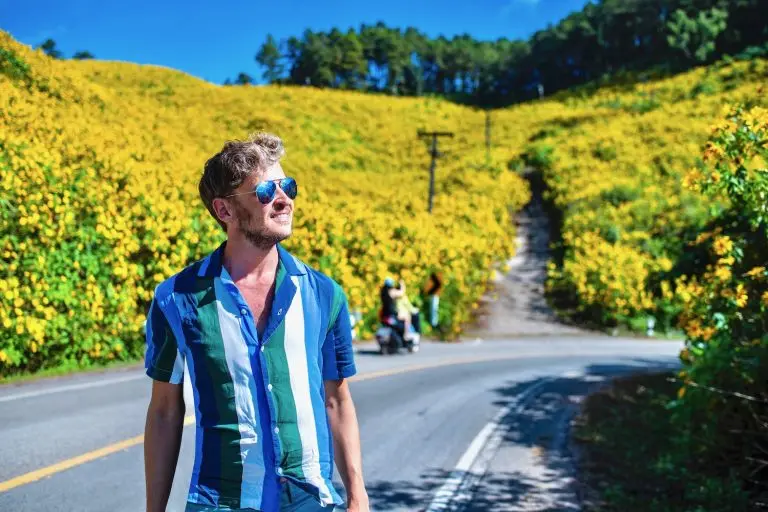
Well, not sunflowers in the American or European sense; the ones that supposedly covered a hill about halfway along the road between Mae Hong Son and Mae Sariang (my next destination) probably resembled more what we would call brown-eyed Susans or even yellow daisies.
The fact that the "sunflowers" weren't real sunflowers at all wasn't what surprised me when I finally arrived there.
No, the shock was that the field (which was indeed on a slope – it was mostly too steep to cross on foot) was more or less publicly accessible. People could park along the roadside and wander around to their heart's content. It wasn't commercialized or regulated; it was simply there.
This was a fitting preview of Mae Sariang itself – which was disappointing in some ways. Here I experienced neither the strange (albeit decades-old) familiarity of Pai nor the warm hospitality of Mae Hong Son.
The people in Mae Sariang seemed reserved, not out of malice, but because they were living their own lives. The presence of tourists like myself was merely a means to an end for them.
After a greasy, fiery lunch of Pad Grapao Moo Grob, I spent the afternoon searching for the perfect spot to watch the sunset. It didn't surprise me that in a place like Mae Sariang (a tourist town that wasn't touristy), there was no consensus on the best one.
I began my hike at a white pagoda that appeared to be on the highest hill in the city, but ended up at a gleaming golden stupa in a rather inconspicuous location.
It turned out to be a wonderful day. Not only because the sky left behind by the setting sun was the most colorful I had seen on my entire trip, but also because the satisfaction I felt while taking photographs allowed me to accept a simple truth: Mae Sariang was exactly as I had hoped the entire Mae Hong Son tour would have been.
That fits in a certain way: only by having gone through the cycle almost completely was I able to acquire the gift of understanding its nature.
On the drive back to the city, as the last rays of the sun faded, the sad side of this truth hit me. I had spent much of my trip oscillating between mild anxiety and sheer terror, with my inner companion begging me to cancel, and even my travel-self more cynical than optimistic.
The next morning, when I went to a 7-Eleven to get some coffee and found there was no vending machine at that location, I saw a group of monks walking barefoot through the city begging for food.
Had I been in a place with more than a dozen foreign tourists, I might have concluded that it was some kind of staged alms ceremony, like those that take place every morning in Luang Prabang, Laos.
But no, I was completely alone, along with the surprisingly few locals who were even awake, let alone willing to give anything to the mysterious orange robes floating through the dimly lit streets. I had neither my camera nor my phone with me; I even ran quickly to my room to get the camera.
They weren't moving very fast, I thought. And the city isn't very big. You'll definitely find them again, especially if you come back quickly.
It only took a few seconds, but then they were gone.
To end my Thailand trip with a bang, I planned a day trip that combined two destinations in one day: Koh Larn Island and Pattaya. I set off early; by 10 a.m. I was already on my way from the island's pier to the main viewpoint.
Looking down from the precipice, I saw what appeared to be dozens of speedboats circling the base of a golden Guan Yin statue, which was actually hundreds of meters above them. From this perspective, the reality of Robert's impending hibernation hit me like a ton of bricks.
The free, happy reality that now defines my everyday life will, less than 48 hours after this moment, be nothing more than a memory, a past I long for, and a future I make plans for.
If I had no other obligations in my life – if I had no idea of a life beyond this life – then this would be all I would ever need.
But I do it, and I do it, so that's not it.
In fact, I briefly considered extending my trip several times during the last few days. Of course, that would have been unthinkable in the days and weeks after my return to Asia, when Robert was still in charge at home.
He finally relented and allowed the version of me who writes (in case you're interested: I'm Travel Robert) to live as I wanted. I realized I now have to make way. I'll reappear soon, but my time is almost up.
Sometimes, of course, I provoked this myself. For example, when I enthusiastically documented the lantern festival, but at the same time couldn't wait for it to be over. You can love something and enjoy it with every fiber of your being, and yet still not really be able to bear it.
Don't forget that you are one. While this may come from a fictional film, it has become an incredibly important mantra for me in my life. Or rather, in my lives.
Unlike Elizabeth and Sue, who both couldn't stop exploiting each other long enough to recognize the inevitable destruction they were destined for, I have come to an inescapable conclusion: self-control (and in some cases, self-suppression) is the key to success and the antidote to failure.
(Even if success for me means remaining a Nimcel throughout my middle age.)
Sometimes I have to be kinder like my father, even if it makes me seem (or become) older and more content; I have to be curious like Parker, even if it means I achieve less.
On other days, I can be like a box hurtling thousands of meters across the jungle, propelled by nothing but my own free will.
(Even if, in reality, an inconspicuous fruit vendor somewhere on the ground is pulling the strings, with the cuts of his blade through the flesh of the orange papaya being a secret Morse code that literally works magic).




Community
Comments 0
Start the conversation.