I'm not exaggerating when I say that from the first sip of Thai tea (which was over 20 years ago now) I knew I absolutely had to visit Thailand. Any country that could produce such a heavenly drink was worth a whole day on a plane for that reason alone.
When I finally made it to Thailand in 2010, I was surprised. While it wasn't impossible to find Cha Yen (ชาเย็น), as it's called in Thai, it wasn't as ubiquitous as I had expected.
With this post, I want to create a kind of repository for Thai iced tea, with strategies on where (and how) to find the best orange gold in Thailand, and also instructions on how to prepare it as authentically as possible at home.
Why Thai iced tea tastes better in Thailand
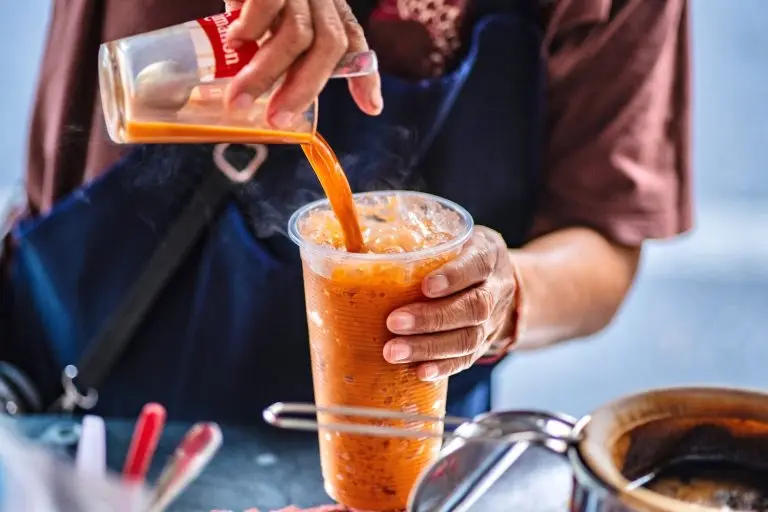
If you've never seen Thai tea being prepared on the streets of Bangkok, I recommend paying close attention the first time. First, notice the strength and concentration of the tea. It's unmistakably orange, but appears almost black unless exposed to direct light. This is partly because it's brewed with a device that I can only describe as resembling a sock.
As soon as the person preparing the drink adds a heaping tablespoon of condensed milk (usually in a short, clear glass), and especially once sugar is added, the liquid takes on its characteristic color. While these steps form the basis of the flavor, for me the enjoyment isn't complete until the drink is poured over ice and topped with a generous splash of condensed milk.
The best ways to enjoy Thai iced tea in Thailand
Visit a chain like ChaTraMue.
For those who want to enjoy authentic Cha Yen without risking food poisoning, the ChaTraMue stalls (incidentally, the most popular Thai tea brand in supermarkets) are the perfect place. Whether you choose classic Thai tea or one of the many other beverages, you're guaranteed to be satisfied.
Go to a street stall early in the morning.
This doesn't mean that buying Thai milk tea on the streets of Bangkok, Chiang Mai, or any other Thai city will cause stomach problems—it's almost never happened to me. However, it's worth noting that Thai tea isn't sold on the street all day long; it's typically drunk in the morning. Go early to avoid queues and perhaps even to chat with the vendors.
Order it at the restaurant.
Well, it's an air-conditioned restaurant. Thai iced tea isn't common in traditional Thai restaurants, but you're guaranteed to find it on the menu at any Thai restaurant in a shopping mall or other establishment catering to foreigners/wealthy customers. These restaurants are usually more expensive than street vendors and, unfortunately, sometimes the tea isn't quite as good.
Buy the materials yourself
In a few steps, I'll explain how you can easily prepare Thai iced tea at home. Until then, there's another option: you can buy the ingredients in a Thai supermarket or convenience store and prepare the tea in the kitchen of your hotel room or Airbnb accommodation (if available).
Do not accept pre-mixed Thai tea.
It might surprise you, but I advise against buying Thai tea at 7-Eleven. The main reason is that in most stores, the tea is pre-mixed and dispensed from a vending machine. Even worse, some street vendors also pre-mix their tea and simply pour it into a cup. If you notice this, be suspicious; walk away! It's not worth the calories—trust me!
How to make Thai iced tea at home
Making Thai iced tea at home is easy, even without the aforementioned "sock" device. Here are the individual steps:
While I cannot guarantee that your first attempt at making orange Thai tea will be on par with the tea you would get in Thailand, I can promise you that it will get better with each attempt.
Other frequently asked questions about Thai iced tea
How much does Thai iced tea cost in Thailand?
Thai iced tea typically costs around 25–35 baht per glass when bought on the street, but can cost double or even triple that at a stall or restaurant in a shopping mall. Regardless, it's guaranteed not to be nearly as expensive as in the US or Europe.
What are the ingredients in Thai iced tea?
The base of Thai iced tea is a strong black tea, whose orange color comes mainly from food coloring. It is first mixed with condensed milk and then with sugar, subsequently poured over ice and topped with evaporated milk. In short: a heavenly treat!
Why is Thai iced tea so orange?
Some claim that Thai tea is orange due to herbs or other natural reasons, but the truth is less fascinating. Thai tea contains orange food coloring, which gives it its characteristic hue. On the plus side, you probably don't drink it every day, so it likely has no adverse health effects. Note that Thai lemon tea, also called Cha Manaaw, can appear particularly orange!
Conclusion
Do you love Thai iced tea as much as I do? Probably not, but you're certainly just as knowledgeable about the drink as I am. You know, for example, where to find the different varieties in Thailand, whether in Bangkok or elsewhere. And you also know how to prepare a really delicious glass of Thai iced tea at home, as authentic as possible. Speaking of which, I'm going to make myself one right now. Would you like even more insider tips before your next trip to Thailand? Then simply book me to help you plan your trip!




Community
Comments 0
Start the conversation.