When I learned that it had snowed in Kyoto, I was sweating in an old shop in Bangkok's Chinatown. That was planned – I mean that I stayed in the shop, not that I sweated.
Well, it was planned that way, but not by me. The shutters of the turn-of-the-century building weren't airtight; the high ceilings and the general spaciousness meant that it usually took longer than Prus and I were ever there for the cool air from the cheap electric wall air conditioner to permeate the entire room.
For those two days, we were like two local boys who, in addition to their backyard breakfasts—yen dafo and pork wonton soup—also ate pa tong go. We were like an old married couple: strolling along the illuminated Yoawarat Road, hand in hand whenever we had space, separating when necessary to let others (most of the other old married couples) pass.
An elderly couple was telling old wives' tales. "Did you know you can easily earn a million baht per bag with this?" he asked, scooping a slice of fish bladder out of the soup we were sharing as one of three appetizers that evening.
I laughed for his sake, without much interest in verifying his claim. And then it occurred to me that it had snowed in Kyoto: when I lived there, it never snowed; I could still be there if I had wanted to.
I could have been in Kyoto on the penultimate Sunday morning of January 2022, but instead I was on my way to Kanchanaburi in Thailand. As Prus and I crossed the Pinklao Bridge into Bangkok's Thonburi district, the memory of our life in Chinatown faded behind us like the Grand Palace. Had we been there for two days or two years?
“How far away are we?” he asked after about 30 minutes, referring to Wat Sampran, better known as the Dragon Temple.
“If you turn up there – ‘in 800 meters,’ Siri repeated – it’s about 5 km further,” I said, suddenly realizing that we would be driving almost due east.
Prus grabbed my hand and cracked my knuckles one after the other. I flinched each time, less from pain and more from fear of feeling it.
We arrived at the temple and, as I had suspected, the light was coming from exactly the wrong direction.
Prus, who was using a smartphone that automatically corrected such things, was amazed. "I'm sure your photos will be good," he assured me as we made our way through the interior of the Dragon, a stark concrete cylinder that completely squandered the creative potential of its exterior design, to the top of the building.
As we left the dragon and its gloomy light behind, the landscape became first more idyllic, then more dramatic. Karst mountains rose above dammed rivers, where lotus flowers bloomed as far as the eye could see. Esperanza and bougainvillea trees, and the occasional fruit vendor, lined the road.
“These daengmo are poison,” said Prus, pointing to a songthaew full of perfect-looking watermelons that appeared to have been made that way by the excessive use of pesticides.
The landscape was idyllic, dramatic, and somehow familiar, but only vaguely. My sister and I had come here almost ten years ago on her first (and so far only) trip to Thailand, in a minivan from Bangkok's southern bus station, having missed Thonburi station. Stephanie had sat in the back between two plump local women; a bootleg copy of the then-current Resident Evil movie, dubbed in Thai with Russian subtitles, played at full volume for almost the entire journey.
As Prus and I drove along in his Camry, which seemed positively luxurious compared to yesterday's van, 90s music played in the background at a moderate volume. About an hour after leaving Wat Sampran, we reached Wat Tham Suea.
“We didn’t make it this far back then,” I said to Prus, referring to Stephanie and me in 2012 when we took what was probably the most unsafe funicular railway I have ever ridden from the car park to the foot of the observation tower.
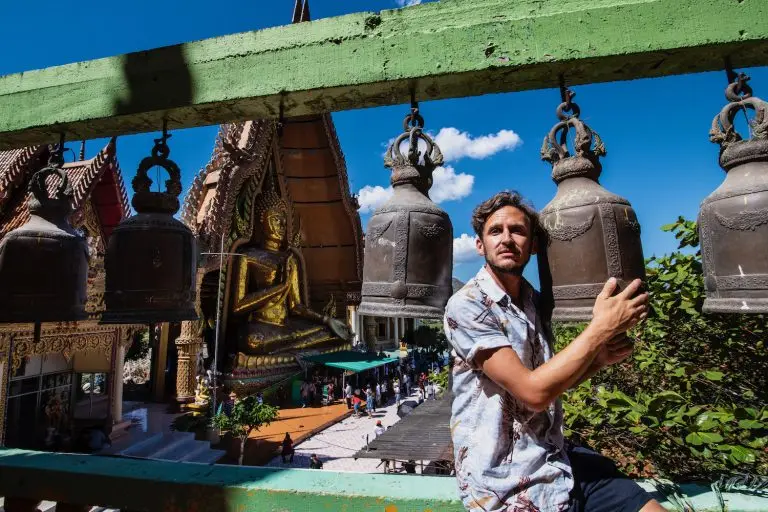
Once there, we climbed at least eight flights of stairs to the very top before realizing that a balcony on the third or fourth floor actually offered the best view. The temple's Buddha was located in a kind of artificial cave, presumably as an homage to the so-called "Tiger's Cave" below the complex. Behind the temple, the Kanchanaburi river landscape seemed to stretch endlessly.
It seemed as if the karst rocks, rice paddies, palm trees and tributaries stretched endlessly to the horizon, as if neither Bangkok nor Chiang Mai nor any places beyond it even existed.
After we had all rung the bells on the balcony, we descended through the tower. Inside were impressive murals depicting Hindu deities or Gautama Buddha, rather than the ruling Chakri dynasty of Thailand.
Once I reached the bottom, I found myself behind a queue of locals who had lined up to touch the statue's giant fingers – Prus was not among them, which made me wonder where he had gone.
After a hasty search for him proved fruitless, I began to panic slightly. Then I noticed tiny pieces of gold leaf rustling across the cheap tiles covering the floor. At that precise moment, I turned around and saw his smiling face.
I left Kyoto voluntarily, but without the necessary information or foresight to make the decision I made. Had I known that Japan would still be keeping its borders almost completely closed nearly seven months after my departure, I probably would have stayed – my visa was valid until March 30th, so for another two months.
Are abandonment fears still abandonment fears if you are the one doing the abandoning?
Before Prus and I reached Kanchanaburi, we made a stop at our third and final temple of the day. Like Wat Sampran, Wat Ban Tham is also a dragon temple, and it happened to be backlit during our visit. Unlike Wat Sampran, the climb to Wat Ban Tham requires a strenuous hike, made even more difficult by the oppressive heat and my luggage, which weighed at least 23 kilograms.
When we reached the summit, I was completely exhausted, a feeling I almost never experience otherwise, not even after much longer hikes.
At the entrance to the golden stupa, which marked the precipice, stood a statue of Bhaji. "It's as if we've arrived in hell," Prus joked, alluding to the stupa's role in Buddhist mythology. The irony was not lost on me.
On the way back, first through the cave system into which the temple builders seamlessly integrated themselves, and then through the dragon itself (which, I am pleased to report, was considerably more creatively designed than the one at Wat Sampran), I made a self-deprecating remark about my appearance.
"Don't worry," Prus assured me. "No one but me can see you – you're a ghost."
From opening the doors of the stuffy car to arriving at our guesthouse, only 15 minutes passed. While charming, it wasn't really "in town" as described in the Booking.com ad. What I liked best about our room was the open area directly behind it, planted with at least a dozen plants – a kind of wilder, more Thai-style version of a Japanese garden.
“We should have something like that here too,” Prus joked, although I knew he was basically serious.
The guesthouse was charming, but lacked comfort and space, so we decided to kill time until our sunset boat trip at a floating restaurant on the riverbank.
As I tucked into Yam Takrai, a lemongrass salad with prawns I hoped had been caught within the last 24 hours, the platform on which our table stood rocked in the wake of a passing boat. Beyond the water, the sun sank behind the palm trees that rose above the village.
“Do you think this cost a million baht?” I asked Prus, poking around with my fork in a piece of fried fish stomach.
He laughed, but said nothing. Older couples don't need to congratulate each other on remembering their bad jokes.
The boat trip made me painfully aware of how far our guesthouse was from the city center. It also humbled me – I hadn't realized how rural Kanchanaburi is. Most of the pastel-colored houses along the riverbank were private residences, not hotels; monks were sweeping the steps of the temples we passed, for themselves, not to clean for tourists who weren't going to come anyway.
“You know,” said Prus, as we approached the famous bridge on the Kwai, “there is no ‘River Kwai’. It is actually called the Khlong River.”
We sailed under the iron bridge piers, and the captain docked in the small marina on the north bank of the river. After a brief stroll through the town center – there isn't much to see there – we went up onto the bridge to find the perfect spot for a group photo.
"Get on one knee," Prus said, half-jokingly, as the camera shutter took the first of nine preset shots. I did it for him, half-seriously.
The road to Erawan National Park and the Srinakarin Dam is a 65-kilometer stretch of dead straight road, which meant that Prus and I didn't have much to do except argue about trivial things. Tensions ran high, but we never actually argued as we sped past roadside Buddha statues and dodged stray dogs that suddenly ran in front of the car.
I was obsessed with his insistence on visiting the dam instead of just the national park and the waterfall of the same name. He told me he wanted to take me there to show me all the beautiful hotels floating on the artificial lake.
I interpreted it differently. "When you decided to come here with me, I offered to book a better hotel for us," I said regretfully as we sat down on a bench overlooking the water. "I guess you now wish you hadn't refused."
“That’s not what I meant,” Prus said, putting his arm around my shoulder and kissing my head. “I just want to help you broaden your horizons.”
As you can probably guess, I also misunderstood this comment. What's the word for idleness again? Is there perhaps a Thai version with ยมบาน?
Luckily, seven cascades of waterfalls awaited us in the national park, which we could hike to – there was nothing to do for the next few hours, at least not for our bodies.
I, too, was lost in thought. Many Thais continued to wear their face masks, not only in the middle of nowhere, but some even in the water, many wearing life jackets, even though the water was less than a meter deep. It's strange that the international community considers such a blatant failure a success.
By the time we reached the seventh waterfall, I think I had declared at least the fifth and sixth stages my favorites; the fourth was unspectacular and strange; the third was beautiful, but completely unsuitable for swimming.
After reaching the seventh, Prus and I continued our hike and climbed a side path up to an even more secluded pool so we could swim, relax and enjoy time together without disturbing the peace, especially the peace of the poor souls wearing N95 respirators in the water or life jackets on land.
Prus stood in the water and held me like a baby; we looked deeply into each other's eyes. We both wanted to say something—the same thing, or at least something similar, I think—but we held back and simply enjoyed the moment.
When I returned from the waterfall, more soaked with sweat than with water from swimming itself, snow-covered Kyoto was the last thing on my mind.
When the thought finally came back to me, I didn't focus on the desire to see the lamé of Kinkaku-ji behind thick, falling snowflakes, but on the harsh reality: My six-month stay in Japan had really begun over a year ago; when I voluntarily ended it six months ago, I gave up every opportunity and expectation that my 15-month visa should have given me.
As I held Prus's hand in mine, this became all the more apparent to me: if I were still there, wandering through the Sagano bamboo grove or along the Philosopher's Path in a snowstorm, I would not feel this way now.
After returning to the car, Prus and I drove the 65-kilometer straight route back to the city, this time without any significant disagreements.
Well, apart from the fact that when we finally arrived at our destination and realized how difficult it would be to find a parking space, I was so hungry I almost got annoyed. Prus bought me two freshly fried pieces of Gai Thood to satisfy my hunger.
Finally, we strolled through the city's fresh market and bought a colorful selection of Thai specialties. Prus suggested we walk down to a temple by the water, where monks were sweeping the steps we passed, both for themselves and for us. There were no other tourists.
As we sat in the glow of the setting sun, he cracked my ankles again. I relaxed and felt what he was trying to tell me; this time I didn't scream.
Other frequently asked questions about traveling from Bangkok to Kanchanaburi
How do I get from Bangkok to Kanchanaburi?
Most travelers take a train from Thonburi Station in Bangkok (note: this is neither the main train station nor is it in the city center). From there, a train runs twice daily between Bangkok and Kanchanaburi. On weekends, a train departs from Hualampong Station and/or Bang Sue Grand Central Station and returns the same day. Alternatively, you can take a bus or minivan, or rent a car.
Is Kanchanaburi worth a visit?
Kanchanaburi is a charming destination for a weekend getaway from Bangkok, but it won't change your life. I'd recommend a visit if the opportunity arises. But if it doesn't work out, don't worry too much. Kanchanaburi isn't going anywhere.
Is there a train connection from Bangkok to Kanchanaburi?
While there are train connections between Bangkok and Kanchanaburi, the journey isn't always straightforward. Trains depart twice daily from Thonburi Station in Bangkok, located opposite the old city on the other side of the Chao Phraya River. On Saturdays and Sundays, you can also depart from stations in the city center (Hualamphong or Bang Sue), but these routes are only suitable for day trips and are inconvenient for travelers wishing to stay overnight.




Community
Comments 0
Start the conversation.