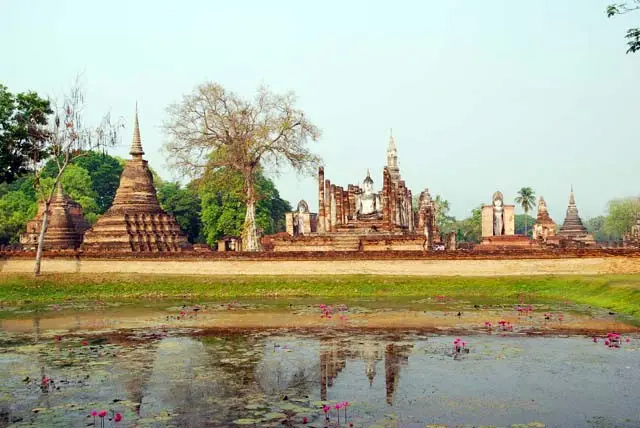
Travel journalist Julie Miller explores the World Heritage-listed ancient sites of Sukhothai in central Thailand.
When it comes to historical monuments, Thailand isn't necessarily the first place that comes to mind – Cambodia or Egypt are more likely to spring to mind. However, Thailand is home to two significant ancient sites, both UNESCO World Heritage Sites, and well worth exploring for anyone interested in history, architecture, and culture.
While the old city of Ayutthaya is often visited as part of a day trip from Bangkok, the original capital Sukhothai in central Thailand (427 kilometers from Bangkok) is, in my opinion, even more impressive, better preserved, breathtakingly beautiful and easy to reach.
Many scholars date Thailand's rise to nationhood to the Sukhothai period (mid-13th to 14th centuries). During this time, the Thai script was invented, traditions such as Loi Kratong were established, and the north and south were united – a process considered the "seedbed of Thai democracy".
The rule of the Sukhothai dynasty, whose name translates as "dawn of happiness," ended with the rise of Ayutthaya in 1378. However, the ruins that remain in the old city reflect the "golden age" of Thai history, with beautiful "lotus bud" chedis and impressive Buddha statues located in five different zones.
A popular and enjoyable way to explore the historic park is by bicycle. However, I was there in the sweltering heat before Songkran – I was already drenched in sweat just walking around and was glad to escape into an air-conditioned van! I recommend planning your visit for the cooler months of November to February – then you can truly enjoy your time there and soak up the tranquility of the place.
The most spectacular temple within the city walls (which, within an area of 2 x 1.6 km², encompass the ruins of 26 temples and a royal palace) is Wat Mahathat. It houses a seated Buddha, a rare statue of a striding Buddha, and several stupas. Another beautiful temple is the smaller Wat Sra Si, featuring a Sri Lankan-style chedi surrounded by a reflecting moat.
My favorite place in Sukhothai, however, is probably Wat Si Chum, which lies on a hillside outside the city walls. Inside is a 15-meter-high seated Buddha statue, known as the Talking Buddha. The story behind it is fascinating: To encourage his troops, the king went through a secret passage behind the statue and gave an inspirational speech, pretending it was the Buddha's own words.




Community
Comments 0
Start the conversation.