What food is Thailand famous for?

Thailand is famous for Pad Thai, Tom Yum Goong, green curry, Som Tam (green papaya salad), Massaman curry, and mango sticky rice. Closely followed by Pad Kra Pao, the stir-fried dish with holy basil that Thais eat daily for lunch, and Khao Soi, the coconut curry noodle soup from Chiang Mai. Thai cuisine combines sour, sweet, salty, and spicy flavors in a single dish and can be largely divided into four categories: Tom (soups), Yam (salads), Tam (pounded salads like Som Tam), and Kaeng (curries), in addition to the fried noodles and rice dishes adopted from Chinese chefs.

Here are 20 dishes you should know, each with its Thai name, the region it comes from, its spiciness level, the street price, and the stall or restaurant where it tastes best. The most popular versions are usually the cheapest. An authentic bowl of each in a shop that has been serving only that one dish for fifty years will cost between 40 and 150 baht.

Where to stay, starting in Bangkok

This guidebook covers two regions. Select your desired region, then your preferred location, and search by your travel dates. Filter for free cancellation if you'd like to book a room and decide later.

Open Booking.com with your travel dates · also on Expedia · Trip.com

Key facts

Legends say the price is 40–150 baht per dish.

A bowl of boat noodles costs 20–30 baht, a moo ping skewer 10–25 baht, khao soi 50–80 baht, and Thipsamai's pad thai cooked in an egg 120–150 baht. A notable exception is Jay Fai's crab omelet for 1,000–1,500 baht. A full day of good food in Bangkok costs approximately 300–600 baht.

Seasoning is negotiable, so learn a sentence.

"Pet nit noi" (a little spicy) is suitable for almost anything, "mai pet" (not spicy) is a last resort, and "pet mak" means you like it really spicy. Som Tam, Larb, and South Indian curries are typically the spiciest. Chili flakes, sugar, fish sauce with chilies, and vinegar are available on every table so you can adjust the spiciness to your liking.

The well-known shops have short opening hours.

They open when they open and close as soon as the pots are empty. The stalls in Khao Soi are usually sold out by early afternoon, On Lok Yun is a breakfast spot, and many food stalls in Bangkok are closed on Mondays. You can find the opening hours of individual establishments here. Therefore, it's best to plan your eating days from morning until midday.

Chinatown after dark – ten different dishes on a single street

Yaowarat, Bangkok's Chinatown, fills up with countless stalls from around 6 pm. At Nai Ek you can find Kuay Jab, at Jek Pui curries and grilled seafood – all just a few blocks away. A guided culinary walk is the easiest way to sample a dozen dishes on your first evening without having to spend ages deciding what to order.

The safest ones are at the busy stalls.

High turnover means fresh ingredients and dishes prepared right before your eyes – so the long queue is a guarantee of hygiene. The restaurants featured in this guide are exactly that. Take it easy for the first few days and, as always, be cautious with raw food in remote areas.

The 20 dishes at a glance

The prices listed are those of the restaurants and typical food stalls mentioned. The same dish is more expensive in tourist areas.

The 20 most famous Thai dishes

The dishes are roughly ordered by popularity, starting with those that are staples on every Thai menu abroad and ending with those that are especially popular with Thais. Each dish listing includes the corresponding restaurant, and the map below contains the opening hours and directions.

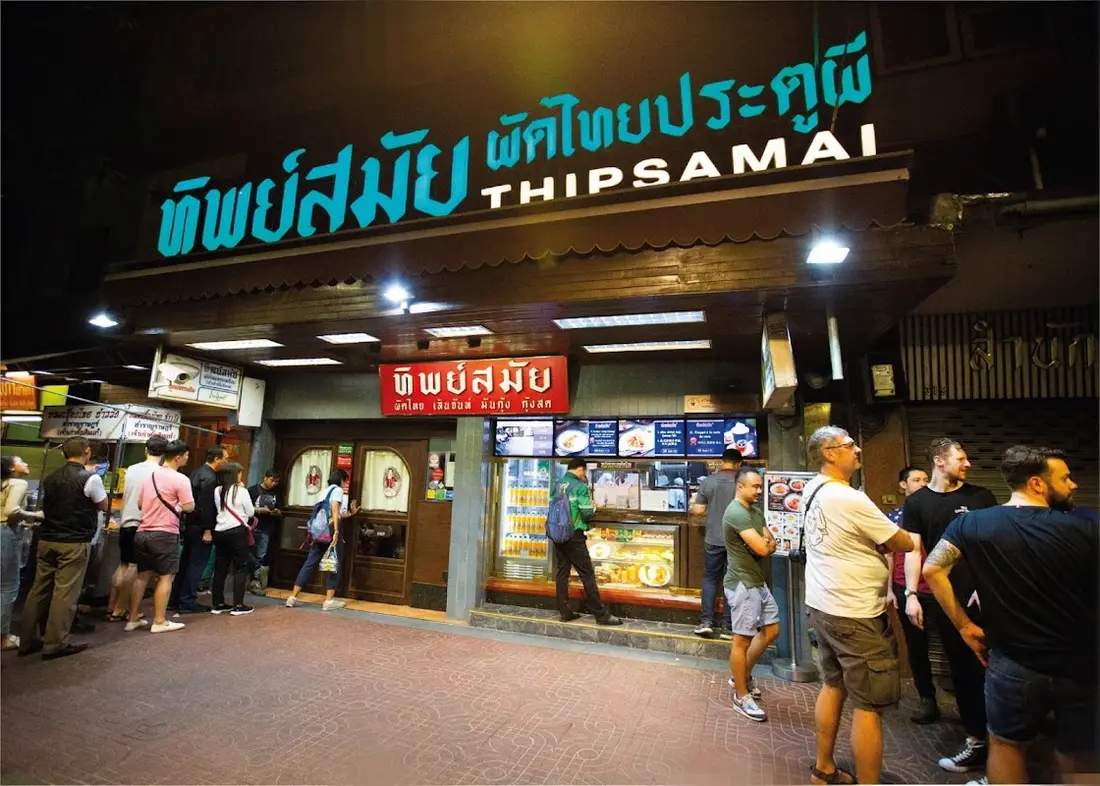
  • 1. Pad Thai (ผัดไทย), Bangkok and the Central Plains: Mild, stir-fried rice noodles with tamarind, palm sugar, fish sauce, egg, dried shrimp, tofu, and peanuts, served with lime, chili, and bean sprouts. It's the dish most often called Thailand's national dish, yet it's relatively young. The government of Prime Minister Plaek Phibunsongkhram promoted rice noodles during the rice shortage of World War II, and Pad Thai originated from this campaign. Thipsamai on Maha Chai Road has been cooking it over charcoal since 1966, and the egg-wrapped version costs 120–150 baht. Pad Thai Fai Ta Lu was awarded a Michelin Bib Gourmand for its smoky version with crispy pork, and MaeThum and Kratong Thong are the specialists for Pad Thai in the Old City and can be found on our list of the best Pad Thai in Bangkok. A street stall charges 50–80 baht. Thipsamai Padthai Pratoopee 4,2 (12,559) $$$$ Mon 9:00–12:00, Wed–Sun 9:00–12:00 Directions
  • 2. Tom Yum Goong (ต้มยำกุ้ง), Central Thailand. Hot and sour shrimp soup with lemongrass, galangal, kaffir lime leaves, chili, lime, and fish sauce. It comes in clear (Nam Sai) or creamy (Nam Khon, with condensed milk or chili paste), with the river shrimp version being the most popular. The Tom Yum noodles are iconic. Rung Rueang at Sukhumvit 26 serves the ultimate hot and sour pork soup and closes in the late afternoon. The best shrimp soup is at Mam Tom Yum Kung in Soi Kraisi near Khao San Street—the river shrimp stall made famous by a video by Mark Wiens. Rung Ruang Pork Noodles: 4.4 (9,333) $$$$ Daily 8:00 a.m.–5:00 p.m. Directions
  • 3. Green Curry (แกงเขียวหวาน), Central Thailand, medium to spicy. Kaeng Khiao Wan, literally "sweet green curry," is a dish made with coconut milk cooked with a paste of fresh green chilies, Thai eggplant, and sweet basil, usually with chicken or fish balls. It is sweet and spicy with a decent kick. Jek Pui in Chinatown is a curry and rice stall known for having chairs but no tables. Its green curry is one of the most highly praised and costs around 40 baht with rice, served by hand. For a traditional Central Thai meal, Krua Apsorn on Dinso Road is recommended. Jek Pui, 4.5 (1,946 Baht), $$$$, daily 2:00 PM–7:30 PM, Directions
  • 4. Som Tam (ส้มตำ), Isan, northeast Bangkok. Spicy. Grated green papaya is pounded in a mortar with lime, chili, garlic, fish sauce, palm sugar, tomatoes, long beans, and peanuts. It's eaten with sticky rice and usually grilled chicken and is naturally spicy. Order "Pet Nit Noi" if you don't want the Isan version. Som Tam Nua at Siam Square is considered Bangkok's benchmark, including the wait. Som Tam Der in Sala Daeng has a Michelin star and offers its entire Isan menu in English. Som Tam Jay So in an alley near Silom costs 50–80 baht per plate. Street vendors charge 40–60 baht. Som Tam Nua: 4.4 (3,639 baht) $$$$ Daily 11:00 a.m.–9:30 p.m. Directions
  • 5. Massaman Curry (แกงมัสมั่น), Southern Thailand. Mild. Slow-cooked beef or chicken with potatoes, peanuts, cardamom, cinnamon, and tamarind in coconut milk. The name comes from the Persian word for Muslim, and most sources attribute it to the Muslim cooks of the south and the ancient court of Ayutthaya. CNN ranked it number one on its list of the 50 best dishes in the world in 2011 and again in 2018. It's mild and sweet, the ideal curry for those who don't like it too spicy, and is usually served in restaurants rather than on the street. It's also the curry taught in most cooking classes—a good reason to take one.
  • 6. Pad Kra Pao (ผัดกะเพรา), spicy all over: Minced pork or chicken, briefly stir-fried with holy basil, garlic, and plenty of chili, served on rice with a crispy fried egg. This is a typical Thai lunch, available at any small shop or street stall for 50–80 baht. Order "Kai Dao" to get the egg. Every Thai has their own favorite dish, so there isn't one that's considered the best. Phed Mark, near Ekkamai, is the only restaurant that specializes exclusively in it. There, you can choose the spice level when ordering. Phed Mark 4.0 (3,392) $$$$ Daily 10:00 AM–7:00 PM Directions
  • 7. Khao Soi (ข้าวซอย), Northern Thailand. Mild to medium spicy. Egg noodles in a coconut curry broth, topped with a nest of crispy fried noodles and finished at the table with pickled mustard greens, shallots, lime, and chili oil. The dish arrived in the north with Muslim traders from Chin Haw and is believed to have originated as a Burmese noodle soup. It is hardly known outside the north, so a visit to Chiang Mai is recommended for 50–80 baht per bowl. The Michelin-starred Khao Soi Maesai is considered a hidden gem among locals and is usually sold out by the afternoon. Khao Soi Khun Yai is a lunch spot by the castle moat, Khao Soi Islam offers halal dishes, Lamduan Fa Ham is the old name on the riverbank, and Lung Prakit in Hai Ya is the restaurant where critics order the beef. Our list of the best khao soi in Chiang Mai includes all the restaurants, and two bowls a day are perfectly reasonable. Khao Soi Maesai 4.5 (6,006) $$$$ Mon.–Sat. 8:00 a.m.–4:00 p.m. Directions
  • 8. Mango Sticky Rice (ข้าวเหนียวมะม่วง), Central Thailand. Not spicy. Ripe Nam Dok Mai mango next to sticky rice soaked in salted coconut cream and sprinkled with crunchy mung beans. The fruit is in season from about March to June, when it is sweetest and cheapest, although it is available year-round. K. Panich on Tanao Road has been selling sticky rice from brass pans since 1932, about 130 baht per box, open Monday to Saturday from 7:00 a.m. Mae Varee in Thong Lo is open daily until 10:00 p.m., and Myth I satisfies late-night cravings. A cart costs 80–120 baht. Panich Sticky Rice 4,4 (3,129) $$$$ Mon.–Sat. 7:00–17:00 Directions
  • 9. Tom Kha Gai (ต้มข่าไก่), Central Thailand: Mild chicken simmered in coconut milk with galangal, lemongrass, and lime leaves, finished with lime. It contains similar herbs to Tom Yum, but the coconut milk mellows the chili's heat. Therefore, this soup is ideal for those who find Tom Yum too spicy. Thais eat it as a side dish with rice, not as an appetizer. Every good Thai restaurant offers it, and it's rarely found at street stalls.
  • 10. Pad See Ew (ผัดซีอิ๊ว), available everywhere. Mild, wide rice noodles stir-fried with dark soy sauce, egg, Chinese broccoli, and pork or chicken until the edges are slightly charred. It has a sweet, smoky flavor and is not spicy at all—a dish especially popular with children and those who don't like it too hot. Pad See Ew is available at street prices from any noodle stand that prepares the noodles fresh. Chili, sugar, and vinegar on the table are used to round out the dish in the Thai style.
  • 11. Larb (ลาบ), Isan and Northern Taiwan (spicy): A warm salad of minced meat with lime, fish sauce, chili, shallots, mint, and toasted rice flour, served with sticky rice and raw vegetables. The Isan version is sour and spicy. The northern version, Larb Muang, uses a dry spice mix instead of lime and is sometimes served raw. In Chiang Mai, Larb Duang Dee Mee Sook is a simple street food stall recommended in the MICHELIN Guide to Northern Taiwan. It is open daily from 11:00 AM to 10:00 PM, and Larb dishes cost less than 200 Baht per person. Larb Duang Dee Mee Sook, 4.7 (324), $$$$, daily 11:00 AM–10:00 PM, Directions
  • 12. Moo Ping (หมูปิ้ง), available everywhere. Not spicy. Pork marinated in garlic, coriander root, palm sugar, and coconut milk is grilled on bamboo skewers over charcoal. Served with a bag of sticky rice, it's the quintessential Thai breakfast on the way to work. Look for the smoke from street vendors early in the morning. One skewer costs 10–25 baht.
  • 13. Boat Noodles (ก๋วยเตี๋ยวเรือ), Bangkok and Ayutthaya. Medium-sized. Small bowls of rice noodles in a dark, spicy pork or beef broth, enriched with blood. Named for the boats from which they were once sold on the canals. The bowls are intentionally small (20–30 baht each) and are ordered by the stack. Boat Noodle Alley at Victory Monument is the perfect place to enjoy them. It's open daily from 9:00 a.m. to 8:30 p.m. near BTS Exits 3 and 4. At Toy Kuay Teow Ruea, you can witness the ritual of stacking the bowls. Boat Noodle Alley (Victory Monument) 4,3 (601) $$$$ Daily 9:00 a.m.–8:30 p.m. Directions
  • 14. Khao Man Gai (ข้าวมันไก่), Central Thailand. Mild Hainanese chicken rice dish, Thai style. Poached chicken on rice, cooked in chicken fat and broth, served with a cup of soup and a sauce made with ginger, garlic, and fermented beans. Go-Ang Pratunam, the shop with the staff in pink shirts, is the Michelin-starred standard at 50–70 baht per plate—the perfect quick lunch in the labyrinth of Pratunam Market. Go-Ang Pratunam Chicken Rice: 4.2 (7,216) $$$$ Daily 3:00–10:00 p.m. Directions
  • 15. Gai Yang (ไก่ย่าง), Isan, Northeast Thailand. Not spicy (only the dipping sauce is hot). Whole chicken marinated in garlic, coriander root, and pepper, slowly grilled over charcoal and then dipped in Jaew, a sauce made with dried chilies, lime, and roasted rice. Along with Som Tam and sticky rice, it's a staple of Isan cuisine. In Chiang Mai, SP Chicken in the Old City is the most popular spot. Open from 10:00 AM to 5:00 PM, cash only, under 200 baht per person, and often sold out by the afternoon. An alternative is Cherng Doi near Nimman, where you can eat in. Closed on Mondays. In Bangkok, Polo Fried Chicken at Lumpini Park offers a deep-fried version with crispy garlic. SP Chicken: 4.2 (2,237 Baht), $$$$, daily 10:00–17:00. Directions.
  • 16. Kuay Jab (ก๋วยจั๊บ), Bangkok's Chinatown: Mild, peppery, rolled rice noodles in a clear, white-peppered pork broth with crispy pork belly and offal (optional). Originating from Teochew Chinese cuisine, this dish is one of the reasons Yaowarat Street is considered the country's best food street. Nai Ek on Yaowarat Street has been serving it since 1960 and is the place to go. The nearby Guay Jub Ouan Pochana is another well-known name. Nai Ek Roll Noodle: 4.4 (4.774) $$$$ Daily 7:30 a.m.–12:30 a.m. Directions
  • 17. Khao Kha Moo (ข้าวขาหมู), available everywhere (Chinese-Thai). Mild pork knuckle, braised for hours in soy sauce and five-spice powder until the skin is tender. Sliced ​​and served with rice, a boiled egg, pickled mustard greens, and a tangy chili-vinegar sauce. There's a stall at every market in the country. The most famous is the "Cowboy Hat Lady's" stall at the night market by Chang Phueak Gate in Chiang Mai, open daily from 5:00 PM to midnight, under 200 baht per plate. Use the sauce and pickled vegetables. Khao Kha Moo Chang Phueak 4.2 (1,918) $$$$ Daily 5:00 PM–Midnight. Directions
  • 18. Crab Omelet (ไข่เจียวปู), Bangkok. Not spicy. An egg is deep-fried around a mound of crab meat until crispy on the outside and tender on the inside. A simple Thai omelet with rice, kai jeow, is an inexpensive everyday dish. The crab version is something special. Raan Jay Fai is the only global superstar of the street food scene. The ski-goggle-wearing chef has a Michelin-starred crab omelet that costs 1,000–1,500 baht from Wednesday to Saturday, with long wait times. Krua Apsorn on Dinso Road offers the acclaimed alternative at a fraction of the price, along with pan-fried crab meat in yellow chili sauce. Krua Apsorn 4.3 (3,923) $$$$ Daily 10:30 a.m.–8:30 p.m. Directions
  • 19. Kua Kling (คั่วกลิ้ง), Southern Thailand. Very spicy. Minced pork or beef is dry-fried with southern Thai curry paste, turmeric, and kaffir lime leaves until no sauce remains, only heat. Southern Thailand boasts the hottest dishes in the country, and Kua Kling, along with Gaeng Som, a sour curry, are prime examples. Raya, located in a two-story wooden house in Phuket's Old Town, is the ideal place to try both. Since there's no air conditioning, a visit after dark is recommended. Nearby is One Chun, which has been awarded a Michelin Bib Gourmand for its yellow curry with crab and noodles. Raya Restaurant, 4.4 (3,453), $$$$, daily 10:30 a.m.–10:00 p.m. Directions.
  • 20. Kua gai (ก๋วยเตี๋ยวคั่วไก่), Bangkok: Mild, wide rice noodles stir-fried in a very hot wok with chicken and egg until the edges are crispy and slightly charred. This Bangkok dish is often unknown to travelers. Ann Guay Tiew Kua Gai on Luang Road, between the Old City and Chinatown, serves only this dish. A plate costs around 60 baht, and the restaurant has been awarded a Michelin Bib Gourmand. It is open daily from 2:00 p.m. to 11:00 p.m., making it ideal for an early dinner before a stroll through Yaowarat. Ann Guay Tiew Kua Gai, 4.4 (2,814), $$$$, daily 2:00 p.m.–11:00 p.m., Directions
  • Thai cuisine by region

    Thailand's four regions boast distinct culinary traditions, and its famous dishes can be easily categorized by origin. Knowing a dish's region of origin helps you pinpoint the best version. If you're struggling to choose a destination, the guidebook "The Best Places to Eat in Thailand" offers a ranking of cities to help you.

    The north, around Chiang Mai

    Less sweet, less coconut, more herbs, smoky aromas, and pork. Khao Soi is the main attraction, and the menu also features Sai Ua (herb sausage), Nam Prik Noom (green chili dip with pork crust), Hang Lay (a Burmese pork curry), and Larb Muang. Huen Phen, near Wat Phra Singh, has been considered the benchmark for northern Thai cuisine in the old city for decades, and the list of the best Thai restaurants in Chiang Mai includes the other restaurants.

    Isan, the northeast

    Som Tam, Larb, Gai Yang, and Nam Tok (grilled meat salad) are among Thailand's spiciest and most sour dishes, traditionally eaten by hand with sticky rice. Originating in the Isan region, they were brought to all major cities by local chefs. In Bangkok, Som Tam Nua and Som Tam Der are the most famous Isan dishes.

    The center and Bangkok

    The cuisine most people worldwide know as Thai food is richer and sweeter, featuring coconut curries, Tom Yum, Pad Thai, and mango sticky rice. Bangkok adds a strong Sino-Thai influence, with dishes like Kuay Jab, Khao Man Gai, Khao Kha Moo, wonton noodles, and Wattana Panich's beef broth in Ekkamai, which has been simmering for half a century. These are featured on lists of Bangkok's best street food stalls.

    The south and Phuket

    Turmeric, fresh chilies, seafood, and the hottest spice in the country, with Malay and Muslim influences in Massaman and Roti. Phuket Old Town offers its own Hokkien-Chinese dishes, and Tu Kab Khao on Phangnga Road serves Phuket pork stew and crab fried rice in a restored, century-old building. The list of the best restaurants in Phuket covers the entire island.

    How to order Thai food

    Thais eat with a fork and spoon, using the fork to push the food onto the spoon. Chopsticks are used for noodle soups. Sticky rice is eaten with the hands, rolled into a ball, and used to scoop up Som Tam or Larb. Dishes are shared and served as soon as they are ready, so it's better to order several portions for the table rather than just one per person.

    In a one-dish shop, you order the dish on the sign. Specialization is the key to Thai street food, and a shop that's been serving Kuay Jab for sixty years doesn't need to cook anything else. At a curry and rice stand, you simply point to the trays – one or two curries with rice, that's it.

    The spiciness level ranges from "mai pet" (not spicy) to "pet nit noi" (mildly spicy) to "pet mak" (very spicy). Even "mai pet" Som Tam can still be quite spicy. If a dish is too hot, rice is more effective than water.

    Vegetarians should ask for "Jay" dishes. These are Thai Buddhist dishes without meat, fish sauce, or other animal products. Stalls offering these dishes can be identified by yellow flags with red lettering.

    Learn how to prepare them.

    Curry dishes are among the most difficult to prepare well at home, yet easiest to learn in a single morning. A half-day cooking class often begins at a market and includes making curry paste from scratch, a soup, a stir-fry, and mango sticky rice. Cooking classes in Chiang Mai are known for their courses on farms outside the city, while those in Bangkok are known for their market tours in the city center. Lists of the best cooking classes in Bangkok and Chiang Mai compare these.

    Other restaurants in Bangkok

    Here's a shark.

    Wattana panic

    Polo Fried Chicken

    On Lok Yun

    The best hotels in Bangkok

    My hotel selection in Bangkok in every price category, based on Google's hotel rating system. My top 10 hotels are displayed first, followed by the highest-rated ones. Each button takes you directly to the hotel's page on Booking.com, where your travel dates are already entered.

  • #1 Luxury · 5-Star Millennium Hilton Bangkok 4.6 (12,976 reviews) Upscale hotel directly on the banks of the Chao Phraya River with excellent service and breathtaking river views. Check prices
  • #8 Mid-range · 4 stars · Centara Watergate Pavilion Hotel Bangkok · 4.5 (4,456 reviews) · Elegant hotel in Bangkok with spacious rooms, rooftop bar, spa, and unbeatable location near top-notch shopping. Check prices
  • Affordable · 3 stars · Old Capital Bike Inn · 4.9 (386 reviews) · Check prices
  • More Khao Soi in Chiang Mai

    Khao Soi Khun Yai

    Khao Soi Lung Prakit Kad Kom

    Khao Soi Islam

    Khao Soi Lamduan Fa Ham

    The best hotels in Chiang Mai

    My hotel selection in Chiang Mai in every price category, based on Google's hotel rating system. My top 10 hotels are displayed first, followed by the highest-rated ones. Each button takes you directly to the hotel's page on Booking.com, where you've already entered your travel dates.

  • #1 Luxury · 5-Star Shangri-La Chiang Mai 4.6 (4,289 reviews) Upscale hotel near Chiang Mai's Night Bazaar with spacious rooms, pool, spa, and Sichuan cuisine. Check prices
  • #3 Mid-range · 4 stars · U Chiang Mai Hotel 4.8 (2,000 reviews) · Chic boutique hotel on Rachadamnoen Road with fitness center, European bistro, and open-air bar. Check prices
  • #9 Budget · 3-Star Cross Chiang Mai Riverside 4.8 (994 reviews) A boutique riverside resort in Chiang Mai with stylish rooms, a spa, a pool, and fine dining. Check prices
  • Frequently Asked Questions

    Frequently asked questions about the 20 famous Thai dishes to try and where to eat them.

    Pad Thai, Tom Yum Goong, green curry, Som Tam (green papaya salad), Massaman curry, and mango sticky rice are the dishes for which Thailand is known abroad. Within Thailand itself, Pad Kra Pao (fried rice with holy basil), Khao Soi (Northern Thai curry noodles), boat noodles, and Khao Man Gai (chicken rice) are equally popular and often rated even higher by travelers.

    Bangkok offers the largest and most diverse selection, as all regional cuisines are represented here. Those wishing to experience the cuisine of a particular region in all its glory should travel to Chiang Mai to try Khao Soi and Northern Thai cuisine, to Phuket's Old Town to enjoy Phuket Chinese dishes like Moo Hong, or to the cities of the Isan region to sample Som Tam, Larb, and grilled chicken. The guidebook "The Best Places to Eat in Thailand" lists these.

    Pad Thai is the usual answer. The government of Prime Minister Plaek Phibunsongkhram promoted rice noodles during the rice shortage of World War II, and Pad Thai became a national dish as a result of this campaign. Tom Yum Goong is another dish often given this title, and many Thais would call it Pad Kra Pao, as it's what the country eats daily.

    Pad Thai, Tom Yum Goong, Green Curry, Som Tam, Massaman Curry, Pad Kra Pao, Khao Soi, Mango Sticky Rice, Tom Kha Gai and Pad See Ew. Larb, Moo Ping, Boat Noodles and Khao Man Gai complete the list with twenty more dishes in this guidebook.

    Abroad, people eat Pad Thai. In Thailand, however, you order Pad Kra Pao, stir-fried minced meat (pork or chicken) with Thai basil and chili, served with rice and a fried egg. It's the standard order at every food stall in the country and costs 50–80 baht.

    South Indian dishes like Kua Kling (dry-fried minced meat in curry sauce) and Gaeng Tai Pla, as well as Isan dishes like Som Tam and Larb, are ordered as locals would eat them. Order "Pet Mak" if you like it really spicy, or "Pet Nit Noi" for a milder version.

    Pad Thai, Pad See Ew, Khao Man Gai, Kuay Jab, Khao Kha Moo, Massaman Curry, Tom Kha Gai, Moo Ping, Gai Yang, and Mango Sticky Rice are all mild or not spicy at all. For all other dishes, please say "Mai Pet" (not spicy) when ordering.

    Both dishes contain lemongrass, galangal, and lime leaves. Tom Yum is a hot and sour broth, usually with shrimp. Tom Kha is made with coconut milk and typically chicken, making it creamier and much milder.

    Yes, in a word. Ask for "Jay" food, Thai Buddhist cuisine without meat, fish sauce, or other animal products. Stalls offering it will have yellow flags with red lettering. Elsewhere, fish sauce and shrimp paste are added to most dishes, so a meatless curry isn't vegetarian unless you specifically ask for it.

    A typical dish from a street stall or small shop costs 40–150 baht, and most of the legendary restaurants in this guidebook charge exactly that price. A bowl of boat noodles costs 20–30 baht, and Khao Soi 50–80 baht. A full day of good food in Bangkok will set you back about 300–600 baht. The notable exception is Jay Fai's Michelin-starred prawn omelet, which costs 1,000–1,500 baht.

    Generally speaking, yes, with one rule: eat where the locals are queuing. High turnover means fresh ingredients and hot woks, and by that measure, the famous stalls in this guidebook are the safest food stalls in the country. Enjoy dishes prepared right before your eyes and take it easy for the first few days.

    Thipsamai on Maha Chai Road, where they've been cooking over charcoal since 1966, is the classic answer, and the egg-wrapped version costs 120–150 baht. Pad Thai Fai Ta Lu was awarded a Michelin Bib Gourmand for its smoky version with crispy pork, and Baan Phadthai in Charoenkrung offers the upscale version with river prawns.

    The curry noodle soup from northern Thailand consists of egg noodles in a coconut curry broth, garnished with crispy fried noodles and pickled mustard greens, shallots, and lime. Try it in Chiang Mai for 50–80 baht per bowl. Khao Soi Maesai, Khao Soi Khun Yai, and Khao Soi Islam are the three most popular spots.

    Most would say yes to this once-in-a-lifetime experience. The crab omelet is a veritable crab torpedo encased in a crispy eggshell, and watching the cook, wearing protective goggles, handle her charcoal woks is a true Bangkok spectacle. Expect to pay 1,000–1,500 baht for the omelet and be prepared for a long wait; it's only available from Wednesday to Saturday. For those wanting to enjoy the same dish at a fraction of the price, Krua Apsorn is a highly recommended alternative.

    Where you can stay during your trip

    Start with Bangkok (see below) – this guide also covers Chiang Mai; everything can be researched on the respective booking sites.

  • Compare prices on different websites.
  • Filter for free cancellation
  • Secure checkout on the partner site
  • Compare prices on Booking.com

    Compare prices on Trip.com

    We may receive a commission for bookings made through these links – this will not incur any additional costs for you. Learn more.

    Discover more in this guide

    You might also like this

    2-week Thailand itinerary

    Capital city, night train, mountains, then along the Andaman coast island by island – thirteen nights, one way.

    7 days in Thailand

    Capital city, mountains, islands – six nights, two short flights and not a single day was lost to the journey.

    10 days in Thailand – Itinerary

    Capital city, night train, mountains, then ferry to the Andaman coast – nine nights, one way, no return.

    Thailand Honeymoon Guide and 10-Day Itinerary

    Villas with private pools, sunsets in a longtail boat, and evenings perfect for two.

    Thailand on a budget

    Thailand for less money, without sacrificing the best

    I lived in Bangkok for four years and traveled throughout the country from there. The guidebooks reflect my personal opinion and are written as I would explain things to a friend planning a trip.

    Ready to create your travel itinerary?

    Use our free trip planner to save places, organize days, and share your trip.