Following the 2018 Annual General Meeting of the Australian Travel Journalists Association in Bangkok, travel journalist Rhonda Bannister embarked on a three-day trip to the western provinces of Thailand. She explored Kanchanaburi and returned via the estuary province of Samut Songkhram, where she discovered places to experience life like the locals. Here is an excerpt from her article, which appeared in "Holidays for Couples".
The Mae Klong River originates in Kanchanaburi, the gateway to Thailand's Wild West, at the confluence of the Khwae Noi and Khwae Yai rivers. The region boasts untamed wilderness, jungle-covered mountains, and rushing rivers, making it an ideal base for exploring the numerous attractions in the surrounding area. However, the region also has a dark past, vividly depicted in Pierre Boulle's novel "The Bridge on the River Kwai" (1952). David Lean adapted the novel into a film of the same name in 1957.
During World War II, Japanese forces forced Allied prisoners of war to build a railway line from Thailand to Burma. The route wound through dense jungle and along steep riverbanks. Around 16,000 prisoners of war died under unimaginable cruelty while being forced to construct the 400-kilometer railway. The backbreaking work began in Kanchanaburi. Therefore, upon arrival, we do what all visitors do: we pay our respects to the fallen at the Commonwealth War Cemetery, where the remains of nearly 7,000 British, Dutch, and Australian soldiers rest, before crossing the infamous steel bridge.
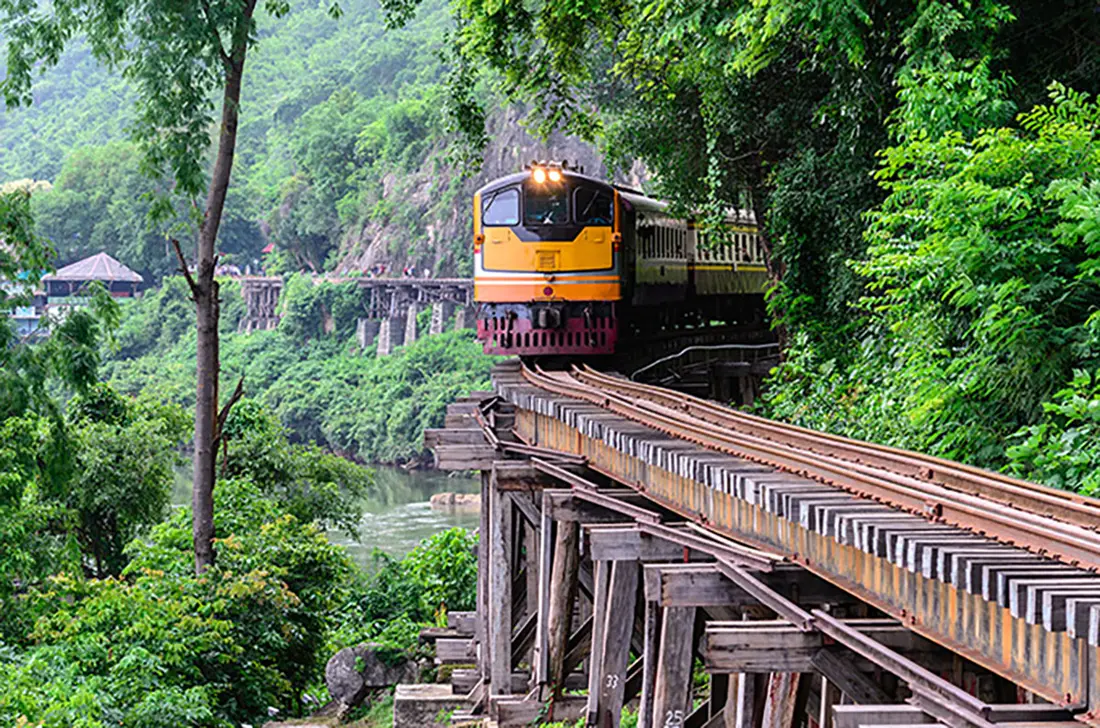
We then take the train, which departs from Bangkok three times a day and continues along the Death Railway. The route takes us through narrow rock passages before we reach the Wampo Viaduct. It's a breathtaking experience, especially when combined with visiting Hellfire Pass the following morning (it's difficult to do everything in one day). But I think it's a trip every Australian visiting Thailand should take at least once to understand the immense privileges we enjoy thanks to the sacrifices of these brave young men.
Kanchanaburi (a two-hour drive northwest of Bangkok) is definitely worth a longer stay, with so much to see and do, and a wide range of accommodation options – from backpacker rooms to luxury hotels. Those who enjoy the thrill of being on a river should look out for one of the floating hotels along the banks. Water sports include bamboo rafting, fishing, kayaking, canoeing, and a river water park for all ages. Adventurers and animal lovers will adore the scenic hiking trails, lush native forest, and native wildlife (including langurs) of Erawan National Park. You can easily spend a whole day here hiking through the jungle and swimming under Erawan Falls. The seven-tiered waterfall, with a natural pool at each level, is a truly spectacular sight.
Anyone who has ever wanted to get up close to an elephant can fulfill this dream ethically at Elephants World. This sanctuary for older elephants, whose years of work and mistreatment are now over, is a welcome alternative to other animal encounters. We spend a wonderful afternoon cutting banana grass for their dinner before "helping" these majestic and playful animals bathe in the river. Although they don't actually need any help, the elephants graciously allow us to brush off the mud and splash them with water. In short: A must-see!
Read Rhonda's full article here.




Community
Comments 0
Start the conversation.