Bangkok sometimes feels like the Thai version of a Russian babushka doll. It opens up, revealing neighborhoods within villages, villages within cities, and cities within the great City of Angels. John Borthwick takes us on a profound journey of discovery…
Bangkok's largest city within a city by far is Yaowarat, supposedly the oldest, if not the largest, Chinatown in the world. To explore this complex place in more detail, I'm taking part in a guided tour with Urban Adventures entitled "Chinatown: Sights and Culinary Delights".
We begin our tour at Wat Traimit, the Temple of the Golden Buddha, the most visited attraction in Chinatown. There stands a colossal, five-meter-high, 5.5-ton Buddha statue, made almost entirely of gold. Our guide, Khun Ae, proves to be a tireless storyteller as he recounts an adventurous legend about the Buddha statue's loss in the 13th century (centuries ago), its discovery (by whom?), its concealment (under stucco), its displacement (by a flood), its rediscovery (by chance), its revelation (by chance), and finally its relocation here to Chinatown.
We stroll through a labyrinth of side streets, from which wafts the aroma of spicy, steaming stir-fried vegetables, filling our lungs, eyes, and appetites. Khun Ae leads us through a narrow alley, its painted doors opening onto tiny houses, to a small restaurant with only three tables. He orders bowls of Tom Sap, a spicy Thai-Laotian soup with pork, ginger, galangal, and lemongrass. I leave only my spoon in my bowl.
With a fresh battery, we soon find ourselves in the unassuming Soi Phat Sai, where the Easae teahouse, owned by the same Thai-Chinese family for four generations, has been serving traditional teas since 1927. We take a seat at old round tables, thus upholding both old and new traditions. An abacus lies next to the cash register, the Wi-Fi password is prominently displayed on the wall, and as foreigners, we stand out but fit perfectly into the scene.
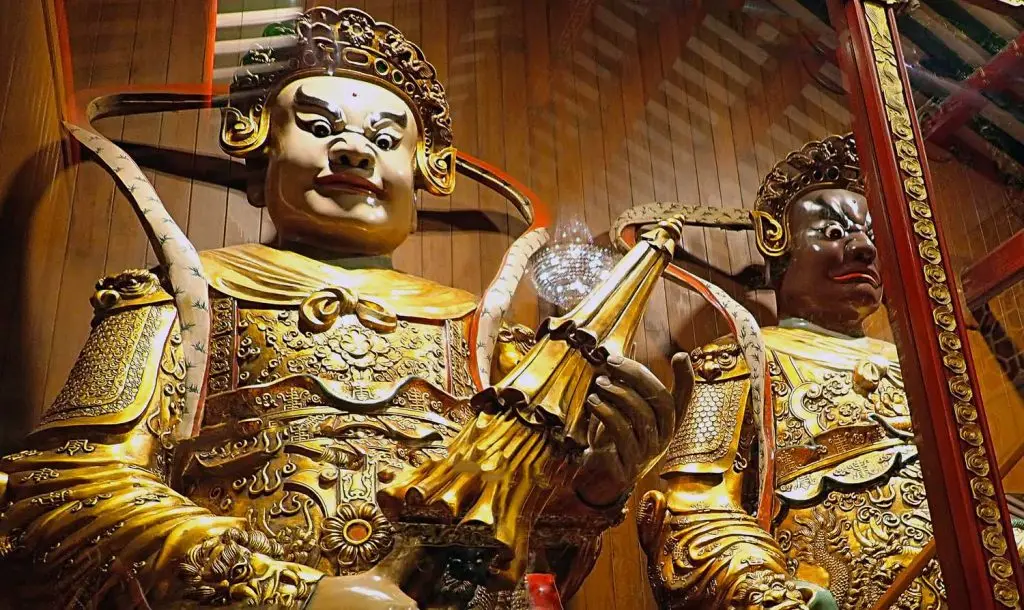
We continue on to Bangkok's largest and most important Chinese shrine, the Dragon Lotus Temple Wat Mangkon Kamalawat, built in 1871. Under the grim gaze of the giant warrior statues with their bulging eyes, members of the city's Chinese community gather to earn merit at the temple's incense-draped altars and then have their fortunes told.
We emerge from a side street and suddenly find ourselves on Chinatown's famous main thoroughfare, Yaowarat Road – a wide, neon-lit avenue bustling with activity, from bustling businesses to bustling food vendors. In Feng Shui, Yaowarat is considered a "Golden Dragon area" – the ideal place to make a few baht or dollars. Or better yet, a million. If Chinatown is a golden dragon, then this is its jewel-encrusted spine.
Alongside pharmacies, goldsmiths, and alleyways straight out of a Blade Runner movie, we enjoy delicious skewers of grilled pork and chicken, fresh from a street vendor's stall. Exoticism aside, bustling Yaowarat is the heart of the flourishing Thai-Chinese economy and, in reality, revolves much more around finance and trade than the oriental charm of its streets.
I can't eat another bite, but I don't mind, because we're leaving Yaowarat's endless feasting behind. Our goal is mojitos, not food. At the venerable Grand China Hotel, we take the elevator and then follow Ae up a narrow staircase to a little-known rooftop bar whose real attraction is the view of the sunset over the Bangkok skyline. In a city with a dozen soaring sky bars boasting 360-degree panoramic views and countless trendy bartenders, the Grand China's lesser-known bar is, to put it mildly, only half as glamorous—but delightful nonetheless. Half the height (23rd floor), half the view (only 180 degrees), and half the price of drinks, it's perhaps twice as enjoyable.
Community
Comments 0
Start the conversation.