Nakhon Si Thammarat is famous for its shadow puppetry, called Nang Thalung. The puppets are carved from buffalo hide and then intricately sculpted into figures from Thai dramas. Performances are becoming increasingly rare, but puppeteer Suchart Subsin works tirelessly to keep this ancient folk art alive.
Suchart has made Nakhon Si Thammarat a center of puppetry, and as such it is becoming a popular destination for foreign and domestic tourists.
Shadow puppetry has evolved from simple figures to detailed and colorful performances. It serves as a form of entertainment that reflects the spirit of the times and is full of humor and vibrancy. It is especially popular at festivals and birthdays. The tradition of shadow puppetry dates back centuries and is widespread in many countries, including Egypt, Turkey, Greece, Indonesia, Malaysia, and Thailand. The history of puppetry is rooted in Hinduism. Shadow puppet shows are highly entertaining and a true delight.
There are several characters, each with a distinctive silhouette, all of whom rely on humor. During the performance, the puppets are positioned behind a white curtain, which is backlit, creating a beautiful silhouette. The puppeteer alone narrates the story while manipulating the puppets. Therefore, he needs a wide vocal range and excellent storytelling skills. Drums, gongs, and symbols enhance the performance.
The production of shadow puppets is a lengthy process requiring considerable skill. A treated cowhide is dried on a frame for three days. Once the leather has hardened, a design is drawn onto it. The motifs can range from figures to animals, often used for home decoration. The design is then carved out using small hand tools. Carving the leather demands patience, skill, and a great deal of time. Depending on the level of detail in the design, the carving can take hours or even months.
The skin is then painted black, green, red, and yellow. Bamboo sticks are attached to the dolls to control their movements. The dolls are sold at various markets and festivals and used in performances or for home decoration. They make excellent souvenirs.
Mr. Subsin wants to keep the history of shadow puppetry alive in his home. It houses numerous shadow puppets from all over the world, some up to 200 years old, as well as more recent pieces. He showcases the evolution of artistic design and coloring. His museum contains puppets from around the globe. He promotes local tourism by also displaying a variety of agricultural implements. Furthermore, he is involved in media outreach and the fight against AIDS and malaria.
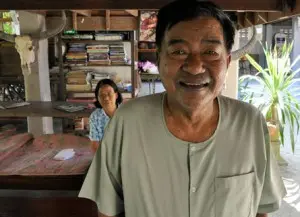
Mr. Suchart Subsin, the puppeteer
Suchart Subsin was born on July 2, 1938, in Tha Sala district. After completing his primary education, he began to study and develop an interest in shadow puppetry, or Nang Thalung.
He learned both how to make and operate shadow puppets. At the age of 16, he used his knowledge and began performing the characters he had created. Suchart soon gained renown as a shadow puppeteer and puppet maker, particularly in the southern United States.
He also had numerous opportunities to travel abroad, showcase his art, and learn from other cultures. He is a professional artist and is considered the best in Thailand. He has received many awards for his exceptional talent.
In 1985, Mr. Subsin had the opportunity to perform before His Majesty King Bhumibol Adulyadej at the Thaksin Ratchantvesha Palace. His Majesty the King repeatedly and warmly thanked him for his contribution to keeping this ancient folk art alive in modern times.
Suchart passed on the art of shadow puppetry with enthusiasm and pride to his children and the people of southern Thailand.
Inspired by the words of His Majesty the King, Mr. Subsin has opened his house and museum at 110/18 Si Thammasok, Nakhon Si Thammarat to the many people interested in puppetry, hoping that the entertaining Nang Talung tradition will not be lost.
Ban Nang Talung is about a ten-minute walk from Wat Phra Mahathat. It is a unique and beautiful museum dedicated to the history of shadow puppetry, housing shadow puppets from around the world. The museum and Mr. Subsin's residence are located on the same grounds. Just at the entrance to the museum grounds, you'll find a small, one-story building where the puppet-making process is demonstrated, along with a souvenir shop and a donation box. The museum itself consists of two buildings. The first is a wooden house on stilts. Upstairs, you'll find shadow puppets, including a rare 200-year-old puppet, as well as puppets from neighboring countries such as China, India, Indonesia, Malaysia, and Turkey.
Besides shadow puppets, Mr. Suchart also collects iron tools and knives. Wherever he appears, he asks the locals about interesting antiques in their area and buys them if they meet his interests.
In the museum you will discover the following:
The Muslim drum was made from water buffalo hide and the wood of a sugar plum tree. Water buffalo hide is very hard. Muslims used the drum to call people to gatherings or prayer times, as there were no loudspeakers in those days.
– Musical instruments used in shadow puppet performances. There are a total of 7 different instruments.
– A lantern that was used in the past, before the invention of electric light, to create shadows on the canvas.
– Dolls over 200 years old, presumably originating from Nakhon Si Thammarat. All of these dolls depict giants.
– Puppets from the time of the Second World War. The puppets are small because the screen was also small. The puppeteer had to be careful of bombing raids and could not use a sound system.
Pramotai puppets originate from Isaan, in northeastern Thailand. They were very popular during the reign of King Rama VI. The performances served both educational and entertainment purposes and were extremely popular with children. The people of Isaan call shadow puppet shows "pramotai." Pramotai puppets emerged after the funeral of King Rama V and spread throughout Isaan.
Wayong Kulae is the Malay term for shadow puppetry, used by Thai Muslims. The Chawa-influenced puppets are used in the Rammakien story, while the Thai-influenced puppets exhibit characteristics of Thai Muslims from southern Thailand to Malaysia.
– Puppets from Central Thailand. We don't know exactly when the shadow puppet shows originated, but they were developed based on puppets from the south during the reigns of King Rama IV and V in the Rattanakosin Kingdom. The Rammakien story is a popular performance in Central Thailand. The puppets are made from cowhide.
The second building is also a wooden house on stilts, displaying household items, tools, basketry, and knives. The exhibits are presented without descriptions. This is intentional, as the owner prefers that visitors ask him or other family members for more detailed explanations. In addition, a play is performed for visitors in a small theater, with Mr. Suchart providing the voice. The performance, enriched with contemporary anecdotes and humor, offers excellent entertainment.
The museum is family-run: Mr. Wathi and his son, a lecturer in art and culture, coordinate and manage it. Public relations efforts are very successful, as the museum also attracts international visitors. Therefore, the museum's promotional brochures are written in English to facilitate their understanding of the shadow puppetry.
Suchart Subsin, a renowned master of shadow puppetry, said: “I fear that shadow puppetry will disappear from our culture. The stories in my shadow plays are diverse and contemporary, in order to appeal to people and preserve this art form. The performances vary depending on the target audience.”
Visit Mr. Suchart Subsin and discover the history of a unique art form in his museum, located at the following address:
Ban Nang Thalung Suchart Subsin 110/18 Si Thammasok, Soi 3 Nakron Si Thammarat 80000 Thailand Tel. 66 75 346 394
Award for Most Outstanding Achievement – Best Cultural and Tourist Attraction – Thailand Tourism Awards
Community
Comments 0
Start the conversation.