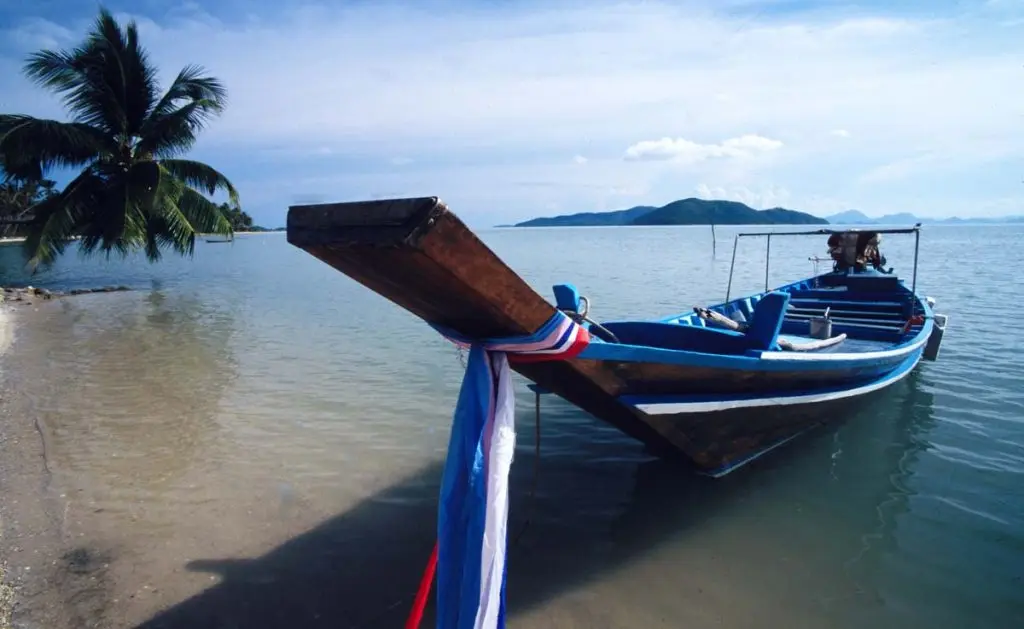
Thailand has hundreds of islands. Guest author John Borthwick focuses on the islands in the beautiful Gulf of Thailand and embarks on an island-hopping tour.
Koh Chang (Elephant Island) is the second largest island in the kingdom, and despite its growing popularity, it still boasts plenty of jungle and sandy coves. The white sand beach (Hat Sai Khao) is the ideal spot for a relaxing holiday filled with seafood, romance, and braided hairstyles, while places like Bang Bao and Klong Prao offer a more authentic, local atmosphere.
Much of the west coast has been rapidly and recklessly developed. Those seeking peace and relaxation will find a suitable alternative in Koh Chang National Park with its 47 islands, even though most of them don't offer accommodation. Koh Chang, on the other hand, attracts visitors with good restaurants, affordable shopping, and a wide range of massage options.
Koh Kood, in the far east of the Koh Chang archipelago, is Thailand's fourth largest island. While the selection of resorts is limited, the quality is good, including Cham's House, Peter Pan, and Soneva Kiri (pure luxury, no oxygen required). On Koh Kood, the beaches aren't overrun with beach bars and umbrellas, and the taxis aren't frequented by touts. The waters off the coast offer excellent diving and snorkeling, and there's also the option of kayaking on the river. Generally speaking, there isn't a great deal to do on the pristine, jungle-covered Koh Kood for visitors seeking a more tranquil experience.
Koh Phangan, 15 km north of Koh Samui, was once primarily known for its full moon parties on Hat Rin Beach. Then came the half moon and new moon parties. Subsequently, numerous, increasingly luxurious resorts have transformed the island into more than just a backpacker destination. There are now several hundred accommodations, ranging from bungalows to luxurious pool suites. "Try to avoid Hat Rin. It's about as much a part of Koh Phangan as Bangkok is of Thailand," one blogger wisely advises. Other beaches on Koh Phangan, such as Hat Mae, Hat Yao, and Hat Sadet, still offer the relaxed siesta you've always dreamed of.
Koh Samet, just a half-day drive southeast of Bangkok, might lead you to expect it to be overcrowded and overrun with tourists. However, the opposite is true: this forested national park island off Rayong still offers tranquil beaches and a pleasantly relaxed tourist atmosphere. Most accommodations are in bungalow resorts, alongside a selection of upscale hotels. Leisure activities include beach walks, dining on the sand (with fire dancers), and swimming. During the week, the atmosphere is laid-back, while weekends are a bit livelier with those seeking to escape Bangkok. Samet (also called Ko Samed) embodies a typical Thai contradiction: it is both a protected national park and densely populated with resorts, particularly along the eastern beaches like Hat Sai Kaew.
Koh Samui welcomed its first tourists 50 years ago. Since there was no accommodation, they had to stay in a temple. Today, this tourist magnet in the western part of the Gulf (off Surat Thani) receives millions of visitors annually.
The island's development has two sides: on the one hand, the vibrant bar and club districts along the beaches of Chaweng and Lamai, and on the other, a growing number of exclusive resorts. Tex-Mex restaurants, Swiss pubs, and dive schools confirm that you are in modern Thailand. Yet the rugged jungle interior and the coastal beaches on the west coast (most beautiful at high tide) offer true havens of tranquility on this 25-kilometer-long island.
Koh Si Chang, 120 km from Bangkok, was a favorite retreat of the Siamese royal family in the 19th century. Today, you can stroll through the beautiful, terraced parklands surrounding the former Chudhadhuj Rajthan Palace. Despite its proximity to Bangkok, there are no ostentatious resorts here. Si Chang has remained untouched by mass tourism thanks to its few spectacular beaches. Since there are no cars, it's recommended to rent a motorbike and explore the rugged island. Visit the white Buddha Footprint Temple, which offers stunning views of the island and the sea. Enjoy a meal or coffee in town, or a beer at sunset from the Chong Khao Khad viewpoint.
Koh Talu, in the southwest of the Gulf of Bangkok, boasts a single resort, pristine sandy beaches, countless palm trees, and no garish neon lights. The 1,500-hectare island lies on the "sunrise side" of the Gulf, 370 km south of Bangkok. The comfortable, Thai-style bungalows of the Koh Talu Island Resort offer breathtaking views of the long, white sandy beach of Big Bay and the smaller, idyllic Ao Muk (Pearl Bay). Activities include snorkeling, kayaking, bush walks, and relaxing cocktails. Access is via a 160 km train or car ride from Hua Hin to Bang Saphan, followed by a ferry ride to the island.
Koh Tao (Turtle Island), 45 km north of Koh Samui, is considered the largest diving training center in Southeast Asia. The numerous reefs, the diverse underwater world, and the excellent visibility have made this diver's paradise highly regarded by both travel guides and hotel operators. Compared to the larger and more sophisticated Koh Samui, the accommodations on the tiny (21 km²) island of Koh Tao are rather basic and in the mid-price range – which suits the needs of adventurous backpackers. The real attraction, however, lies underwater. Even from the often crowded beach, beautiful coral reefs are easily accessible.
Text and photos © John Borthwick 2020
Community
Comments 0
Start the conversation.