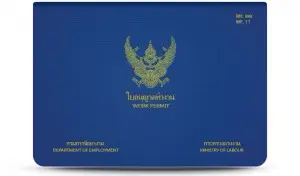
If you are a foreigner working in Thailand, a Thai work permit is essential. In fact, it is illegal to work in Thailand without a work permit. Both employers and employees should therefore be well-informed about the applicable regulations.
Taiguo.Source date 4 min read
Adapted from ThaiEmbassy.com (Siam Legal). Any first-person experiences in this article belong to the original author.
If you are a foreigner working in Thailand, a Thai work permit is essential. In fact, it is illegal to work in Thailand without a work permit. Both employers and employees should therefore thoroughly familiarize themselves with the application and administrative procedures for obtaining a work permit.
First, you need a non-immigrant visa before you can apply for a work permit. A Thai work permit can be granted to foreigners who meet one or most of the following conditions:
Employment will take place in a company with a minimum share capital of 2,000,000 Baht. One foreigner may be employed for every 2,000,000 Baht of share capital, but no more than 10 foreigners may be employed.
Employment in a company that has paid at least 5,000,000 baht in income tax to the tax authorities in the last three years is permitted. For every 5,000,000 baht in tax paid, one foreigner may be hired.
Employment in a company engaged in export business that transferred foreign currency equivalent to at least 3,000,000 baht in the previous year is permitted. For every 3,000,000 baht transferred, a company may hire one foreign employee, but no more than three.
Working in a company with 50 Thai employees is prohibited. Such a company may employ one foreigner for every 50 Thai employees, but not more than five foreigners in total.
A foreigner who has an income and is obliged to pay income tax to the tax authorities in the amount of at least 18,000 Baht, or who has already paid income tax in the amount of at least 18,000 Baht in the previous year.
The Thai Immigration Bureau may consider granting, extending, and amending work permits, irrespective of the aforementioned requirements, if you meet the following conditions:
If you work as an expatriate for a representative office and perform quality control, procurement, or market research there.
If you work in the fields of investment consulting, administrative consulting, engineering and technology, or regular internal auditing.
If you are a tourism representative who invites foreigners to travel to Thailand.
If you are employed by an international financial institution authorized by the Bank of Thailand.
If you are temporarily working in the fields of entertainment, religion, social work, culture or sports, without the intention of making a profit and paying income tax to the state.
If you work as a contractor on projects with government agencies or state-owned enterprises.
If you work with predominantly local raw materials as a key component of the production process, or carry out work that can reduce the use of imported raw materials.
If your work involves supporting the export of Thai products.
If you are working to introduce new technologies that Thais are not able to use, in order to distribute and pass them on to Thais.
If you work in an area where there is a shortage of Thai workers.
If you can provide a residence permit for Thailand.
If you are married to a Thai citizen, have a legally valid marriage, live together publicly as a married couple, and have a legal profession.
Once you have received your Thai work permit, you must comply with the following regulations:
You must carry your work permit with you during working hours or keep it in the office so that you can present it to the authorities at any time. Violations are punishable by a fine of up to 1,000 baht.
You may only perform work in accordance with the duties specified in your work permit. If you change your duties or business address, you must apply for a corresponding amendment. Violation of this rule may be punished with imprisonment for up to one month, a fine of up to 2,000 baht, or both.
If you wish to continue working in Thailand, you must apply for an extension before your residence permit expires. Otherwise, you face imprisonment for up to three months, a fine of up to 5,000 baht, or both.
If your work permit is damaged or lost, you must apply for a replacement within 15 days of becoming aware of the damage or loss. Otherwise, a fine of up to 500 baht will be imposed.
You must inform the employment office so that your personal details can be updated if you make any changes to them, as stated in your work permit.
In the event of termination, you must return your work permit within 7 days of the termination date. Failure to do so will result in a fine of up to 1000 Baht.
SourceThaiEmbassy.com (Siam Legal)
Contact
Let’s talk Thailand.
Tell us a little about what you have in mind. We’ll review your message and get back to you.




Community
Comments 0
Start the conversation.