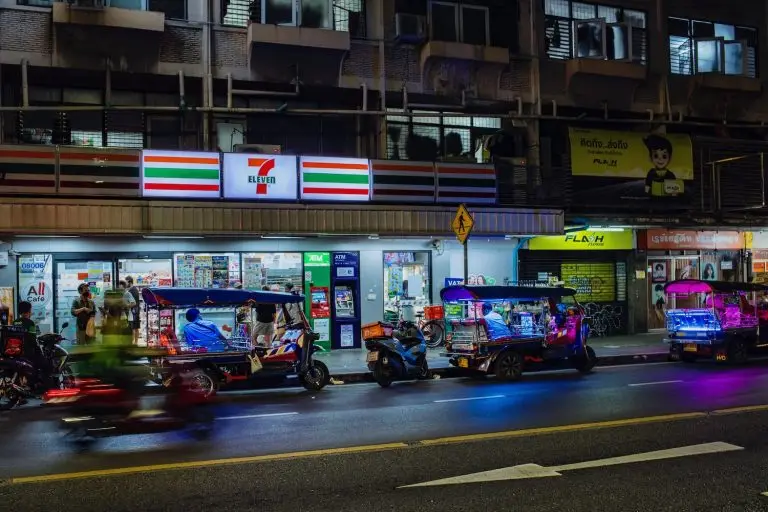
I will never forget my first visit to a 7-Eleven in Thailand. Coming from the American Midwest, where many of these stores are more about meeting shady characters than eating or drinking well, the Bangkok branches seemed almost spotless.
Years later, when I first entered a Japanese 7-Eleven, I had a similar realization: they were just as amazing compared to the Thai ones as the Thai ones had been compared to the American ones.
On the one hand, convenience stores in Asia are undoubtedly impressive, whether you visit a 7-Eleven in Thailand or Japan. On the other hand, the stores in these two countries are not comparable in terms of quality.
Why Asian 7-Eleven stores enjoy such an excellent reputation
Before comparing Japanese and Thai 7-Eleven stores, I'd like to discuss why convenience stores are so much better regarded in Asia than their North American counterparts. The first reason is obvious: they are genuine community hubs. In America, on the other hand, they are primarily the domain of the poor and the working poor—which is fine in itself—but unfortunately also of the homeless, drug addicts, and other shady characters.
The second factor is successful localization. In Thailand, this means products like Thai iced tea and sticky rice moo ping sandwiches; in Japan, freshly prepared onigiri and bento boxes; and in more rural areas, seasonal fruits and vegetables from local farms. This is also reflected in the range of coffee and other ready-to-drink beverages available in shops in both countries, which I will discuss in more detail in another section.
Ways to compare 7-Eleven stores in Japan and Thailand
Number of branches
Surprisingly, the distribution of 7-Eleven in Japan and Thailand is quite similar: Japan is projected to have around 22,000 stores by 2025, while Thailand is expected to have just over 15,000. Relative to their respective populations, this corresponds to roughly the same density. (As I will explain later, however, the large number of other convenience store chains in Japan creates a somewhat unbalanced advantage.) Furthermore, in Japan, particularly in Tokyo, there is a significantly lower propensity to open multiple stores in the same block.
Food and Drink
Are Japanese or Thai convenience stores better? That depends partly on what you're looking for. When it comes to fresh food and drinks, Japan has the edge – in Thailand, you won't find bento boxes, delicious salads, onigiri, or the many different varieties of fried chicken. However, you will find plenty of tasty snacks and various types of Thai iced tea, both at the espresso bar and from the vending machines, all ready-made.
Operation (and self-service)
Speaking of tea (and coffee): One difference between Japanese and Thai 7-Eleven stores (or simply "Seven") is that in Japan, coffee is offered on a self-service basis, with increasingly sophisticated machines, some of which can now also prepare smoothies. Checkout lanes in Japanese stores are also becoming more and more self-service. As for customer service, the staff in both countries are friendly, but in Thailand, they are more likely to speak English.
cleanliness
Comparing older models of Thai and Japanese 7-Eleven stores, the most noticeable smell in Thailand is probably a faint, sweaty odor. However, I don't think it's actually human sweat, as I've noticed the same scent in several stores. It could simply be the accumulated smell of years of use, which for some reason doesn't build up as much in Japan (where the stores are generally more minimalist).
consistency
Nearly every 7-Eleven in Japan offers a similar shopping experience in terms of product variety and service quality. However, store layout can vary depending on location—whether in a densely populated city or in the countryside; urban stores have significantly fewer restrooms than rural ones. In contrast, the quality in older, independently owned stores in Thailand is considerably more inconsistent than in the larger, newer stores, most of which are owned by the CP Group.
Another reason why Japan is winning the convenience store war
Jaan has the most 7-Eleven stores worldwide, so many in fact that you can often find several stores on the same block. However, with few exceptions, 7-Eleven isn't the only retailer. There are national chains (Lawson and FamilyMart are the best-known examples) as well as niche stores like NewDays (operated by the JR East railway company) and Seicomart, which is only found in Hokkaido.
This isn't to say that there aren't other convenience stores in Thailand, regardless of the differences between Thai and Japanese 7-Eleven locations. But in Japan, you simply have more convenience and a wider selection than in Thailand – a hard-to-beat combination. Let's see if the impending "Japanization" of the American 7-Eleven chain will soon make my home country a serious competitor in this market!
Other frequently asked questions about 7-Eleven in Thailand and Japan
Why is 7-Eleven so popular in Thailand?
7-Eleven is popular with locals in Thailand because it's often the only store open 24/7 in most towns and cities. For tourists, it's a place where they can meet their basic needs without having to speak Thai, in a culturally familiar and straightforward environment.
Is it better to travel to Thailand or to Japan?
Thailand and Japan are best experienced together, not as a substitute for each other. I love Thailand for its controlled chaos, tropical warmth and wild beauty, as well as the overwhelming friendliness of its people. In Japan, on the other hand, I appreciate order, tradition and cultural heritage, as well as the unparalleled safety and reliability.
Where is the largest 7-Eleven in Thailand?
Thailand's largest 7-Eleven store is located in Pattaya, near the beach. However, there are also quite large branches throughout the country. If you're in Bangkok, for example, I highly recommend the two two-story stores on Langsuan Road – one on the east side, south of the Chit Lom BTS station, and the other further west near the Sindhorn Midtown Hotel parking lot.
Conclusion
Will you have a better 7-Eleven experience in Thailand or Japan? In my opinion, the decision isn't particularly difficult. While there are some truly excellent 7-Eleven stores in Thailand—a few come to mind right now—on the whole, they're more inconsistent (and less remarkable) than their Japanese counterparts. Furthermore, in Japan, 7-Eleven is just one part of a convenience store ecosystem that is by far the best in the world. Need help planning your trip to Asia? Whether you're focusing on Thailand, Japan, or another country, I'd be happy to assist you as a travel consultant.




Community
Comments 0
Start the conversation.