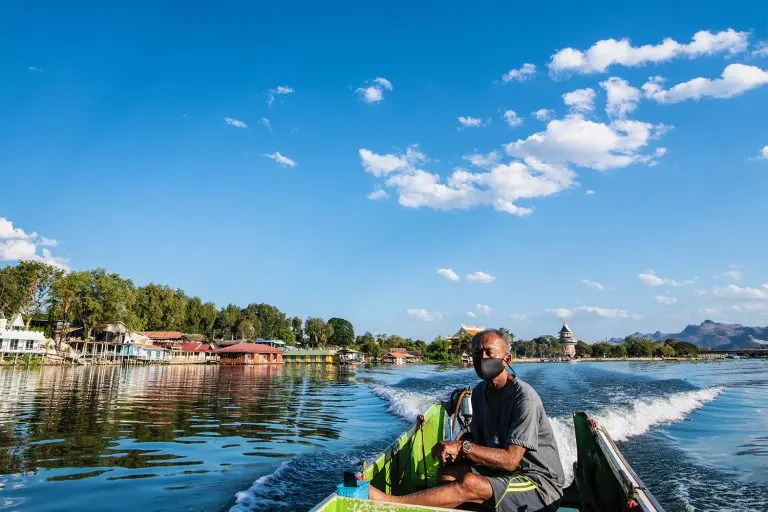
Let me put it this way: Thailand's continued obsession with face masks is making me sick. Disappointed. Annoyed. Ashamed. Perplexed. Disgusted. Angry. Sad.
So why did the proverbial "Land of Smiles" become a faceless dystopia? Contrary to popular belief, masks were not particularly widespread before Covid-19. At the same time, it seems unlikely that the Thai population actually harbors great fear of the SARS-CoV-2 virus.
Nevertheless, there are indications that masks may now be a permanent part of life in Thailand, so I think it makes sense to try to understand the reasons for this.
The "Land of Smiles" is history.
Anyone who has been to the Kingdom of Thailand since the borders reopened at the end of 2021 has surely noticed how many people wear masks. With few exceptions, Thais wear masks everywhere: not only indoors, but also outdoors and even in cars. Many have attached decorative straps to their masks so they can remove them while eating – a sign of the consistency of mask-wearing.
So when did the "Land of Smiles" become a land of faceless zombies? I wish I could tell you it's always been this way, or that there's something in Thai culture that predisposes people to wear diapers over their mouths and noses. In reality, the authoritarianism of the Covid era seems to have broken the Thai people. Many of them seem unable to remove their masks, despite ample evidence that these serve no scientific purpose whatsoever.
Why Thais wore masks before Covid-19
pollution
In early 2018, during my first smog season in Bangkok, my Thai teacher was very direct. She warned me that I was seriously endangering my health if I didn't wear a mask daily (an N95 mask, as I now know). I never followed her advice, but I now avoid central and northern Thailand between February and April.
anonymity
For some locals, what I dislike most about masks in Thailand—that they make it impossible to distinguish many people from one another—is not a disadvantage, but an advantage. In some cases, this stems from social insecurity, especially among young women. In other cases, they simply want to move about the city unrecognized. Not my cup of tea, but to each their own.
Common illnesses
I understand why some people believe that a face mask would prevent the spread of viruses, but science has never confirmed this. Nevertheless, some Thais have always worn masks when suffering from a cold, flu, or allergies, or when receiving hospital treatment, even if they weren't sick. Before Covid-19, however, this affected at most one to two percent of the population.
Copy Japan
During your travels through Thailand, you might notice that the country's pop culture is heavily influenced by trends from Japan and Korea. There's some evidence to suggest that the ubiquity of masks in Thailand, particularly post-pandemic, stems from their continued prevalence in Japan. While I have no proof, my extensive travel experience in both countries suggests this could be the case.
Actual errors
Have you ever wondered why Thais wear masks but (often) don't wear helmets when riding motorbikes? There are many reasons – some of which I'll mention in another paragraph – but one is much simpler than you might think. It's due to the high number of insects in the Thai air. It's safe to say that any physical barrier over your mouth will protect you from an unpleasant bite while riding.
Are Thais really afraid of Covid-19?
As I explained above and in detail in my article on safety in Thailand, it's common to see Thais riding motorcycles wearing masks but without helmets. Since this suggests that Thai motorcyclists aren't afraid of a fatal head impact, it would be strange to assume they fear a mild virus with a near 100% survival rate. I think the reason Thais continue to wear masks lies deeper.
For reasons I cannot elaborate on to avoid risking an entry ban, most Thais tend not only to obey authority but also to behave in ways that signal their obedience. The continued wearing of masks years after the end of the pandemic kills two birds with one stone and also serves several other purposes mentioned above (which most Thais cite, somewhat defensively, when asked about their mask-wearing).
More frequently asked questions about masks in Thailand
Are Thais still wearing masks?
In 2026, the vast majority of Thais still wore masks in almost all situations – indoors, on public transport, and even in cars, even when driving alone. Some Thais were so convinced of the benefits of mask-wearing that they attached their masks to beaded or gold cords so they could safely remove them for eating and drinking.
Is a mask requirement required on international flights to Thailand?
Masks were mandatory on international flights to Thailand in 2020, 2021, and part of 2022. However, since there will no longer be widespread mask mandates worldwide from 2026 onwards, wearing a mask on flights to Thailand is no longer required (although unfortunately many Thais still do so).
Do you have to wear masks in Thailand?
Since July 2022, there has been no legal mask mandate in Thailand. Nevertheless, one frequently sees many Thais wearing masks in all sorts of situations, even in restaurants while waiting for their food. This seems dystopian and contradicts Thailand's reputation as the "Land of Smiles".
Conclusion
The issue of masks in Thailand is, frankly, confusing and frustrating. Thailand is one of my favorite countries, and I love the Thai people. At the same time, the fact that they are still so stubbornly clinging to face masks years after the end of the Covid-19 pandemic makes me fear for the future of travel to Thailand. While there is no mask mandate—so foreign travelers don't have to conform to this strange new cultural custom—the ubiquitous masks feel downright dystopian. Do you need help planning your trip to Thailand? Then hire me!




Community
Comments 0
Start the conversation.