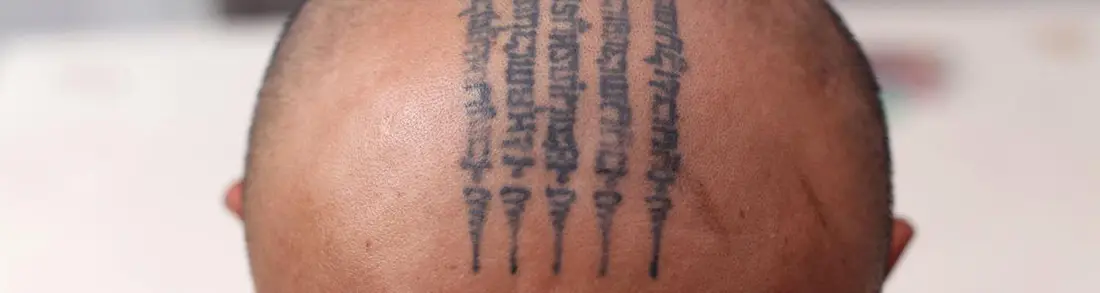
Travel journalist Ian Neubauer recently visited a tattoo school in the heart of Bangkok that has opened its doors to travelers who wish to learn the time-honored art of tattooing in Thailand.
A sacred symbol
In ancient Angkor, when Cambodia ruled large parts of Southeast Asia, soldiers covered themselves from head to toe with sacred tattoos called yantras. These tattoos displayed Khmer characters with abbreviations of religious incantations and were sometimes accompanied by images of snakes, tigers, elephants, and other powerful animal spirits. Yantras were believed to protect the wearer from arrows, bestow mystical powers, and bring good fortune.
Yantra tattoos remain popular in the Cambodian military, but neighboring Thailand has become the world center for this art form. Schools like Bangkok Ink welcome travelers who want to learn the art of Sak Yant tattooing – as the tattoos are called in Thai. In Thailand, Sak Yant tattoos are worn by gang members for protection during clashes between rival groups, by young women as love charms, and by Thais in everyday life, whose tattoos remind them of the moral precepts of Buddhism. In fact, the magical powers of the tattoos are said to be strongest when applied to the head – the most sacred part of the body for Buddhists.
Free tattoos
Vee, a graphic designer, doesn't even flinch when a new Sak Yant is tattooed on his back at Bangkok Ink, a studio and tattoo school that tries to raise the bar for this ancient art form – in a city where the tourist area of Khoa San Road is otherwise known for notoriously cheap ink.
Each year, two to three dozen foreigners spend several months at the school to learn the skills of Sak Yant and modern tattoo styles. Initially, the students practice on pigskin, and once they are more confident, they tattoo Thai models free of charge.
“The tattoo schools in Australia were out of the question because they are too expensive; thousands and thousands of dollars,” said Alex Kelly, a student from Melbourne who is completing his second stint at Bangkok Ink.
"The only way to learn anything there is through an apprenticeship, which is virtually impossible because tattoo artists don't want to compete with each other. Going to Thailand was the only realistic option for me."
The five lines
On the left forearm of Martin Kendall, owner of Bangkok Ink, are the Hay Taew, the five lines – the most popular of all Sak Yants. Each line represents a spell which, when recited 108 times, can induce a deep state of meditation. The first line protects against unjust punishment, drives away unwanted spirits, and protects the home. The second line reverses unfavorable astrological configurations and bad luck. The third line protects against black magic and curses; the fourth line bestows good fortune; and the fifth fosters charisma and attracts the opposite sex.
Leave a lasting impression
Regardless of the tattoo style, most tattoo artists don't draw freehand directly onto the skin. They start with stencils – outlines drawn with felt-tip pens on baking paper – and then transfer these by pressing the paper onto moistened skin.
At the beginning of the 20th century, tattoo stencils were carved into wood and then sprinkled with carbon powder to create a black outline. The wood was then pressed against the body, transferring the carbon powder from the stencil to the skin.
The picture shows Belgian-based graffiti artist Waf Alosta, also a student at Bangkok Ink, tattooing a butterfly onto the upper body of a Thai volunteer using a tattoo machine.
"Most of my graffiti artworks are temporary and are painted over. Tattooing is therefore a way for me to create permanent art."
The Bamboo Master
A less common tattooing method uses steel rods with attached needles. It is a modern version of the tool used by early Southeast Asian tattoo artists: sharpened bamboo sticks. Both Sak Yant and modern tattoo styles can be achieved using the bamboo tattooing method, although it is a technique that takes considerably longer to learn.
“Our bamboo tattoos are more expensive than tattoos done with a tattoo machine because it’s a very specialized technique,” Kendall explained. “The skin is less damaged, there’s less bleeding, and no scabs form. It also heals much faster.”
Pictured here is Kendall's most experienced bamboo tattoo artist, Kritirat. Approximately every 15 seconds, he dipped the needle into a small inkwell, much like an artist using a quill pen.
The pain factor
In this photo, Krittirat Kendall is tattooing a snake on someone's arm, while an assistant holds the skin taut to prevent it from shifting. In Thailand, the snake is considered particularly fast and elusive. It is a master of disguise and moves gracefully and rhythmically. It is believed to possess strong psychic energy and creative power, and to offer protection from religious persecution.
At the start of the 90-minute procedure, Kendall rated the pain level as five out of ten. However, halfway through, he claimed the pain had increased to about seven. The bamboo tattooing method is generally more painful than modern tattoo machines.
“The longer I sit here, the more it hurts because my pain tolerance decreases,” he said. “Tattoos on bony parts of the body hurt much more than on areas with more fat or muscle. But the inside of my arm, where I’m getting tattooed right now, is one of the most painful places of all. I’ll be glad when it’s over,” he said, grimacing between his teeth.
This story first appeared on BBC Travel.




Community
Comments 0
Start the conversation.