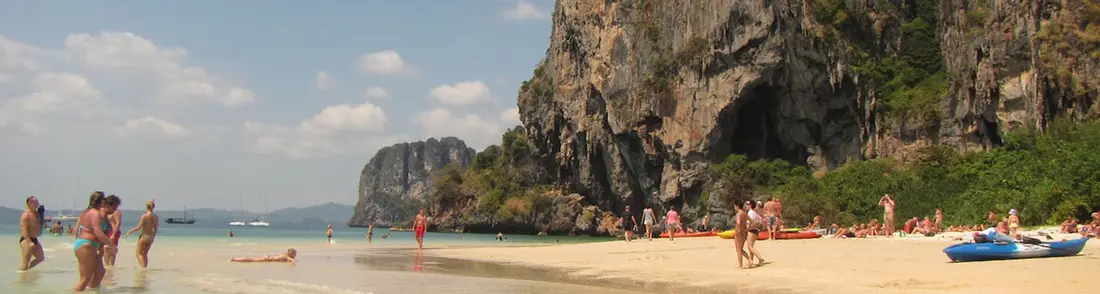
Guest blogger and award-winning Australian travel writer Louise Southerden causes a sensation while rock climbing in Krabi, southern Thailand.
"This isn't cliff diving. We know the difference. We're climbers." That's what a sign outside a climbing school in Tonsai, one of the two beaches on the Railay Peninsula in Krabi, advertises "deep-water soloing" tours. This is the beach where ambitious climbers gather. I'm staying on the other, more touristy Railay beach, where the difference between cliff diving and deep-water soloing completely escapes me—and inspires me to take a day trip deep-water soloing myself.
What is deep-water soloing?
In short, it's a mix of bouldering (climbing close to the ground with a crash pad for protection) and free soloing (climbing without a rope). Put another way: it's a way to enjoy the freedom of rope-free climbing without the risk of dying in a fall – since you're climbing over deep water. The sea (or a river or lake) serves as your safety net.
Deep water soloing (DWS), as it's also known, has enjoyed growing popularity worldwide since the mid-1990s. Therefore, it was only a matter of time before Krabi also offered DWS day trips for climbers – and increasingly for everyone else as well. This is one of its major advantages: no climbing experience is required.
I had just finished a three-day climbing course in Railay and had a few days to spare, so the chance to combine my new love of climbing with my first love, the sea, was too tempting to pass up, especially when I found out that it could be done from a sailboat instead of a noisy longboat.
The excursions start at Railay Beach around high tide to maximize water depth; it is 10 a.m. when the eight of us, all deep-water solo novices, meet at Railay West Beach and board a longtail boat that takes us to a beautiful 32-foot yacht anchored offshore.
Before we knew it, our skipper Pet had given his two crew members the order to hoist the sails, and we were gliding across the glittering sea between the karst islands of Krabi towards our destination, Koh Poda. This alone made the trip worthwhile, and everyone was in high spirits, relaxing on deck under the sails in the tropical sun.
An hour later we arrive: We anchor next to a high limestone wall that rises steeply out of the sea.
“Ready to climb?” Pet asks.
“Yes!” we say, although a certain nervous anticipation wafts through the air.
It feels strange to strip down to our bikinis (the boys in swim trunks), slip into the provided climbing shoes, and board an inflatable boat that takes us to the next rock face. There, we climb a two-meter-long rope ladder spanning the gap between the rock and the sea (this is the most strenuous part of deep-water soloing: pulling yourself up on bamboo rungs while the ladder rocks in the waves of passing longtail boats).
Climbing without a harness and rope is truly liberating. There's no chalk either (it would turn into a sticky paste upon contact with water), but holding onto the rock with wet hands isn't difficult, mainly because the rock is sharp-edged and the routes are easy with large holds and footholds.
Side by side, we explore the steep cliff face, sometimes staying at the bottom, sometimes climbing as high as we dare. We shout loudly before jumping or falling to make sure no one is in the water. The higher you climb, the rougher the water becomes, of course. Up to ten meters, you're considered relatively safe; beyond that, the sea feels like concrete. Pet had told us that you can avoid injuries by falling with your arms at your sides and your feet together. Good to know.
Climbing is fun until I remember my aversion to—and fear of—jumping from great heights. So, after my last jump/fall from my personal best of five meters, I retreat to the bench—the yacht's deck. Deep-water soloing turns out to be the best kind of spectator sport. The participants are clearly visible, like butterflies on a bulletin board. You're right there with them (so close that you often get splashed when climbers fall into the water). And because you've tried it yourself, you know how brave they are to climb higher than you dare.
As a few longtail vans full of backpackers arrive, the rock face fills with colorful crowds. There are girls in Brazilian bikinis, handsome Latinos standing on ledges like Greek gods, guys with tattoos and topknots, even a woman climbing in a neon-colored life jacket.
Most impressive are two Thai climbing guides, barefoot and in long-sleeved shirts and tracksuit bottoms, who climb out of a kayak at the base of the cliff and ascend higher and higher like Spiderman; one of them even swings one-armed ten meters above the Andaman Sea. When he finally jumps, he's so high that it takes him FOUR SECONDS to enter the water. The other deftly climbs back down to his waiting sea kayak. This is deep-water soloing with style: you don't even get wet.
After a quick lunch of fried rice and cold beer back on board, there's still time for snorkeling and a kayak trip to a nearby beach before heading back to Railay. I think I understand the Tonsai mentality better now. Rock climbing is one thing. Cliff jumping is quite another. And deep-water soloing is something else entirely.
Getting there: Fly from Bangkok to Krabi, then take a taxi to Ao Nang beach and continue by longtail boat to Railay. The Hot Rock Climbing School in Railay offers solo deep-water day trips that include climbing, sailing, kayaking, and snorkeling. The best time to climb is from November to April. For more information, visit www.railayadventure.com




Community
Comments 0
Start the conversation.