Guest author John Borthwick visited the Tham Luang cave in northern Thailand, the site of a spectacular rescue operation in 2018. Here's what he found out.
There have already been extensive documentaries and countless interviews. And now Hollywood is adapting the story into a dramatic feature film. "It" tells the extraordinary story that unfolded in June/July 2018, when twelve young Thai soccer players and their coach were trapped in a flooded cave system near Chiang Rai in northern Thailand.
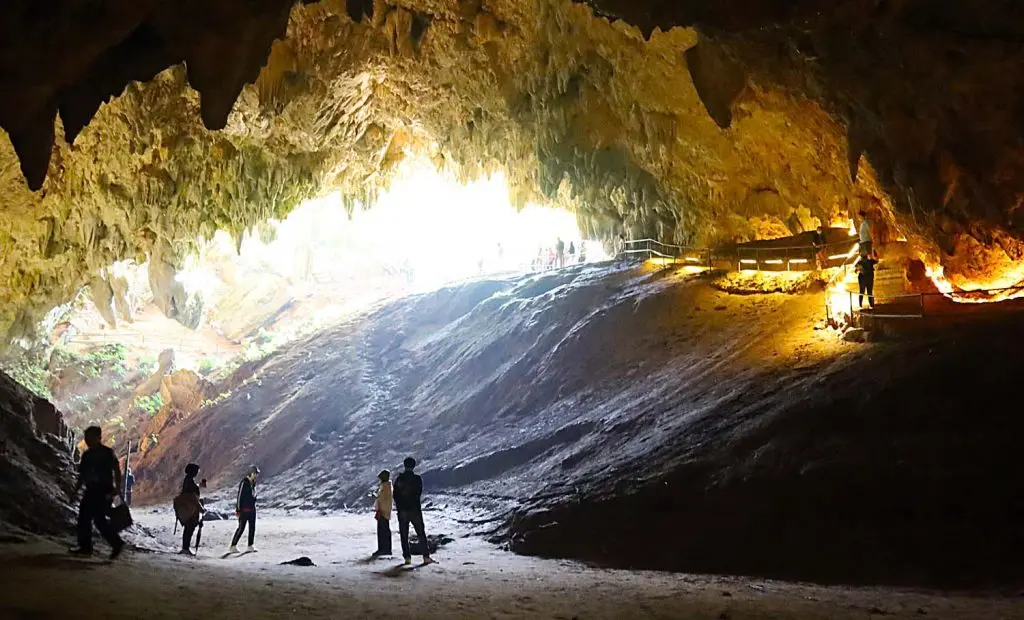
Today, sunlight streams into the cathedral-like first chamber of Thailand's Tham Luang Nang Non, the "Great Cave of the Sleeping." Visitors stroll along a well-maintained path, explore the cave floor, and take selfies. It's hard to imagine that this place was once a hive of activity for two weeks, captivating the world.
Trapped in a narrow labyrinth on a rocky ledge over three kilometers below the surface by rising waters, the Wild Boar football team, whose youngest player was only eleven years old, seemed almost lost. Ten days passed before two British cave divers, summoned by the Thai government, battled their way upstream through the murky water and found the boys alive.
The subsequent perilous rescue operation lasted another week. Twenty-three countries participated in the rescue. Among the thousands of participants and dozens of heroes were the two Australian doctors and cave divers, Richard Harris and Craig Challen, who led the risky task of anesthetizing the boys before diving teams brought them to safety unconscious and underwater. The grandfather of one of the boys said: "It's as if they died and have now been reborn."
The cave in Tham Luang-Khun Nam Nang Non National Park, about a 40-minute drive from Chiang Rai, has reopened to visitors. "During the week, we now have around 1,000 visitors daily, and on weekends even 2,000," a national park ranger tells me. Entry is free, and a shuttle bus runs regularly between the nearby parking lot and the cave entrance.
Visitors can explore the vast entrance hall and climb the steps to the altar of the spirit house. I continue exploring the limestone cave, which stretches for about ten kilometers toward the nearby border with Myanmar. But after just 300 meters, the narrowing passage is firmly blocked by a metal barrier. Thailand's national parks don't take any chances with thrill-seekers trying their luck and attempting to venture as far as possible toward the famous rescue point—even during the dry season.
The area around the cave entrance has now developed into a kind of "rescue" theme park, with murals, maps, a reconstructed tunnel section and a large statue in honor of former Thai Navy SEAL diver Saman Kunan, the only one who died during the mission.
The divers from the British Cave Rescue Council received numerous awards for bravery, as did many Thai SEALs and participants from the USA, China, Belgium, and other countries. The two Australian specialists were jointly named "Australians of the Year." The young footballers—all true heroes—were celebrated internationally, and some of them, including coach Ekkapol Chantawong, who were stateless, were granted Thai citizenship.
At least four versions of the rescue operation will be shown in film and television. The first was the 2019 documentary "The Cave" by Thai-Irish filmmaker Tom Waller. A Netflix miniseries about the young footballers is in the works. The 2021 National Geographic documentary "The Rescue" was impressive on the big screen and is now available on Disney+.
Meanwhile, in the elaborate version by Hollywood director Ron Howard, “Thirteen Lives”, Viggo Mortensen and Colin Farrell will play the British duo who first found the boys.
After all the boys were rescued and safely settled in their own ward at the Chiang Rai hospital, the Thai Navy SEALs posted: "We're not sure if this is a miracle, science, or what?" Probably all of the above.




Community
Comments 0
Start the conversation.