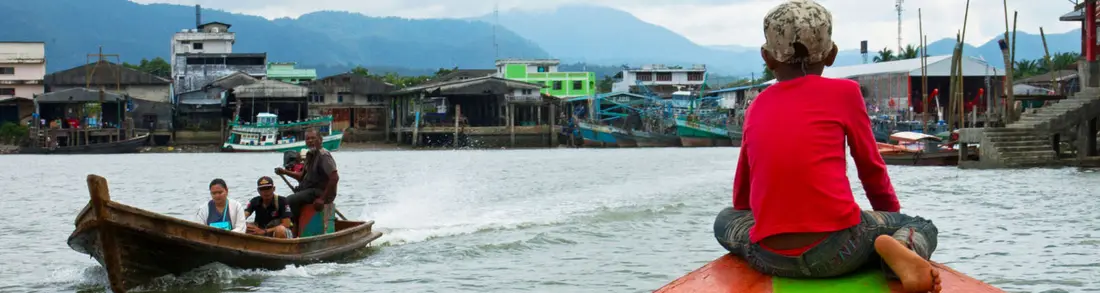
“Ranong is escaping the tourism boom that once engulfed tranquil coastal towns. This port on the Andaman Sea, nestled between the southern tip of Myanmar and the Kra Isthmus in Thailand, is thriving as a fishing and trading town.” Travel writer John Borthwick reveals some of its secrets…
Visitors are, of course, very welcome, and have been since at least 1890, when King Rama V visited Ranong and explored its famous hot springs. Most travelers still do the same and visit the free, public open-air baths of Raksawarin. And believe me, it's hot there! I first try the 40-degree pool, but after four minutes of practically bathing in the heat, I escape to the relative coolness and soothing effect of the adjacent 35-degree natural spring.
You can fly to Ranong, 570 km southwest of Bangkok, or drive five hours north of Phuket. Here I discover a slice of authentic Thailand—or, given its ethnic diversity, more of a Chinese-Thai country—with around 25,000 inhabitants. Ranong was settled long ago and developed primarily by Hoklo immigrants from the Chinese province of Fujian. The streets are lined with traditional shophouses selling everything from computers, fruit, nuts and bolts to washing machines, motorcycles, and gold. The town is clearly doing well (I notice the size of its banks), yet it lacks the stark, contrasting social problems of wealth and poverty so often found elsewhere. I see a BMW and no beggars.
Ranong is an ideal starting point for excursions to various nearby Thai islands or into the Andaman Sea on liveaboard dive boats, for example to legendary dive sites like Richelieu Rock. Those who can afford it should take a yacht cruise to the pristine and unspoiled Mergui Archipelago in Myanmar – a truly unique experience. Ranong is the perfect starting point for this adventure. From Ranong, you can reach Kawthaung (formerly Victoria Point) in Myanmar with a 20-minute, 500 baht ride in a longtail boat. There you can join a cruise, visit the nearby casino island (if desired), or extend your visa for another 15 days in Thailand.
The place's greatest asset is its authenticity. I stroll along the main street, Ruengrat Road – no pushy vendors, no unwanted advances – past the gold shops, browse the markets, admire a few Chinese temples and an old, yet beautifully restored, wooden palace, and then find a pub. Pons Place serves beer or coffee (and also offers travel bookings and Wi-Fi), and afterwards I enjoy delicious, fresh garlic prawns at Hideaway.
Ranong province is the rainiest province in Thailand, yet also one of the smallest and most sparsely populated. Eighty percent of its area is still forested, and the Kra Isthmus contains the narrowest point of the Malay Peninsula – only 44 kilometers of land separate the Gulf of Thailand from the Andaman Sea. Near the city are waterfalls (some flowing year-round), Namtok Ngao National Park, and biosphere reserves, all excellent for jungle treks.
Season: September to May.
Getting there. Ranong is a four-hour drive north of Phuket. Nok Air offers daily flights from Bangkok (Don Mueang); the airport is 23 km south of Ranong. The nearest train station is Chumphon, 120 km east.
All photos by John Borthwick.




Community
Comments 0
Start the conversation.