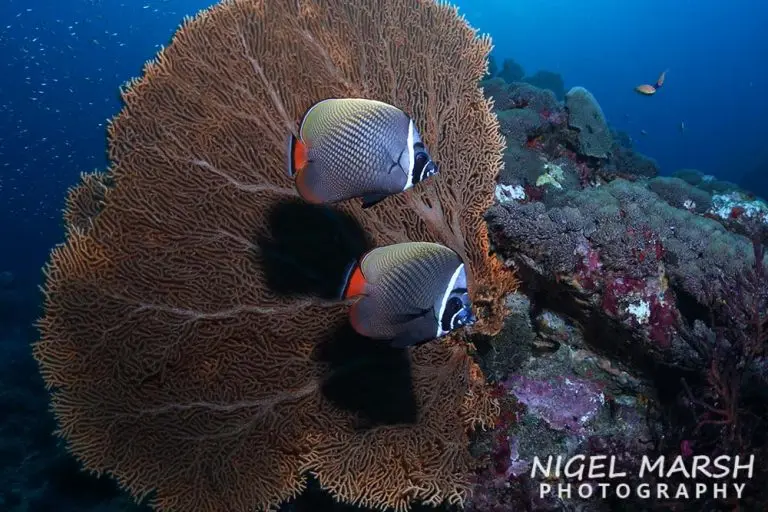
Author and renowned underwater photographer Nigel Marsh reports on his recent diving experiences at the Similan and Surin Islands and his exploration of the rainforest landscape of Khao Sok National Park.
Thailand is blessed with some of the world's most fascinating landscapes and wildlife, both above and below the water. There's hardly anything better than combining these two worlds, and one of the best combinations is a diving holiday to the Similan Islands with a rainforest experience in Khao Sok National Park.
I've been fortunate enough to travel to Thailand many times over the past thirty years and explore almost the entire country, experiencing its wonderful culture, cuisine, ancient cities, vibrant towns, breathtaking national parks, and fantastic diving opportunities. However, on all these trips, I neglected Thailand's best diving area and largest national park. An oversight I recently rectified on a special Diveplanit trip to the Similan Islands and Khao Sok National Park.
The part of our trip that took us to the Similan Islands consisted of three days of diving aboard the "Marco Polo" from Sea Bees. After arriving in Phuket and transferring to Khao Lak, we boarded at 8:00 a.m. The comfortable dive boat accommodates 12 passengers in air-conditioned double cabins with en-suite bathrooms and is perfectly equipped for diving. After stowing our luggage and completing the formalities, we quickly set sail for the Similan Islands, located just three hours off the coast.
The Similan Islands lie 70 km off the west coast of Thailand and are a marine protected area. The archipelago consists of eleven rocky islands, each surrounded by beautiful coral gardens that provide a habitat for a wide variety of fish and invertebrates. Diving is only possible from November to May when the sea is calm. The best way to explore the islands is by liveaboard liveaboard dive boat.
During our three-day trip, we completed ten dives and explored coral gardens, pinnacles, and a shipwreck – just a small selection of the dive sites in the region. A unique feature of this area is that the corals grow directly on the granite rocks that make up the islands and pinnacles, creating a fascinating underwater landscape.
On the first day, we dived at West Ridge near Koh Bon and at Koh Tachai Pinnacle, enjoying 30 meters of visibility. Both dive sites offered beautiful coral gardens with spectacular soft corals, gorgonians, tunicates, and whip corals. My personal highlight, however, was the impressive marine life, with schools of barracuda, trevally, fusiliers, and snappers, as well as a wide variety of angelfish, groupers, butterflyfish, surgeonfish, wrasse, triggerfish, and moray eels.
Richelieu Rock is frequently visited by whale sharks and manta rays.
On the second day, we dived at Thailand's most famous dive site – Richelieu Rock. This enormous rock rises 35 meters out of the water and is covered with beautiful corals and an extraordinary variety of fish and invertebrates. During two dives, we saw schools of pelagic fish, groupers, moray eels, and smaller creatures such as ribbon moray eels, harlequin shrimp, and mantis shrimp.
There were even a few endemic fish I had never seen before – the red saddleback anemonefish and Peters' toby.
On our last day, we returned to the spectacular Koh Tachai Pinnacle and also enjoyed a dive at Koh Bon Pinnacle, where we admired beautiful corals and countless fish. Our final dive, however, was something truly special: On our way back to the harbor, we explored the Boonsung wreck. This old tin dredger lies at a depth of 18 meters and, with visibility of around 12 meters, doesn't offer the best conditions, but it is teeming with fish. Huge schools of snapper, trevally, fusiliers, and bigeyes swarm around the wreck, joined by angelfish, groupers, lionfish, pufferfish, and a large number of honeycomb moray eels.
After three wonderful days of diving, we returned to the harbor, ready for our next adventure in Khao Sok National Park. After an overnight stay in Khao Lak, we were picked up in the morning and taken to Elephant Hills Camp.
Khao Sok National Park is the largest park in Thailand and contains the largest contiguous areas of untouched rainforest in the country. A limestone mountain range runs through the park, and countless spectacular karst formations characterize the landscape.
The breathtaking scenery was the first thing that struck me upon our arrival at Elephant Hills. This eco-resort offers its guests luxurious glamping-style tents arranged around a central reception area with a bar and restaurant. After checking in and enjoying a delicious lunch, we joined an afternoon tour. This included a 90-minute canoe safari on the Sok River, where we spotted long-tailed macaques, a monitor lizard, and several snakes as we glided through spectacular gorges.
Afterwards, we visited the elephant park, home to a dozen rescued elephants. We fed and petted the elephants and learned about their history and their importance to Thai culture.
The next day, more sightseeing was on the agenda, including a two-hour bus ride to Cheow Lan Lake. This vast waterway dominates the national park and was created in the 1980s by the construction of the Ratchaprapha Dam. There, we boarded a longboat and explored the lake, characterized by its towering cliffs and karst formations, before reaching Elephant Hills Rainforest Camp. You can stay overnight at this floating camp and explore the rainforest, but since we had limited time, we enjoyed a delicious lunch, swam in the lake, and kayaked along the waterways. The area is home to fascinating wildlife, and we spotted, among other things, dark langurs and various bird species.
My combined Thailand reef and rainforest tour came to an end far too quickly and left me with the desire to see much more of this region.
Community
Comments 0
Start the conversation.