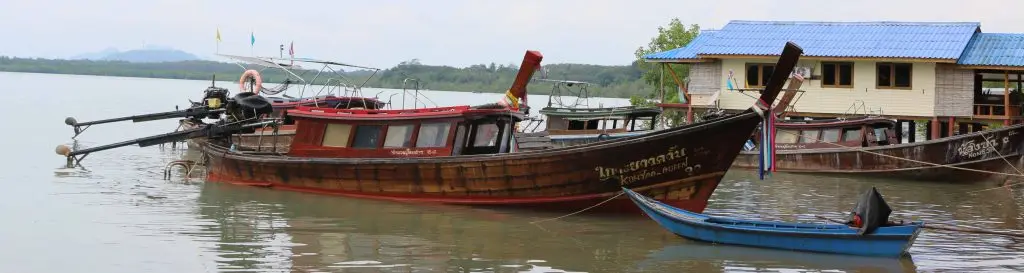
Homestays in Thailand are becoming increasingly popular – demand is rising across Southeast Asia, and not just because of the affordable prices. These accommodations offer an excellent opportunity to experience authentic Thai village life, far from – yet often not far from – the hustle and bustle of Phuket, Koh Samui, Bangkok, and Chiang Mai.
Travel journalist Deborah Dickson-Smith explored the simple life on Koh Yao, just a 35-minute ferry ride from Phuket in the Phang Nga province. Here is her account.
After the short ferry ride from North Phuket, I enter a completely different world when I arrive at Manoh Pier on Koh Yao. What awaits me there is entirely unclear, let alone where I should go. My host is called "Uncle Bao," and his son Lee greets me at the pier on a scooter. He examines my luggage and scratches his head. "We'll pick it up again later."
And so we drive into town – a school, a police station, a mosque, and a row of shops, surrounded by rice paddies. Soon we turn into a grassy driveway, I'm shown to my small bamboo hut, introduced to Mrs. Bao, and asked to be ready for lunch at noon. Mrs. Bao smiles kindly while her son asks about food allergies and then disappears to take care of my luggage.
An hour later, I finally meet Uncle Bao at lunch in the family kitchen. He explains village life to me and suggests a few excursions. It's a Muslim household, and indeed, I learn during lunch that 98 percent of the villagers are Muslim.
After lunch, Lee picks me up on his scooter and we take a tour around the island. First, we visit a small fishing village, then a quiet sandy beach with cafes and souvenir shops, and finally a village built on stilts over the water, winding around a long boardwalk through the mangroves. Afterward, I visit one of the rubber plantations that characterize the island, sharing space only with rice paddies. The rubber is still collected in coconut shells, which are attached to the trunk of each tree—the same method used for over 100 years. The diagonal grooves in the trunks are renewed every morning.
As we circle this small island, I catch glimpses of the towering limestone islands of Phang Nga Bay, which I will explore tomorrow, but for now there is nothing to do but relax until dinner.
At dinner, I learn a little more about Uncle Bao's village and about Uncle Bao himself. Bao has been running this guesthouse for over 25 years. The idea came to him when he was trying to secure his previous livelihood – fishing. Around that time, the large commercial fishing boats arrived in the bay and practically overnight took away the villagers' livelihood.
Bao tried unsuccessfully to persuade the local authorities to stop the boats and therefore took his fight to Bangkok. There he had the idea of recruiting students to his cause. He invited groups of students to his village so they could see the situation for themselves and fight for him in the capital.
His strategy proved successful in two ways: firstly, commercial fishing boats were eventually banned from fishing in these waters; secondly, Bao had discovered a new source of income – homestays – which quickly became very popular with backpackers. Homestays were set up in villages all over the island, the fishermen returned to their jobs, and the villagers were so grateful that they elected Uncle Bao as their representative.
And so here I am, on this quiet, small, alcohol-free island that has since developed into a thriving tourist destination, far removed from the hustle and bustle of Phuket and Krabi. Here I can spend my days in a hammock on my veranda, perhaps go to the beach, wander aimlessly through rice paddies and rubber plantations, or take an island-hopping tour in Phang Naha Bay.
The next day, I opt for an island tour, accompanied by Uncle Bao, in a longboat steered by his brother-in-law. We explore several limestone islands, some with caves and hanging stalactites, others with white sandy beaches, and at least one inhabited by a large family of crab-eating macaques who climb over the rocks to eye us.
I can't remember the last time I felt this relaxed – and it's not because I've been forced into a digital detox. There's free Wi-Fi and fantastic mobile reception here. I simply don't feel the need to use it, inspired by the uncomplicated life around me.
Accommodation: Mr. Bao's host family and bungalows. 32 Moo 1 Koh Yao Noi, Phang Nga. Email: [email protected]
Getting there: Thai Airways flies twice daily from Sydney to Bangkok and daily from Melbourne, Brisbane, Adelaide, and Perth. Connections to Phuket are quick and easy. The ferry to Koh Lao departs from Bang Rong Pier.




Community
Comments 0
Start the conversation.