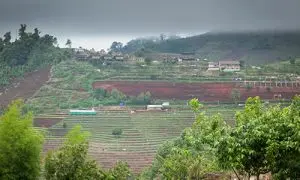
Chiang Mai (Thailand) – October 5, 2016 – (travelindex.com) – Anyone who has hiked in the forests of northern Thailand, gazing at the wooded slopes stretching to the horizon, might have assumed that this region remained relatively untouched until modern times – a primeval realm of nature. But the truth is that these hills have long been home to a multitude of indigenous peoples – half a million in number – who live off the land, cultivate crops on small farms, and tenaciously preserve their unique customs and cultures.
These hill tribes are believed to have migrated from China and the Tibetan Plateau to Myanmar, Laos, and Thailand over the last few centuries. Today, they comprise six main groups: the Akha, Lahu, Karen, Hmong (or Miao), Mien (or Yao), and Lisu, each with its own language and culture. Until recently, these hill tribes lived as pastoralists, raising livestock and cultivating crops, including small quantities of medicinal opium. However, with the arrival of the modern world and the escalating Vietnam War in the 1960s, modern communication technologies exposed these hill tribes to a more ruthless outside world, and opium became a lucrative source of income, bringing with it all the suffering that entails.
The Nong Hoi Royal Project Development Centre in Chiang Mai, Mae Rim Subdistrict, was established in 1984 by His Majesty King Bhumibol Adulyadej to assist the region's tribal population in transitioning away from opium cultivation, while simultaneously improving their living conditions and the country's reputation. The project has been a resounding success: thanks to new cultivation methods, training, and equipment provided by experts, sustainable and marketable crops are now grown on slopes once dedicated to opium cultivation.
This success is largely due to the fact that the region where the tribal population lives lies between 850 and 1460 meters above sea level and has an average temperature of 21 degrees Celsius – ideal conditions for growing a variety of crops that do not thrive in the hotter plains of central Thailand. These fruits and vegetables include artichokes, lemon thyme, mint, chamomile, rosemary, plums, seedless grapes, strawberries, red olives, herbal teas, and tomatoes. Many of these fresh ingredients are delivered directly to restaurants and hotels in Chiang Mai that prioritize sustainable and high-quality food.
Thanks to its charming surroundings and the unique way of life of the locals, Nong Hoi has become a popular tourist destination. In the fresh, clear hill air, idyllic hiking trails, breathtaking views, and insights into sustainable development invite you to linger. Book your visit in advance – a staff member will explain the background of the project to your group, and you can sample fresh local produce and herbal teas.
Perhaps the most important building in Nong Hoi is the Royal Project Center for Plant Development. Here, experiments are conducted to expand the diversity of fruits and vegetables cultivated by the local hill tribes of temperate climates. Government researchers and students regularly come here to conduct research. Visitors are also welcome and can watch fascinating demonstrations of organic and hydroponic cultivation methods for herbs and vegetables.
International Public Relations Department, Tourism Authority of Thailand, 1600 New Petchaburi Road, Makkasan, Ratchathevi, Bangkok 10400, Thailand, Tel.: +66 (0) 2250 5500 ext. 4545-48, Fax: +66 (0) 2250 0246, E-mail: [email protected], Website: www.TATnews.org




Community
Comments 0
Start the conversation.