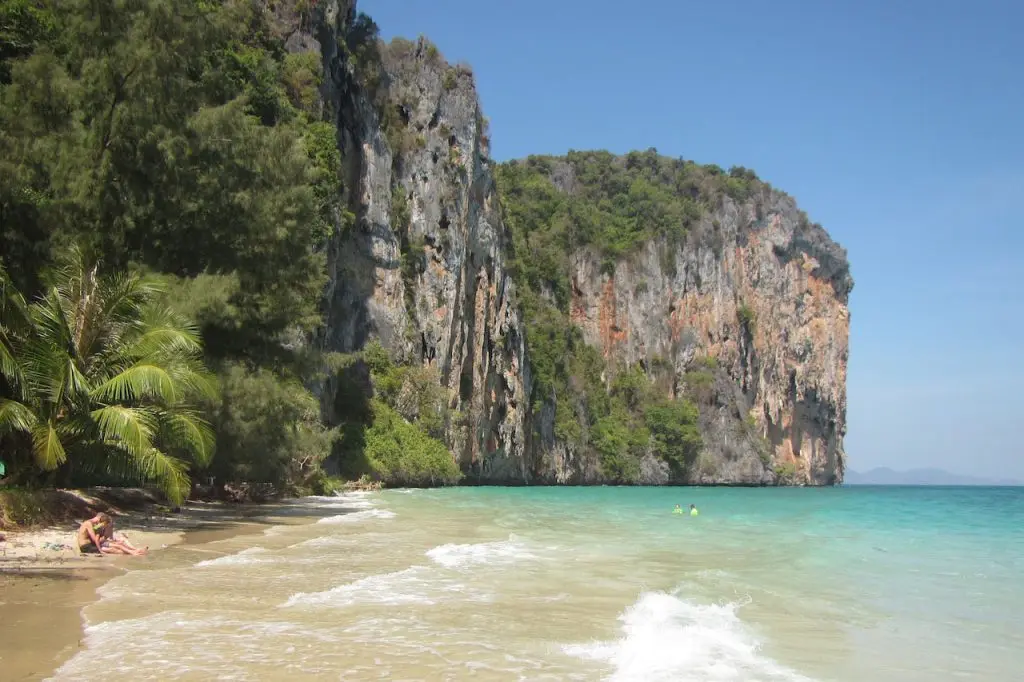
Award-winning Australian travel writer Louise Southerden tries out "sea camping" on Thailand's hidden island paradise Koh Laoliang.
You've probably never heard of Koh Laoliang. Neither had I, until a fellow traveler recommended the island as an idyllic spot for a few days of camping in Thailand. "It's like 'The Beach,'" he said, "only without the hand-drawn map, the suicidal Scotsman, the despotic Tilda Swinton, and, as I was soon to discover, the hordes of sun-seeking day-trippers who flock daily to Koh Phi Phi (in the neighboring province of Krabi), where the film was shot."
Laoliang is a rarity in Thailand: a remote island national park with a stunning beach, untouched by longtail boats or tourists – a maximum of 40 people are allowed to stay overnight in tents at any one time, and day-trippers are not permitted. There are no bungalows or resorts either.
The island, which belongs to the province of Trang, is only open for five months of the year, from November to April. Even getting there is an adventure, especially if you come from Krabi, like me.
It started with a ride on a longboat from Railay to Krabi town, where an American named Richard (hmm, the same name as Leo DiCaprio's character in The Beach…) picked me up on his motorbike and took me to the Krabi bus station (it was nice of him to let me have his only helmet), where I transferred to a double-decker bus for a two-hour journey to Trang.
In Trang I met Pon, a metal fan with a ponytail (we listened to Metallica-style music in his SUV), who drove me and two Swiss mountaineers (who had just arrived by train from Bangkok) to the Hat Samran pier. From there we boarded a longtail boat whose bow pointed towards the open sea and our destination: two karst islands rising 20 kilometers out of the Andaman Sea.
An hour after leaving the coast – having seen flying fish and diving seabirds along the way – our longtail boat docked at North Laoliang Island (the larger South Laoliang Island on the other side of the channel does not offer accommodation, but guests of Laoliang can cross over there for a day trip by kayak).
I could hardly believe my eyes: crystal-clear, turquoise water, a dazzling white beach framed by high limestone cliffs, eagles circling overhead, a thatched dining area under the open sky, and a row of green and yellow tents right on the sand. This is "seaside camping"—and it's wonderfully simple.
The tents all face the sea and were more spacious and comfortable than expected. Each tent has two rooms: a bedroom with two single beds on the floor, made up with sheets and blankets, and a spacious anteroom with a fan and lamp (the island's generator switches on daily at 4 pm).
Two types of visitors come to Laoliang: non-climbers (mostly couples and families with young children) and climbers (who usually bring their own equipment, although guests can rent harnesses, shoes, and ropes on the island). The climbing here is legendary: sport climbing routes of varying difficulty start right on the beach or on rope ladders extending into the water; there are even multi-pitch routes on 100-meter-high walls.
The best thing about Laoliang, however, is the peace and quiet. No longtail boats race past day or night. There's no Wi-Fi or cell phone reception. You can walk barefoot everywhere. The sun wakes you up at a pleasant time: just before 7 a.m. when I was there. There's a small bar with a bamboo platform and cushions where music is played in the evenings, but never so loud as to disturb the tent campers.
It's the kind of place where you can do yoga on the beach in the morning and swim before breakfast. After breakfast, you can go snorkeling (there's a small reef accessible from the beach), rent a kayak, try deep-water soloing (climbing low sea cliffs without ropes and safely falling into deep water), or simply relax with a book in a hammock. In the afternoon, you can go climbing if you like; the east-facing walls are in the shade then (it's too hot to climb in the sun in the morning). After dinner, you can admire the starry sky every evening.
Laoliang isn't for everyone. It's a bit pricey for a tent in Thailand (1700 baht per person per night, although all meals are included). You sleep on the floor (albeit on a comfortable mattress), use a shared bathroom (one for men and one for women), and take cold showers. The food is basic (which is surprising considering that a longtail boat brings new guests and supplies from the mainland every day – after all, we are in Thailand).
But if you love places where nature takes center stage, not the culinary scene, you'll love Laoliang. Sure, there's a diesel generator, and drinking water and all other supplies have to be brought in from the mainland, but in a country where "eco" is almost a dirty word (or at least a misunderstood one), Laoliang is a shining example of hope. May it remain as it is for a long time to come—untouched and unpretentious.
Getting there: Laoliang Island is located 20 kilometers off the coast of Trang Province (south of Krabi Province) in the Koh Petra Marine Park and is only open during the dry season from November 1st to April 30th. You can fly from Bangkok to Trang. Tents cost 1700 baht per person per night, including all meals; 3-day packages cost 6500 baht and include transfers from Trang, meals, and activities such as snorkeling and an introduction to rock climbing. For more information, visit www.laoliangisland.com




Community
Comments 0
Start the conversation.