Some of the most wonderful travel experiences come from seeing a place through the eyes of a local, and that's exactly what we experienced in Chiang Rai. One of Kat's best friends (Elli) is from Chiang Rai, so we recently decided to finally explore her hometown together. We didn't know what to expect, but after three days full of incredible experiences, we were absolutely thrilled with this gem of Northern Thailand.
There were five of us friends, and we met in Chiang Mai to begin our trip. We rented a large SUV and drove along the main road to Chiang Rai – a three-hour drive unfortunately marred by numerous roadworks. However, our first stop, the famous White Temple (Wat Rong Khun) just outside the city, set the tone for what was to come. Afterwards, we checked into our hotel and went to dinner with Ellis's family. Cam was particularly unprepared for this: frogs, frogs, and more frogs!
Although he couldn't tolerate everything, it was still an authentic introduction to northern Thai cuisine. Luckily, we visited Chiang Rai Walking Street shortly afterward and found some tastier alternatives for Cam. Strolling through the bustling streets on a Saturday evening, seeing all the quirky and delicious street food stalls, and watching the locals perform the "Ram Wong" folk dance was an overwhelming experience—in the best possible way. We had arrived in Lanna country, and it was to be unlike anything we had experienced so far in Thailand.
Over the next few days, Elli showed us around, eager to show us the most beautiful parts of her province. We had fun water fights with the locals, watched a Thai superstar perform at a trendy nightclub, visited a sheep farm high in the mountains, and tried some unusual but delicious dishes like grilled bee larvae (Aep Pheung). We left exhausted—it had been an intense trip—but grateful for the special memories we had made with old and new friends. We also got some insider tips for Chiang Rai, which we'd like to share with you below.
Kat & Elli at Akha Farmville, Chiang Rai
10 unique activities in Chiang Rai
1. Rafting tour at Mae Suai Dam
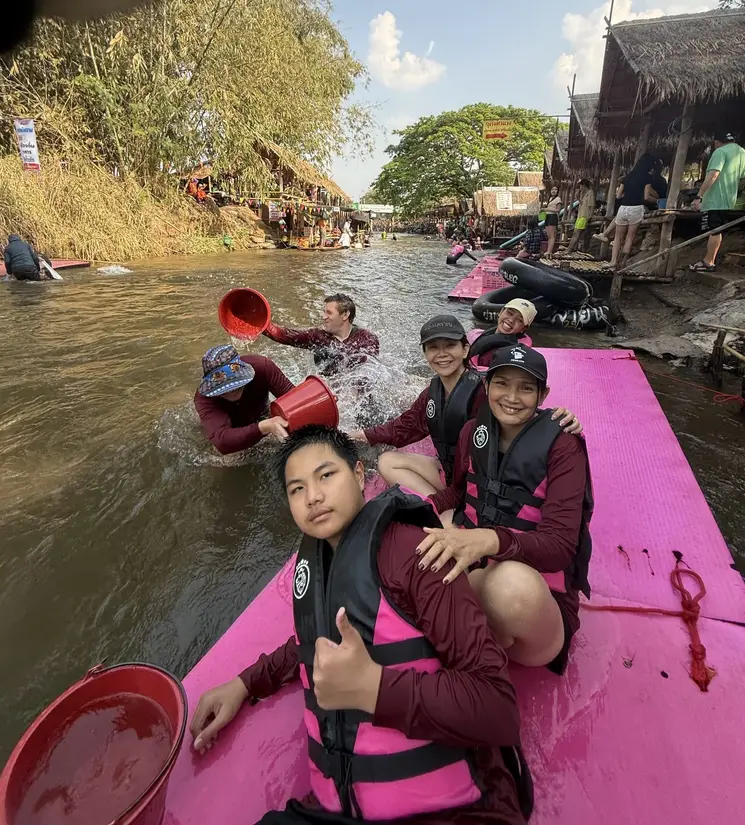
The absolute highlight of our Chiang Rai trip was the rafting tour at the Mae Suai Dam. We had dressed up as a team – in red T-shirts and bucket hats – and bought buckets and water pistols, planning to have a leisurely lunch on the riverbank. Inflatable boats full of enthusiastic locals floated past us, and as soon as they noticed a few "farangs" (westerners) in our group, we were drenched! Our lunch was mostly ruined, but we knew an exciting adventure awaited us.
After sitting on the riverbank for a while and having a good time in the water, we were picked up by a pickup truck and driven to the starting point of our rafting trip. We jumped onto our inflatable raft, packed with a cooler full of beer, and floated down the river with loud music blasting from waterproof speakers. During the ride, we tried to splash as many people as possible – with buckets, water pistols, or simply our hands. Locals shouted "Farang!" and we were immediately targeted, but just like at the Songkran festival, it was all just fun and games.
This is a seasonal experience that takes place from mid-February to mid-May, offering locals a welcome respite from the summer heat. We were there in March, and it was quite busy, although we didn't see any other tourists. The water is released from the dam and is crystal clear and refreshing. Just be careful how much beer you drink—it's easy to slip on the rocky bottom and be swept away. Aside from that, it's a safe and even family-friendly activity. The locals warmly welcome visitors and are happy to see you participating in this popular Chiang Rai tradition.
2. Explore the pedestrian zone of Chiang Rai (Saturday)
We were lucky enough to time our trip to include a visit to Chiang Rai Walking Street, which is only open on Saturday evenings. This huge open-air market along Thanalai Road is considered the most vibrant and authentic market in the entire city. Besides the food, we were particularly impressed by the "Ram Wong," a kind of line dance where everyone moves in sync. The cool and creative dance steps added to the market's unique atmosphere. If you can't make it on Saturdays, the Chiang Rai Night Bazaar, which is open daily, is a great alternative.
Chiang Rai pedestrian zone
3. Admire the Blue Temple (Wat Rong Suea Ten)
Chiang Rai is famous for its colorful, intricately designed temples, and the Rong Suea Ten (Blue Temple) was our absolute favorite. The blue murals inside were extraordinary, and the white porcelain Buddha statue in the center of the room exuded a special presence, especially when locals were praying and performing acts of kindness there. The Blue Temple was designed by Thai artist Phuttha Kabkaew, who, interestingly, was a student of the famous artist who designed the White Temple. Be sure to try the blue coconut ice cream from the vendors outside and take a photo in front of the intricately detailed facade.
Read more: The Blue Temple: What to see and do at Wat Rong Suea Ten
4. Lunch at Chivit Thamma Da
Chivit Thamma Da is a café, bistro, and bar known for its European vintage decor. After subsisting on frogs and fried insects, Cam absolutely had to order a burger, while the girls ordered smoothies and Thai food to share. We also drank beer from silver mugs, saw roosters roaming the grounds, and photographed the vintage cars parked out front. Chivit Thamma Da is just around the corner from the Blue Temple, making it easy to combine both visits in the late morning or early afternoon.
5. Visit the sheep farm in Akha Farmville.
Since a friend of ours was traveling with her daughter, we took the opportunity to visit Akha Farmville, a sheep farm with a café on Doi Chang mountain. Although it sounds like a family-friendly destination, we mainly saw adults trying to take "Instagram-worthy" photos of the sheep and the carousel. Akha Farmville has been compared to New Zealand, which Cam found hilarious—traveling all the way to Thailand just to see sheep he knows from home. Nevertheless, it was a great experience, especially watching the dogs herding the flock and trying the sheep's milk ice cream.
6. Visit the White Temple (Wat Rong Khun)
Just 20 minutes outside the city lies the White Temple, designed by Chalermchai Kositpipat, a Thai artist. He chose the color white to symbolize the purity of Buddha. He designed the Bridge of Rebirth, the temple's most famous feature. Here, visitors cross a bridge over a pit with outstretched hands representing hell. Crossing the bridge leads to the main chapel, which symbolizes the transition from suffering to Nirvana. The temple is rich in symbolism and meaning, but for most, it is simply an architecturally stunning building with mosaics that glitter in the sun.
Read more: The White Temple (Chiang Rai): How to visit Wat Rong Khun
7. Watch live music or a show at Tawandang Mahason
On our last evening in Chiang Rai, Elli had arranged tickets for us to see the Thai singer Kong Huayrai perform live. The concert was at Tawandang Mahason, a kind of "show pub," a combination of restaurant and nightclub. Once again, we were the only foreigners in the audience and got to experience a unique local phenomenon. You reserve tables, order food while the entertainment is on, continue drinking, and then the main artist takes the stage and the dance floor opens.
Kat and Elli were absolutely thrilled to see a Thai "superstar" perform live, while Cam simply enjoyed the show, even if he didn't understand the lyrics. It was a lively night, perhaps with a few too many bottles of whiskey ordered, but it was a blast! Seeing young Thais in their element, standing on chairs in a bustling bar and singing along, was simply fantastic. Tawandang Mahason often has live music or big shows on weekends, so check out their schedules; you might just find a really special evening there.
8. Try the frog specialties from Chiang Rai.
Cam's first dinner with Elli and her family was a real baptism of fire. We ordered food, and there wasn't a single cow, chicken, or pork in sight—just an endless array of frog dishes. He tried frogs with herbs, frog soup, and even crispy frog skin, but the unfamiliar taste was a bit much for him. That doesn't mean he didn't enjoy it, though; quite the opposite. Eating with locals isn't about loving every single bite, but about showing respect and connecting through food. Perhaps he'll develop a taste for frogs on his second visit!
9. Eat Mookata, an iconic northern Thai dish.
Mookata is a popular, social dish enjoyed throughout northern Thailand, and Chiang Rai boasts countless restaurants to choose from. When prepared correctly, it's simply delicious: thick chunks of pork and succulent prawns sizzle on the grill, surrounded by a broth of fresh vegetables, egg, and noodles. The best part is the dipping sauce: a tangy, citrus-based option for the seafood and a sweeter, chili-based one for the meat. On cooler Chiang Rai evenings, this is a wonderful experience, as the heat from the grill warms you from the inside out.
Read more: What to eat in Thailand: 50 dishes you absolutely must try
10. Take a trip to Phu Chi Fa for sunrise.
This had been on our bucket list for a long time, but unfortunately, we didn't have enough time. Phu Chi Fa is a famous mountain region in Thailand, known for its breathtaking sunrises. Getting there, especially for sunrise, is quite an undertaking: it takes two to three hours by car from Chiang Rai. Most travelers therefore book a private driver, organize a sunrise tour, or stay in a guesthouse at the foot of the mountain. With a bit of luck, you might even witness a sea of clouds over neighboring Laos!
Accommodation in Chiang Rai
Frequently asked questions about visiting Chiang Rai
When is the best time to travel to Chiang Rai?
We visited Chiang Rai in early March and were honestly a little worried about arriving right in the middle of the fire season (January to April). However, the air quality wasn't bad at all, and we hardly noticed any smog. It's said to be the hottest time of year, but after the oppressive heat of Bangkok, it felt significantly cooler. The most popular time to travel is between November and February, the supposedly cooler season. However, Chiang Rai is a worthwhile destination year-round and has a lot to offer even during the rainy season: lush, misty landscapes and more affordable hotel prices.
What's the best way to get to Chiang Rai?
Flying from Bangkok is easy and straightforward. Alternatively, you can take a bus from Chiang Mai. However, we recommend renting a car or motorbike and exploring Northern Thailand at your own pace. On our return trip to Chiang Mai, we chose Route 1, which eventually rejoins Route 118 but avoids most of the roadworks and offers a more scenic route. It's significantly more relaxed and only adds about 40 minutes to the journey.
Is Chiang Rai better than Chiang Mai?
This was our first visit to Chiang Rai, but we've also visited and enjoyed Chiang Mai many times over the years. Honestly, we can't say which city is better. We love them both equally. Chiang Mai is more touristy, no doubt about it, but it also has cool student neighborhoods and cozy spots along the river. In Chiang Rai, you feel like you're off the beaten track, which can be a bit of a culture shock, but also a sense of adventure. Chiang Rai is more open and less crowded, which is perhaps its greatest advantage.
Read more: Chiang Mai vs. Chiang Rai: Our honest travel comparison
Local temple in Chiang Rai




Community
Comments 0
Start the conversation.