Anyone who travels through Asia for a while will quickly realize that Thailand and Japan are the two best destinations. No other country on the continent can compete with Thailand's beaches and Japan's seasonal charm. With Bangkok and Osaka, you also have two of the world's most vibrant cities to choose from – neon lights, rooftop bars, and exceptional cuisine await you.
Choosing between these two countries isn't easy, as they appeal to completely different budgets, travel styles, and expectations. Some will love Japan's high-tech efficiency—the rapid journey through the landscape on the Shinkansen bullet train—while others will seek the freedom offered by a scooter ride through Thailand's palm-fringed island paradises.
We've now visited Japan twice, in between our frequent trips to Thailand, and had a wonderful time both times. Admittedly, we only traveled the "Golden Route" (Tokyo, Osaka, and Kyoto) and made a few side trips to Kobe and Nara. However, since Cam's best friend lives in Japan and, incidentally, speaks fluent Japanese, we were able to immerse ourselves much more deeply in everyday Japanese life with him as our local guide. This enriched our travel experience immensely and made us huge fans of the Land of the Rising Sun.
Ultimately, we recommend visiting both Thailand and Japan. If this isn't possible, you might need some help deciding. That's why we've put together this comprehensive travel guide comparing costs, transportation, food, and attractions in these two popular tourist destinations. The biggest obstacle to traveling to Japan is usually the price, so let's start there.
Fushimi Inari Taisha, Kyoto
How far will your money go in Thailand compared to Japan?
Japan is currently experiencing a real travel boom, even though it's more expensive than Thailand. The flight itself isn't the biggest expense – Tokyo is a well-connected city with many budget airlines. It's the accommodations, train tickets, and restaurants that really strain your budget. On our first trip to Japan, we flew from Bangkok and were lucky enough to snag some cheap flights with AirAsia. The flight reminded Cam of home: green coastal landscapes very similar to New Zealand.
Barely landed in Tokyo, we realized that budget hotels don't get you very far in Japan. We had booked a hotel for $80 a night, which we thought was a good deal, but were shocked by how tiny the room was. Unfortunately, this is common in Japan: many budget hotels are tiny. On our next visit, we were able to afford a boutique apartment called Asakusa Kaede (around $150 a night). It was nice, but the room was still quite cramped. If we had spent $150 a night in Bangkok, we could have gotten a spacious four-star hotel with a pool and significantly more amenities.
Another cost factor is the Shinkansen: the trip from Tokyo to Osaka costs between US$90 and US$135 (13,870 to 20,450 yen). However, it's an exciting experience that we highly recommend. You can save money in Japan, especially on food. There are numerous mid-range restaurants, frequented mainly by office workers, offering everything from ramen in small stalls to sushi prepared right in front of you. In these more local establishments, we spend between US$5 and US$15 per meal.
But that's nothing compared to the affordable street food in Thailand. While street food culture isn't as prevalent in Japan, in Thailand it's ubiquitous. Pad Kra Pao can be found for as little as US$2, even in tourist areas. From our experience as a couple, we know that Japan is about US$100 more expensive per day than Thailand. Over 30 days, that adds up to an extra US$3,000. That's why Thailand is such an attractive travel destination. Even on a modest budget, you can feel like royalty here: How about a massage for 300 baht, for example?
Comparison of the weather and the different seasons
Our first trip to Japan took place during "Golden Week"—a period in spring (April 29 to May 5) when four public holidays coincide. It was a wonderful time to travel, as we had sunshine every day and temperatures around 20°C (68°F). On our next visit in early September, at the end of summer, the humidity was, frankly, oppressive. It also rained a lot, which somewhat diminished the beauty of some landscapes, except in Kyoto, which, with its dimly lit streets, actually looked quite charming in the rain.
Japan definitely has four distinct seasons, while Thailand is hot year-round and can essentially be divided into a dry season and a rainy season. We recommend visiting Japan in spring to experience the cherry blossoms, unless you're traveling to Hokkaido for powder snow. In that case, you should obviously come during the winter months of January or February. Summer is also a good time to visit, especially for Okinawa Prefecture.
The best time to travel to Thailand is usually from November to April. During this period, clear days and calm seas prevail, ideal for island hopping. Those wishing to combine both countries in one trip should visit Thailand in March and arrive in Japan in early April, when the cherry blossoms are in full bloom. An important weather tip for Japan: Don't underestimate the summer heat. Experience shows it can be even more oppressive than during the Songkran festival (Thai New Year).
Island hopping in Thailand in February
Is Thailand or Japan easier to travel to?
Thanks to its efficient train network, long-distance travel in Japan is straightforward. You can get from Osaka to Hiroshima in no time, and even remote places like Sapporo are accessible via scenic train routes. This is quite different from Thailand, where domestic flights are often the most convenient option, especially for long distances like Bangkok to Phuket. Even the night buses in Japan are fantastic. We took a bus from Osaka, and the passenger compartment was separated by curtains, allowing us all to sleep. It's these little details that make Japan so special.
Public transportation in Japan runs like clockwork – a true spectacle. For the Shinkansen between Tokyo and Osaka, you can buy an unreserved seat (the cheaper option) and then wait for a train with an available seat, as they run approximately every ten minutes. Even the subways in cities are remarkably punctual despite the heavy traffic during rush hour.
This isn't to say that public transport in Thailand is bad. Bangkok, for example, has a fairly good subway and BTS network, though it's certainly not as impressive as Japan's. Thailand is distinguished by its unique local alternatives such as tuk-tuks, songthaews, and "win" motorbikes. The well-developed ferry and boat routes are also not to be underestimated, making it easy to reach remote islands like Koh Rok and Koh Haa.
All in all, traveling in Thailand is less smooth than in Japan, but significantly cheaper. We could hardly believe how expensive a short taxi ride to the airport was in Japan: 50 US dollars for 20 minutes. So another time, we tried taking the Tokyo subway to the airport, which only caused us more problems. The carriages were so overcrowded that there was no way we could fit in with our luggage. In the end, we had to wait for three or four trains and almost missed our flight.
Traveling by train in Japan
How the local culture and atmosphere are
Thailand is a predominantly Buddhist country; Buddhism is practiced by over 90% of the population and permeates many aspects of daily life. Less well known, however, is that Japan is also influenced by Buddhism in its own way. Throughout Japanese history, Buddhism and the indigenous Shintoism coexisted, and many people integrated elements of both faiths into their lives. Nevertheless, Japan is largely secular today and views these practices more as cultural traditions than as strict religions.
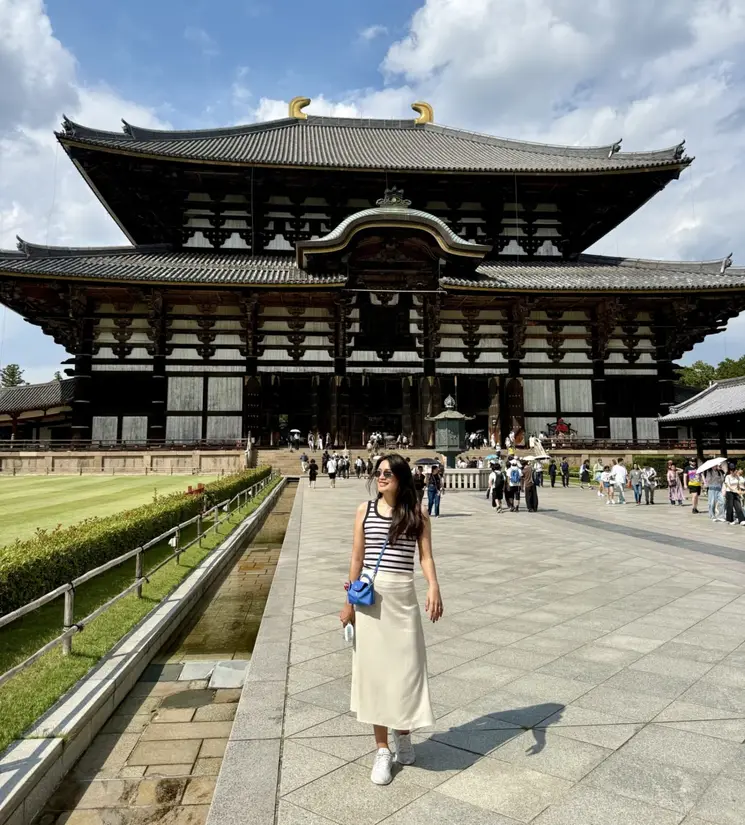
The impressive architecture of both countries reflects these spiritual identities. Thailand, of course, is home to a multitude of magnificent temples – from Wat Pho in Bangkok to Wat Si Chum in Sukhothai. Japan, on the other hand, surprised us with some of the most imposing temples we have ever seen. The Buddhist Todai-ji temple in Nara truly blew us away, and we were equally captivated by the serene and elegant atmosphere of Kennin-ji temple in Kyoto, famous for its black and white dragon paintings.
Japan generally exudes a very peaceful atmosphere. We remember how we imagined it would be to live here. This is mainly due to the polite and respectful customs of the locals. It's impressive to see how quiet people are on the trains, how clean the streets are, and how you're greeted with a warm "Irasshaimase" (welcome) in restaurants. Even the deer sometimes bow, as we observed in Nara Park.
That doesn't mean the Japanese don't have a sense of fun – quite the opposite. We watched children playing baseball in the parks, participated in a rock-paper-scissors tournament in Osaka, and saw go-karts whizzing through the streets of Tokyo. Some people think the Japanese are reserved, but we experienced it quite differently. In the small, quaint bars, it's easy to strike up a conversation with locals and experience how lively the night can be. Making new friends is incredibly easy.
The same is true for the Thai people, who radiate incredible warmth wherever they go. Thailand has a certain "mai pen rai" (no worries) mentality, which contrasts sharply with Japan. This can lead to phenomena like "island time" and chaotic markets, but if you embrace this easygoing nature, you'll be captivated by it in the best possible way. Thailand's rugged charm appeals to backpackers seeking freedom, while Japan's modern comfort attracts travelers who value convenience.
Buddhist temples in Thailand
Kat is playing "Rock, Paper, Scissors".
Thai food vs. Japanese food: Which is better?
Food lovers will find a true paradise in Thailand and Japan – the quality and variety of the cuisine is exceptional. Both countries share a passion for seafood, evident in Japan's fresh sashimi and giant rock oysters, and Thailand's steamed crab and grilled fish. Excellent barbecue is also very popular: yakiniku in Thailand and mookata in Japan. Japanese beef is legendary, while Thai pork sizzling on the grill pairs perfectly with the famous dipping sauces. We even developed a fondness for grilled beef tongue in Japan. It might sound unusual, but the texture is irresistibly juicy and tender.
Japanese beef is world-class and far superior to Thai beef, whether you prefer Wagyu sushi or teppanyaki (where the chef prepares the food right in front of the guests). However, Japanese beef is expensive and probably not something you eat every day. We tried Kobe beef (in Kobe) and, to be honest, didn't find it particularly good value.
Some of our best meals in Japan were actually eaten in unassuming local restaurants. Cam had the best tuna of his life at a small food stall near Osaka Station, and Kat simply enjoyed takoyaki (octopus balls), sweet potatoes, and tuna mayo onigiri from Lawson. This is how you can eat cheaply here: small meals from bakeries, snack bars, and supermarkets. The three largest convenience stores in Japan are Lawson, FamilyMart, and 7-Eleven, and they all offer enough to keep you fed throughout the day.
There are many 7-Eleven stores in Thailand, but we recommend trying street food instead to save money. Dishes like som tum, khao soi, and boat noodles can be found there for under 100 THB. However, local Thai food can be very spicy, so be sure to order "ped nit noi" (a little spicy). Aside from wasabi, Japanese cuisine isn't very spicy, which is why we prefer Thai food.
Spicy salmon salad, Thailand
Comparison of cities and European Capitals of Culture
Tokyo was a bit of a disappointment in Japan. While some sights are impressive and everything is very organized for such a large city, it lacked the energy of Bangkok. We preferred Osaka with its vibrant Dotonbori district and nearby temples like Katsuoji. Cam's boyfriend lives in Osaka, so we were able to have a more authentic experience there.
Right after our arrival, we went to a bar where Cam's friend surprised him with a portion of whale bacon. Cam had no idea what it was, but eventually got the joke. It wasn't bad, but we wouldn't try it again, knowing how controversial whaling is. Later, we explored Osaka Castle, did some shopping, and visited a karaoke bar. In our opinion, Osaka simply has more charm than Tokyo.
Our favorite city in Japan was Kyoto, and we even found it more beautiful than Chiang Mai (a similar cultural capital). Kyoto is only a 30-minute train ride from Osaka, and the atmosphere is simply enchanting. On our first visit, we stayed up all night in Kyoto and took the train back at 6:00 a.m. after only a short nap in one of the hotel internet cafes.
Our next visit to Kyoto was a much more relaxed experience. We booked a few nights at the cozy Akatsuki Villa and explored the beautiful Gion district, taking walks along the river, visiting the Arashiyama Yusai-Tei Gallery, and seeing the Golden Pavilion. While Chiang Mai has a similarly laid-back atmosphere, Kyoto is simply unique.
The charming streets of Kyoto
Does Thailand or Japan have more natural beauty?
Thailand's biggest advantage over Japan is the abundance of beautiful, tropical islands in the south. While the Okinawa islands can certainly compete with their pristine beaches and crystal-clear waters, the selection is smaller. Places like Koh Tao, Koh Ngai, and Koh Kood are perfect for beach lovers. Japan, on the other hand, scores points with its seasonal activities: from relaxing in the onsen (hot springs) of Kyushu in winter to experiencing the autumn foliage in Arashiyama and climbing Mount Fuji in summer.
Both countries boast a wealth of charming mountain towns: Chiang Dao and Mae Kampong in Thailand, and Takayama and Shirakawa in Japan. And both offer breathtaking landscapes, from Khao Sok National Park to Nikko National Park. Ultimately, the choice of scenery comes down to personal preference.
Khao Sok National Park, Thailand
Frequently asked questions about traveling to Thailand vs. Japan
Do people in Thailand or in Japan speak more English?
In the tourist areas of Thailand and Japan, people speak basic English, enough to easily check into a hotel and buy train tickets at the station. However, we were surprised by how little English the Japanese speak compared to the Thais. Apps like Google Translate can help, and a few "Arigato gozaimasu" (Thank you) and "Kanpai" (Cheers) never hurt.
Is Thailand as technologically advanced as Japan?
Thailand is making rapid technological progress, for example with mobile payments via QR code (linked to Thai bank accounts). Compared to Japan, however, it's still a long way off. We were once in a hotel in Tokyo and were woken up in the middle of the night by an earthquake alarm. We barely felt the quake, but it was impressive to see how well the technology works.
We've also stayed at the Henn na Resort & Spa Kansai Airport, where the entire check-in process is handled by robot dinosaurs acting as receptionists. You can even converse with them in your preferred language. It was bizarre, almost as strange as Japan's high-tech toilets, which are quite confusing to operate. There are so many functions that it's almost impossible to find the flush button.
Dinosaur robots at Henn na Resort & Spa
How does Japan compare to Bali and Vietnam?
If Japan is beyond your budget, but you still want to visit other Asian destinations (besides Thailand), we recommend Vietnam. The country is extremely affordable and offers excellent value for money. Another budget-friendly alternative is Bali, where you can find luxurious pool villas at reasonable prices. However, don't let the price deter you from Japan: it offers a fascinating blend of tranquility and entertainment.




Community
Comments 0
Start the conversation.