Travel journalist and blogger Roderick Eime (Traveloscopy.com) visits the villages in Thailand where Her Majesty Queen Regent Sirikit has helped to preserve the ancient art of traditional Thai silk weaving.
Deep in the jungle of the Isaan region, far from the hustle and bustle of nearby Surin, lies the small village of Ban Tha Sawang. It is one of several villages in the area that specialize in the ancient art of silk weaving and enjoy high esteem at the royal court.
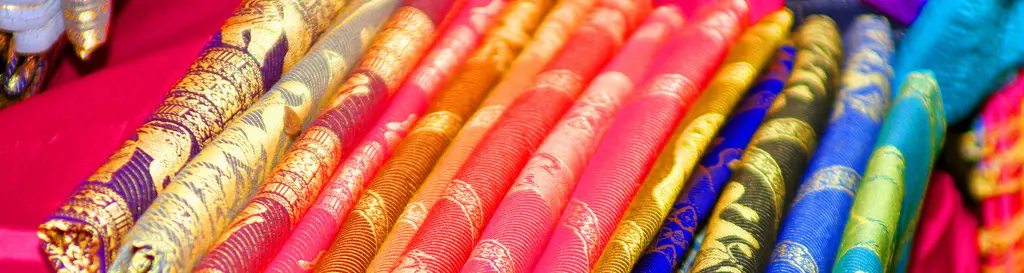
In a makeshift shelter, a dozen young Thai women chat and giggle as they busily weave intricate designs with fine gold and silver threads. Adjacent rooms are a hive of activity: small looms and busy hands intertwine the delicate threads into magnificent, richly detailed fabrics. The girls' nimble fingers weave softly shimmering Chan Soma silk threads into brocade, which possesses the characteristic luster of genuine Thai silk and changes color depending on the light.
Royal silk, also known as Pha Yok Thong, is reserved for monarchs and heads of state. Her Majesty Queen Sirikit's SUPPORT Foundation (Promotion of the Supplementary Occupations and Related Techniques) is dedicated to preserving this unique traditional weaving technique. Thanks to the Queen's personal funds, the villagers of Ban Tha Sawang have the necessary facilities to produce this world-renowned silk. In addition to establishing colleges and workshops throughout the country, the Royal Family contributes to the preservation of this ancient craft by ordering and wearing the fabrics themselves and for high-ranking visitors.
Queen Sirikit is a great advocate of Pha Yok Thong fabric and often wears it to state occasions. At the 2003 APEC summit, heads of state and government were presented with shirts and scarves specially made from this special fabric for the occasion. These were crafted by the royal craftsman and teacher Ajarn Weeratham, along with a team of 100 villagers from Ban Tha Sawang. Ajarn also presented the Queen with an incredibly artistic piece as a thank-you gift for her birthday; an identical replica hangs in the village workshop.
In the enormous neighboring building stands the massive, handcrafted loom. This intricate machine was meticulously crafted according to a centuries-old, traditional design. It is a cumbersome device that requires four operators working simultaneously and continuously to produce perhaps two centimeters of fine silk yarn per day.
According to Ajarn, the more elaborate designs require around 50 days to produce a single meter of fabric. That equates to 1,600 working hours. The cost: 40,000 baht (US$1,500) per meter. Royal effort for a royal fabric whose popularity remains undiminished.




Community
Comments 0
Start the conversation.