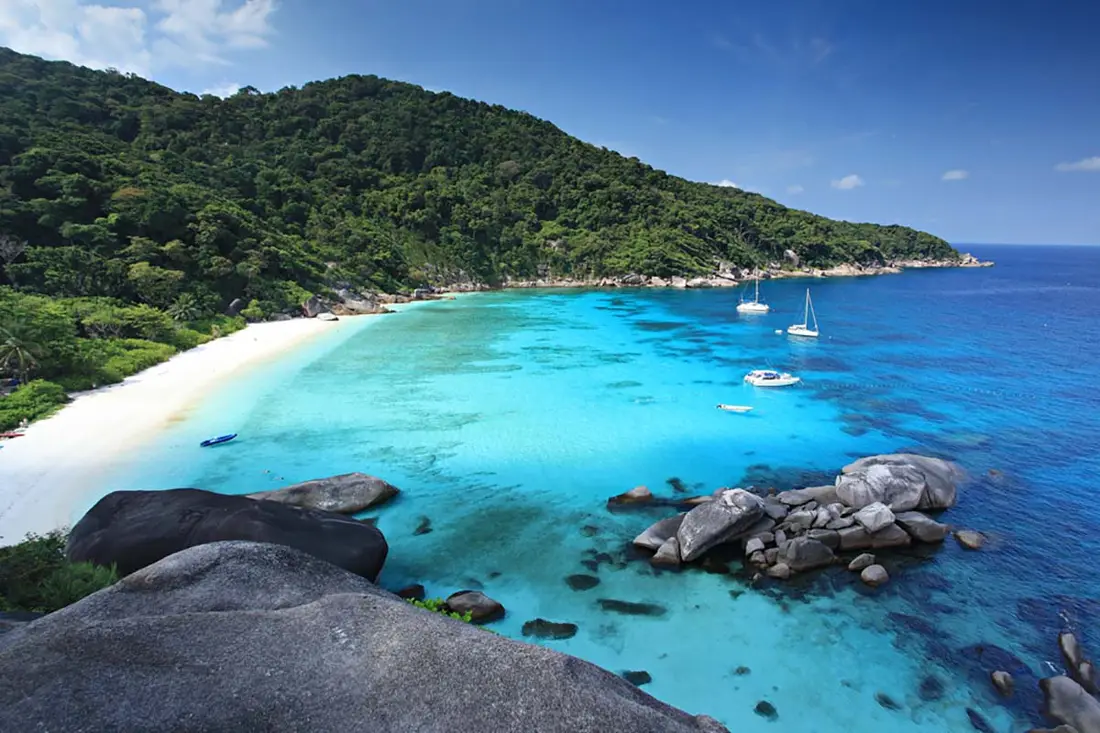
New daily limits on the number of tourists and divers, strict fishing regulations and bans on single-use plastics are already having a positive impact on the visitor experience on Thailand's Similan and Surin Islands.
Thailand is taking many steps in the right direction to protect its marine environment and has launched a number of environmental initiatives and environmentally focused programs.
Most recently, the Department of National Parks, Wildlife and Plant Conservation (DNP) closed a number of islands (some indefinitely) and introduced a permit system for the Similan and Surin Islands, limiting the number of day-trippers and divers allowed each day.
Over the past 20 years, tourism in Thailand has increased massively, and this, along with related factors such as overdevelopment and plastic pollution, has had a negative impact on Thailand's marine environment, which is why the government is now taking drastic measures to counteract this.
Local diving operator Holger Schwab, owner of the Phuket-based Sea Bees Dive Centre, which has been offering diving trips here for 27 years, reports that divers are already noticing the positive effects of these regulations on the marine environment.
“Tourism always impacts an ecosystem, and it is the responsibility of the authorities to minimize these impacts. Thailand became very popular with the diving community after the turn of the millennium, leading to an increase in boats and divers in the Similan Islands, inevitably impacting the environment. Fortunately, most divers behave in an environmentally conscious manner, and the damage to marine life was limited. However, with the new wave of mass tourism, primarily from Asia, this changed, and we found ourselves dealing with a large number of people who had a different understanding of Mother Nature. This quickly became apparent, and it was time to act.”
"After mass tourism swept through Thailand and the Similan Islands, the islands suffered both above and below the water. Fortunately, apart from some hard coral species, marine life can recover very quickly, and it is never too late to shift towards more environmentally friendly tourism."
"Following the 2004 tsunami, coral bleaching, mass tourism, and the associated negative press, the reputation of Thailand's diving areas has suffered dramatically. The Department of National Parks (DNP) of Thailand has recognized this development and has begun working on regulations to reduce the impact of mass tourism on the ecosystem and Thailand's reputation."
The recently introduced stricter rules are not the first improvement the DNP has made. In recent years, dive operators have noted significantly better control of fishing and more efficient monitoring of the parks.
"Together with the established daily maximum number of divers and snorkelers, we are seeing an immediate positive effect at all dive sites."
"Sightings of sharks at Phi Phi Island have increased, the soft coral fields at the Similan Islands have expanded, and overall we are finding that there are many more fish and marine life at the dive sites."
In summary, the reefs look healthier and the customer feedback on our first Similan diving safari and day trips this year has been extremely positive.
“Thanks to these new regulations, the Similan and Surin Islands, as well as the stunning dive sites around Phi Phi Island, are well on their way to once again becoming some of the best diving destinations in the Andaman Sea. Our customers are already thrilled by the greater marine biodiversity, the numerous pelagic fish, and the less crowded beaches in this unique paradise above and below the water.”
Another positive step for the marine environment: The groundbreaking initiative “No Foam No Plastic” was launched in Phuket this month.
The program will be launched on Valentine's Day – February 14, 2019 – in collaboration with the TAT Phuket Office, the Phuket Tourism Council, the Southern Chapter of the Thai Hotels Association, the Phuket Industrial Council, the Patong Hotels Association, the Kata-Karon Hotels Association and the Phuket Chamber of Commerce.
The governor of the Tourism Authority of Thailand (TAT), Yuthasak Supasorn, stated: “This is an important step in the right direction in line with the Thai government’s goal for sustainable tourism development, ‘Thailand 4.0’. Hopefully, Phuket will be a positive example that the whole country can follow.”
"The importance of Phuket as one of Thailand's most famous tourist destinations should not be underestimated."
From February 14, 2019, local retailers participating in the program will no longer use polystyrene containers for food or other items. From October 1, 2019, they will be encouraged to switch entirely to paper bags or eco-friendly bags and straws.
The tourism sector will encourage its business partners to do the same from February 14, 2019.
As part of its ongoing mission to expand and further improve the practice of sustainable and responsible tourism, the TAT has taken a leading role in nationwide efforts and has launched a number of programs and campaigns in collaboration with various organizations.
In August 2018, the Tourism Authority of Thailand (TAT) fully supported the National Parks Administration's (DNP) implementation of a ban on single-use plastics in 154 national parks. This step towards reducing the amount of waste polluting nature and threatening the kingdom's wildlife is highly welcome. The ban includes plastic bags, plastic cutlery, straws, water bottles with lids, polystyrene food containers, and essentially all plastic items that are typically used only once and then discarded.
The DNP estimates that the ban on single-use plastics will help reduce plastic waste by about 3 million items, and that around 10 million people will participate in the initiative in the first year of implementation.
In August 2018, the TAT, in collaboration with various stakeholders including the Expedia Group and the Thai Hotels Association, announced the “Travel Thailand in Style, Reduce Plastic Waste” initiative, with the aim of reducing tourism-related waste by up to half by 2020.
The initiative started in Bangkok and was expanded to other tourist destinations throughout the kingdom. It provided support and recommendations for reducing waste and single-use plastics, for example by using cotton bags instead of plastic bags, reusable water cups instead of plastic bottles, and reusable cutlery instead of plastic cutlery.
“Upcycling the Oceans, Thailand” is another TAT initiative that began in March 2017. The national tourism authority partnered with PTT Global Chemical (PTTGC) and the Ecoalf Foundation, and Thailand was the first Asian country to join the global ocean cleanup initiative.
As part of this initiative, the "Save the Ocean & Save for Your Dives" campaign was launched in Phuket to rid Thailand's seas, islands, and coastal areas of trash, particularly in popular tourist areas on the east coast, in the Gulf of Thailand, and in the Andaman Sea. The campaign aims to demonstrate that trash can not only be removed but also reused by being processed into yarn for fabrics, granules, and other products.

Community
Comments 0
Start the conversation.