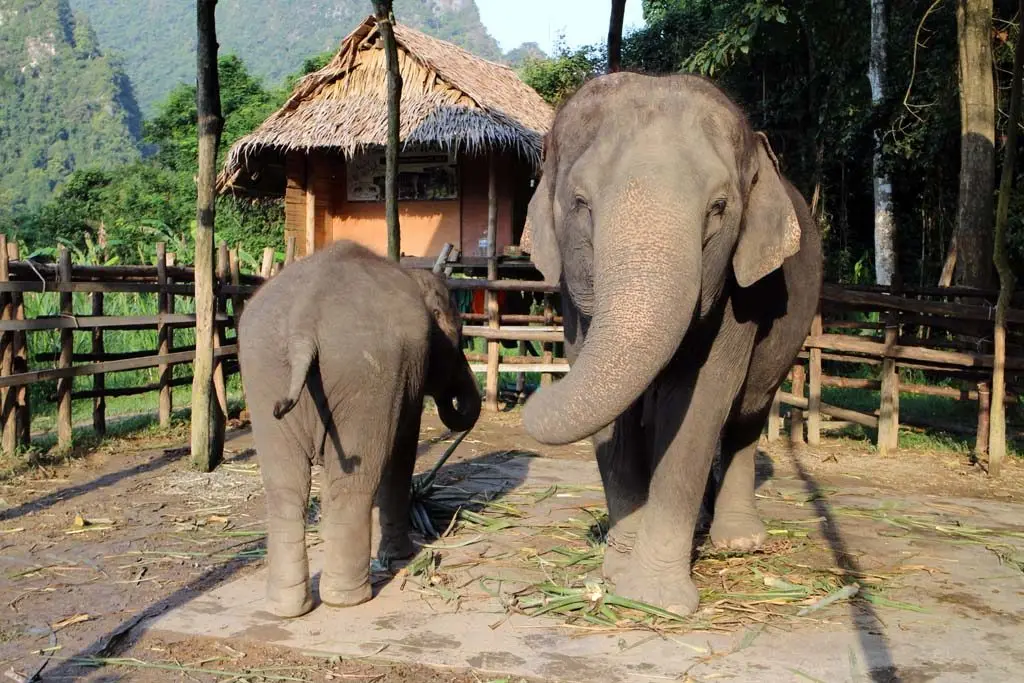
Elephant Hills Safari Tours, recently highly praised at the Thailand Green Excellence Awards, offers visitors to Thailand who want to experience the country's wildlife up close a unique Thailand experience. According to Chris, CEO of Elephant Hills: "Our approach at Elephant Hills is to avoid elephant riding and elephant shows in order to provide a more responsible, unique, and enriching experience for both elephants and people."
“We also place great importance on animal welfare; our guests have the opportunity to feed, wash, and interact with Asia’s largest land animal. This is an excellent opportunity to get up close to these gentle giants in a responsible way, while also learning more about their status and situation in Thailand.”
A typical Elephant Hills safari tour lasts two to three days and takes place in one or both tented camps in Khao Sok National Park.
The safari begins with an early pick-up from your hotel in Phuket or Krabi. You will be provided with water and peanuts for the 2.5-hour drive to our first camp in Elephant Hills.
Upon arrival, you will be welcomed with a sumptuous lunch buffet and escorted to your glamping accommodation before embarking on a kayaking tour on the Sok River. Afterwards, you will continue to the elephant camp, just a few minutes away.
Here you will encounter the elephants and receive a comprehensive lesson on everything from their behavior in the wild to their use in the now-defunct timber industry, to what ultimately brought these animals here to a sanctuary in the far south of Thailand, far from their homeland.
In Thailand, natural habitat for Asian elephants is scarce – a legacy of deforestation that has left isolated patches of rainforest in many parts of the country. As a result, it is difficult for elephants to survive in their natural state. Furthermore, some of these animals have been domesticated for so long that they have lost their natural behaviors.
Today, Thailand boasts numerous national parks, the result of a grassroots environmental movement that began in the 1980s. This movement halted deforestation for the timber industry, prevented the construction of a dam in central Thailand that would have had devastating environmental consequences, and fostered a generation of conservationists.
Thais visit their own national parks more often than people of other nationalities – the parks aren't just for international tourists like myself. Protecting nature is a value that aligns well with Buddhist philosophy. Following the success of the environmental movement in the 1980s, Buddhist monks instilled this value in the younger generation in Thai schools.
And then there are places like this, educational centers that bring tourists closer to these magnificent animals. The elephants come from northern and central Thailand and are accompanied by their Karen mahouts. These mahouts wear colorful traditional clothing and keep their mischievous charges in line with clicks, clucks, and pats, while the guests learn to scrub the animals before preparing a lunch of pineapple, bananas, sugarcane, and elephant grass. In the evening, guests are treated to a dance performance by local schoolchildren and a cooking demonstration of Thai cuisine.
The next day, guests continue on to Camp Two: a floating camp on Cheaw Lan Lake. Here, they can participate in a three-hour jungle hike and climb one of the high limestone cliffs to reach a large cave.
Back on the lakeshore, you can spend the rest of the day and the following morning swimming and kayaking on the lake, or simply relax and listen to the sounds of the surrounding animals: cicadas, hornbills and gibbons enjoy themselves in the jungle.
Further information can be found on the Elephant Hills website.
Community
Comments 0
Start the conversation.