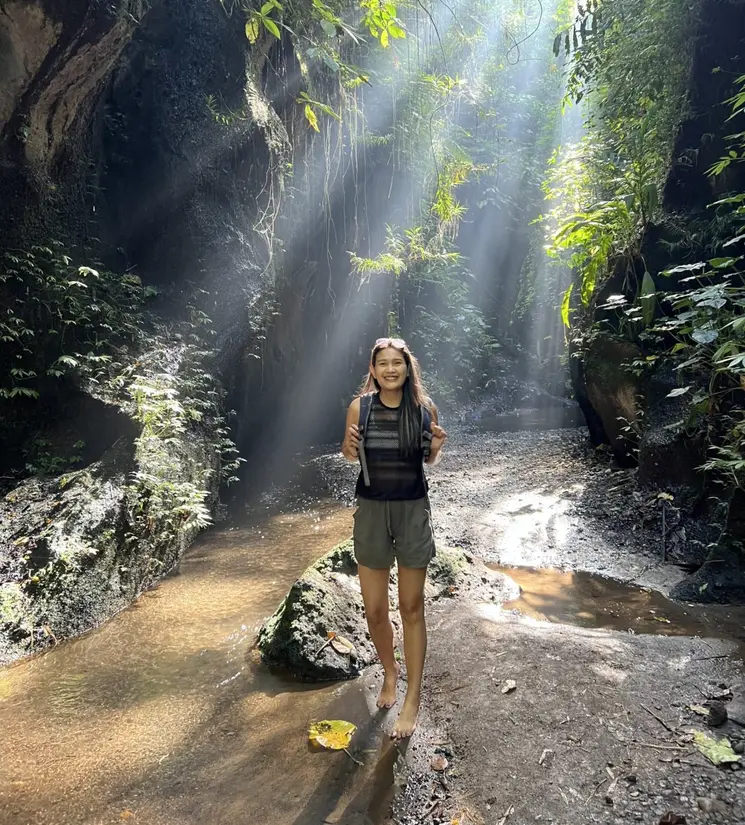
We were incredibly excited when we first arrived in Bali. We flew in from Japan, the next stop on our six-month trip through Asia, and headed straight to Ubud. We spent the following weeks exploring waterfalls, getting lost in rice terraces and temples, and enjoying the incredible food this part of Bali has to offer. Apart from the monkeys (more on that later), it was a magical experience, and we fell in love with the island.
Shortly after, we returned and this time spent our stay in Canggu and Kuta, but we didn't get the same feeling. Perhaps it was our travel fatigue, the kitschy beach clubs, or the sheer number of tattoo parlors. Whatever it was, Bali didn't quite live up to our expectations. Nevertheless, we had a lovely time and enjoyed the little moments: the sunset over the cliffs of Uluwatu, a few beers with the locals, and spending time with Cam's parents, who visited us for a few days at the end of our trip.
Based on these experiences and our extensive time in Thailand, we can confidently say that these two hotspots offer completely different atmospheres. Both are famous for their beaches, of course, but only one allows you to immerse yourself so easily in local life. In our opinion, Thailand offers the better overall package – after all, we're comparing an entire country to an island. Bali, on the other hand, has unique qualities that are unparalleled worldwide. Here's our assessment of how these two travel giants compare.
Tukad Cepung Waterfall, Bali
Sharing a beer with the locals
Getting around in Thailand vs. Bali
Thailand is roughly 90 times the size of Bali – any comparison should take that into account. Traveling in Thailand means constantly packing and unpacking, and using domestic flights, trains, buses, and boats to get from Chiang Rai in the north to Koh Lipe in the far south. In Bali, on the other hand, all you need is a nice villa and a motorbike to comfortably explore the island for weeks. Bali's biggest weakness is its public transportation: there's nothing comparable to Bangkok's MRT or BTS.
Bali has truly terrible traffic for an island, unlike Thailand with its dozens of relaxed islands where getting around is a breeze. We could hardly believe how long it took us to finally reach our hotel in Ubud, and even with rented scooters, things didn't improve. We constantly had to squeeze through traffic jams and at times even drive on the sidewalks just to avoid wasting the whole day.
Once you leave the tourist hotspots, the roads in Bali are significantly less crowded, and you can easily travel from a surf spot to a jungle hike with a waterfall within an hour. This is Bali's biggest advantage over Thailand: the island is smaller, and the sights are closer together. As long as you can ride a scooter safely, you'll manage just fine; otherwise, you'll be reliant on Grab services and private drivers, which can increase costs somewhat. Thailand generally offers cheaper alternatives for local transport, such as songthaews or tuk-tuks.
Is Thailand cheaper than Bali?
That's a tricky question, as it depends on several factors. Flights to Bali are obviously cheap for Australians and anyone living in Asia, while Americans or Europeans usually need one or two layovers. Conversely, you can fly directly to Suvarnabhumi Airport (BKK) from many different destinations, including Paris, London, and Vancouver. This can, of course, save you several hundred dollars on the overall flight price.
Once in Thailand, you'll find it easier to locate local markets and inexpensive street food. Unfortunately, Bali's popular areas are dominated by trendy brunch spots, Western-style cafes, and expensive beach clubs like FINNS. You might be surprised to find that a flat white costs about the same as it does back home. These daily food expenses quickly add up and negate any savings you might have made by finding a cheap pool villa.
Comparison of beaches and surf conditions
Thailand is simply unbeatable when it comes to tropical beaches – whether you choose the palm-fringed paradise of Koh Kood, the crystal-clear lagoons of Koh Kradan, or the limestone landscapes of Railay. Bali offers a similarly beautiful coastline, but the landscape is different. Here, instead of postcard-perfect white sand beaches, you'll find the deep black volcanic beaches of Amed, the breathtaking cliffs of Nusa Penida, and the rugged surf spots of Uluwatu.
It's hard to say which is better, as it ultimately comes down to personal preference: Do you prefer calm waters for relaxation or the thrill of riding big waves? Bali and all of Indonesia are considered top-notch surfing destinations, while Thailand only offers gentler waves in certain spots like Khao Lak. For beginners and intermediate surfers, Bali is a true paradise. Experienced surfers, on the other hand, will find a greater challenge in the Mentawai Islands.
Read more: The 15 most beautiful beaches in Thailand: Famous spots and hidden gems
Why Bali scores highly when it comes to waterfalls and rice terraces
One thing we can say for sure: Bali has more beautiful waterfalls and rice terraces. Although Thailand is still a very green country, especially in areas like Erawan National Park, the waterfalls and rice paddies there never really wowed us. Bali, on the other hand, exudes a lush, green atmosphere. Our favorite spot was the Jatiluwih rice terraces: a veritable sea of green with mountains in the background and picturesque little paths lined with gentle streams. We had brilliant sunshine, which made the area incredibly peaceful.
We were absolutely thrilled by Bali's waterfalls. Sekumpul Waterfall offers a fantastic viewpoint, Tukad Cepung Waterfall lets sunbeams fall into a hidden gorge, and Leke Leke Waterfall is famous for its narrow, single cascade. Our only "bad" experience at Bali's waterfalls was when a local vendor at Leke Leke Waterfall ripped us off for a few bottles of water and some passion fruit. We probably paid five times too much, but who cares when you've just explored a little piece of paradise?
Jatiluwih rice terraces, Bali
Leke Leke Waterfall, Bali
The flair/local culture of Thailand and Bali
The atmosphere between Bali and Thailand can be described, as they say in Asia, as "similar yet different." Both places are characterized by beautiful local cultures in which religion plays an important role. In Thailand, this is evident in the customs and traditions of Theravada Buddhism with its magnificent temples, peaceful monks, and the relaxed "sabai sabai" mentality of the people. In Bali, too, you'll find friendly locals, mostly practicing Balinese Hinduism, with daily flower offerings and the distinctive "santai" lifestyle (relaxation).
These cultural peculiarities are most noticeable in the local neighborhoods, which is why it's so important to occasionally leave the tourist hotspots. That's the biggest pitfall in Bali – limiting yourself exclusively to Legian and Seminyak severely restricts your experience. We were somewhat disappointed by the scale of the development and the crowds of digital nomads, gym-goers, and all those supposedly trying to escape the "Matrix" circus, who are naturally drawn to it. Thailand has something similar, but it's not as centralized and intrusive as Bali.
Can the food in Bali compete with that in Thailand?
We consider Thai cuisine to be among the best in the world, probably comparable only to Japanese or Italian. It's no coincidence that almost every city in the world has a Thai restaurant and a Thai massage parlor. In contrast, in Western countries you have to actively seek out a specialized Indonesian restaurant. We know this might sound a bit lazy and uninformed, but the only typical Indonesian dish we tried in Bali was Mie Goreng. Otherwise, in Ubud, Canggu, and Kuta, we were mainly inspired by international cuisine.
International cuisine in Bali isn't cheap, but some of it is really good. In Ubud, we discovered a fantastic Thai restaurant called Warung Siam and a pretty decent Mexican restaurant called Taco Casa. If we'd had Balinese friends to show us around, we certainly would have been immersed in a whole new world of local cuisine, but unfortunately, we didn't. Cam, for example, knows what it's like to travel through his homeland with a local: Kat constantly orders him unusual and delicious Thai dishes, and he loves it.
Read more: What to eat in Thailand: 50 dishes you absolutely must try
Warung Siam Restaurant, Bali
Understanding the different seasons
For us New Zealanders, Bali offers a truly attractive climate with its dry season falling right in the middle of our winter (May to October). In Thailand, on the other hand, the best weather is from November to April, when it's already getting warmer for us. That's why we're always torn about whether to leave the Pacific coast during this time. However, Thailand's dry season is ideal for Americans and Europeans who want to visit a warm country in winter.
If you're planning a longer backpacking trip through Asia lasting at least six months, we recommend traveling to Thailand in January or February and saving Bali for later (for example, June or July). This way, you can enjoy sunshine the entire time. Even the rainy season in Thailand and Bali can be appealing, as long as you have alternatives in place for the inevitable downpours. Since cities like Bangkok and Chiang Mai offer more indoor activities, Thailand is definitely the safer choice during the off-season.
Other regions of Indonesia worth visiting
We also took day trips to Sumba and Jakarta, but in our opinion, only one of the two islands is truly worth seeing. Sumba is unique: there's hardly any infrastructure, and the landscape is wild and untouched. We saw horses everywhere, impressive waterfalls, dancing trees, and rolling hills. Our trip to Jakarta, on the other hand, was very short. We only stayed a few nights to plan our trip and found ourselves in a polluted city where it was difficult to find good food. We would have preferred to visit Raja Ampat and the Komodo Islands instead.
Frequently asked questions about Thailand vs. Bali travel
How does Phuket compare to Bali?
Although Phuket is Thailand's largest island, it is significantly surpassed by Bali in both area and population. Aside from that, the two islands are quite similar: both struggle with heavy traffic, numerous expats and tourists on the roads, and a wide variety of beaches. Phuket is particularly well-suited for foodies and families – the local cuisine in the Old Town has been declared a UNESCO World Heritage Site, and there are countless activities to delight children. Bali, on the other hand, is ideal for couples seeking luxurious pool villas at more affordable prices.
Which typical tourist traps should you avoid?
We must sheepishly admit that we fell victim to a few scams and tourist traps in Bali. One day, we were strolling through the streets of Canggu when a friendly young Balinese man approached us and offered us a scratch-off lottery game with an iPad as the prize. All we had to do was attend the opening of a new hotel. So he ordered us a taxi (admittedly, it was free), and we were driven to the hotel. Once there, we were led into a back room and subjected to aggressive sales pressure to sign up for a strange hotel membership or timeshare subscription.
The idea was that you'd spend X dollars a year and get access to their hotel, apartment, and real estate listings worldwide. That didn't sound too bad, but the catch was that the first payment was due immediately. In the end, we felt sorry for the Balinese employees (who probably just needed a job) and were much angrier at the shady expats running the whole thing. Of course, we didn't win the iPad and only got a discount on the membership, which we had to pay for upfront. No thanks.
Apparently, scams are more prevalent in Bali than in Thailand. We've traveled through Thailand several times and have never encountered such aggressive and professional scams there. We also noticed that there are many so-called "Instagram traps" in Bali. The Handara Gate looks completely different from the photos, and the Monkey Forest in Ubud is awful. We stayed near the forest, and the monkeys broke into the hotel, shook the satellite dishes on the roof, hung around on our balconies, and waited for us outside our doors. It was simply bizarre.
How many days do you need in Thailand compared to Bali?
We recommend spending at least 2-3 weeks in Thailand, although a 7-day trip is also possible. Bali, on the other hand, is ideal for short trips. The decision between the two ultimately depends on whether you prefer a multi-stop adventure or a single island getaway. We know where we stand. A truly special place is one you want to return to again and again, and after two visits, we don't feel the urge to go back to Bali. This isn't due to any scams, but simply because we love Thailand's unique energy, which emanates from the locals and is easily absorbed by travelers.
Community
Comments 0
Start the conversation.