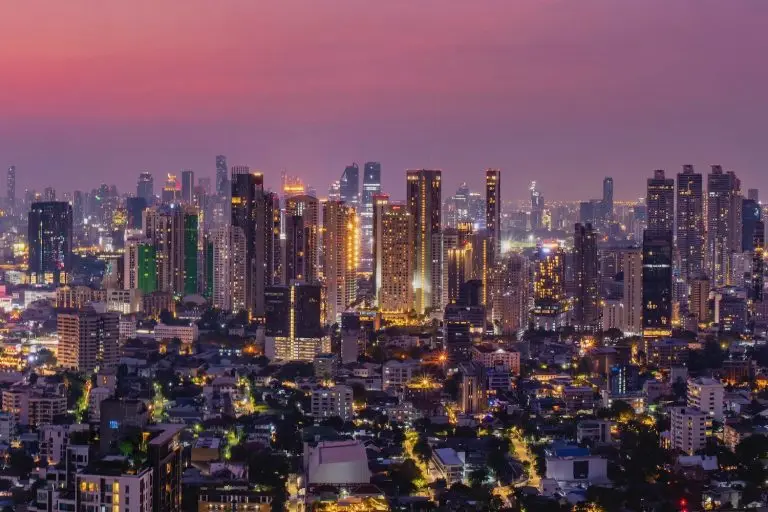
Ideally, landing in Bangkok would be one of the most unforgettable approaches in the world – especially if you're sitting on the right side of the plane. During the descent to Suvarnabhumi Airport, you lose track of the number of skyscrapers in the distance; they are so numerous (and appear so tiny against the horizon) that they seem like blades of grass.
Instead, you mostly see smog, of course. And with a bit of luck, a few shadows and silhouettes that indicate you're entering a populated area.
The good news? That's often a misconception – air pollution in Thailand is nowhere near as bad as it might appear from the air. The bad news? That's only sometimes true: On some days, the air quality in Thailand is downright catastrophic.
How I came to learn about มลพิษ
Although I had been visiting the Kingdom for almost eight years at that point, my first experience with Thai air pollution didn't occur until early 2018. I looked out of the window of my apartment on the 23rd floor of the Sathorn building and noticed that a strange, brown haze was obscuring my view of the buildings I usually saw. I paid it no attention and started my day, assuming the problem would be gone by the next morning.
But that wasn't the case, so I asked my Thai friends about it. "Mon-la-pit," one of them explained, was the literal word for the filth: pollution. He and everyone else advised me to prepare for my first "smog season." For weeks or even months, during the first half of each year, Bangkok (and, as it turned out, most places north of the capital) is covered in a thick layer of PM2.5 particulate matter.
5 things you should know about air pollution in Thailand
This is not an everyday occurrence.
Recently, a private client of mine expressed concern about media reports. Chiang Mai, she said, was dangerously polluted. That was true, at least at the time the report was published. However, as I explained to her, pollution levels fluctuate from day to day – not every day is apocalyptic.
(But it can happen any day)
I wish I could tell you that air quality in Thailand is only bad during the slash-and-burn season (more on that in a moment), which takes place in northern and central Thailand roughly between February and April. However, the reality is that in a developing country with few environmental standards, severe air pollution can occur almost year-round.
The causes are both simple and complex.
Put simply, air pollution in Thailand is caused by the mixing of vehicle exhaust in cities with smoke from farmers burning their crops in rural areas. However, the connections are more complex, as even slight changes in annual rainfall patterns (which are becoming increasingly important) can dramatically affect the duration and intensity of smog.
Residents are demanding more commitment from the government.
Air pollution in Thailand cannot be tackled quickly, yet many locals feel the government is doing little about it. While officials advise farmers to stop burning their crops, promote the purchase of electric vehicles (and offer incentives), and reportedly even use artificial rain to clean the air, their measures lack legal enforcement.
Wearing a mask will probably not help.
Just as Thailand's persistent, almost dystopian mask culture has little impact on the spread of Covid-19 and other airborne diseases, most face masks are powerless against inhaling tiny PM2.5 particles, which are generally much smaller than the pores of the masks. Therefore, wearing one is not worthwhile.
When to visit Thailand to avoid air pollution
Although, as mentioned earlier, pollution is not a daily occurrence in Thailand, there are seasons when air quality is better than others. The rainy season, which lasts roughly from May to November, is one of them. While you won't be able to enjoy bright blue skies during the day or colorful sunrises and sunsets in the mornings and evenings, you won't be suffocating from air pollution either – the rain washes it away.
Another period in Thailand that generally offers optimal air quality is the weeks following the end of the rainy season, specifically the last week of November, most or all of December, and sometimes the first one or two weeks of January. A further advantage of this time of year (compared to the weeks before the rainy season, i.e., April) is that temperatures are relatively cool and the sky is almost completely free of smog.
More frequently asked questions about air pollution in Thailand
Is the air pollution in Bangkok bad?
Air pollution in Bangkok is high compared to most Western cities, but not much worse than in many other developing countries. At least not for most of the year. Unfortunately, between February and April, there can be so much smog for several weeks that the sky is barely visible.
Why is the air quality in Thailand so bad?
Thailand's poor air quality is primarily due to a mixture of vehicle exhaust and smoke from burning crops drifting in from rural areas. Because farmers burn their crops during the dry season, the lack of rain exacerbates this problem, causing smog to linger in the air for weeks or even months.
Which place in Thailand is the most polluted?
Among major tourist destinations, Chiang Mai is considered one of the most polluted places in Thailand. In fact, it's not uncommon for Chiang Mai to be ranked as the most polluted city in the world between February and April!
Conclusion
Air pollution in Thailand isn't always apocalyptic, but I've never visited the kingdom without noticing it somewhere. There are certain times of year you should definitely avoid if you want to enjoy clean air. In particular, you shouldn't visit Bangkok (or other places in northern Thailand) between the end of March and the onset of the first rains. On the other hand, visiting during the rainy season (or late November and early December, when the rains have stopped but the skies are still clear) is the perfect way to escape air pollution. Would you like expert advice on how to avoid air pollution during your trip to Thailand? Book me to plan your personalized Thailand itinerary!




Community
Comments 0
Start the conversation.