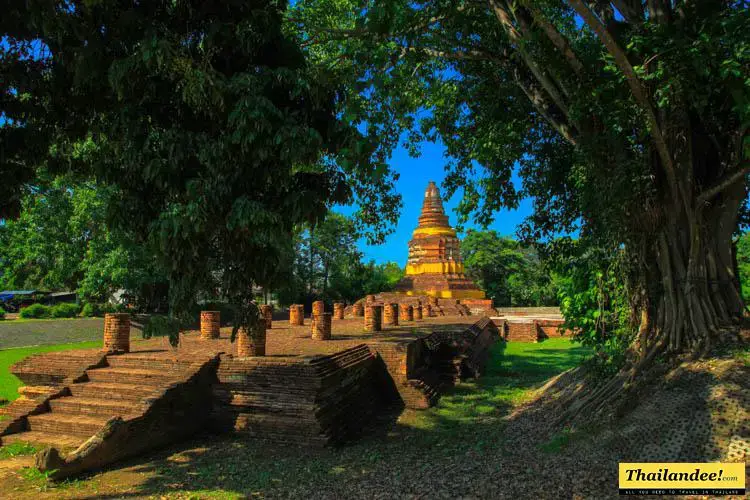
Five kilometers south of Chiang Mai lies the ancient city of Wiang Kum Kam, relatively unknown to tourists and therefore seldom visited. Nevertheless, its charming alleyways invite exploration by bicycle (even if you are occasionally surprised by barking dogs). Here, you journey into the region's past and discover beautiful temples – some ruins of red brick, others better-preserved, more recent structures. King Mhangrai, the first Lanna king, founded Wiang Kum Kam between 1286 and 1295. Chiang Mai was later founded with the aim of making it the center of the Lanna kingdom and maintaining Wiang Kum Kam as a secondary capital. At that time, the two cities were of similar size and population. It was only the wars, particularly with Myanmar, that led to the enslavement of Wiang Kum Kam's inhabitants in the 16th century and ultimately to the city's abandonment. The most important temples in Wiang Kum Kham to visit are—ideally in the order I've listed them—Wat Chedi Liam (formerly Wat Ku Kham), whose most striking feature is the old, five-story Mon-style chedi, similar to Wat Phra That Hariphunchai in Lamphun. This temple also has an ordination hall and is still in use. Wat That Khao consists of the ruins of a red brick temple, the remains of which are a chedi and the foundations of the ordination hall. To the right of the chedi is a seated Buddha statue. Note: If you need water, buy it here from the vendor in the parking lot, as you won't have another opportunity after that. Wat Pu Pia is also a ruined brick temple with other architectural features. Wat E-Kang, also built of red brick, has a more impressive chedi. Wat Nan Chang, right next door, is the least interesting ruin on my list. Wat Chang Kham, on the other hand, is my absolute favorite in Wiang Kum Kham. It may be the old temple Wat Kan Thom, built during the reign of King Mhangrai, when Wiang Kum Kam was still the capital of the Lanna Kingdom. The king commissioned a craftsman named Kan-Thom to import wood from Chiang Saen and construct a wooden viharn. Today, the temple boasts a magnificent viharn with a naga staircase flanked by impressive heads and intricately carved statues. Inside, where paintings were being created during my last visit (May 2018), there is a Buddha statue. Behind it stands a white chedi, and in front of it, a standing golden Buddha statue. To the left is a revered tree, and a little further away are the ruins of the old temple's foundations. For me, this temple is the perfect end to a visit to Wiang Kum Kam. There are other small ruins that I haven't mentioned here, as they are considerably less interesting. The temples of Wiang Kum Kam mentioned here are quite close to each other. The greatest distance between two temples is about 2 kilometers, but often there are only a few hundred meters between two sites.
For me, the ideal route to Wiang Kum Kam is by bicycle, but you can't rent bikes there. Therefore, you'll need to bring your own from Chiang Mai. There are numerous bike rental shops in the city, and many accommodations also offer bicycles. A standard bike costs around 50 THB per day. Alternatively, there's a bike-sharing system in the city. Plan on about 3 hours for a relaxed and comprehensive sightseeing tour by bicycle. Of course, you can also travel by scooter (provided you have the necessary driver's license). Another option is to rent a red car for the tour. This costs around 400–500 THB. As a last resort, you can inquire with a local agency that offers this tour. However, with a GPS device, the tour is also quite easy to organize on your own.
How to get there
How do you get to Wiang Kum Kam? The best way to explore Wiang Kum Kam is by bicycle, but you can't rent bikes there. So you'll need to bring your own from Chiang Mai. There are numerous bike rental shops in town, and many accommodations also offer bicycles. A standard bike costs around 50 THB per day. Alternatively, there's a bike-sharing system in town. Allow about 3 hours for a relaxed and comprehensive bike tour. Of course, you can also travel by scooter (provided you have the appropriate driver's license). Alternatively, you can rent a red car for the trip. This costs around 400-500 THB. You can also inquire with a local agency that offers this tour. However, with a GPS device, getting there on your own is quite easy.




Community
Comments 0
Start the conversation.