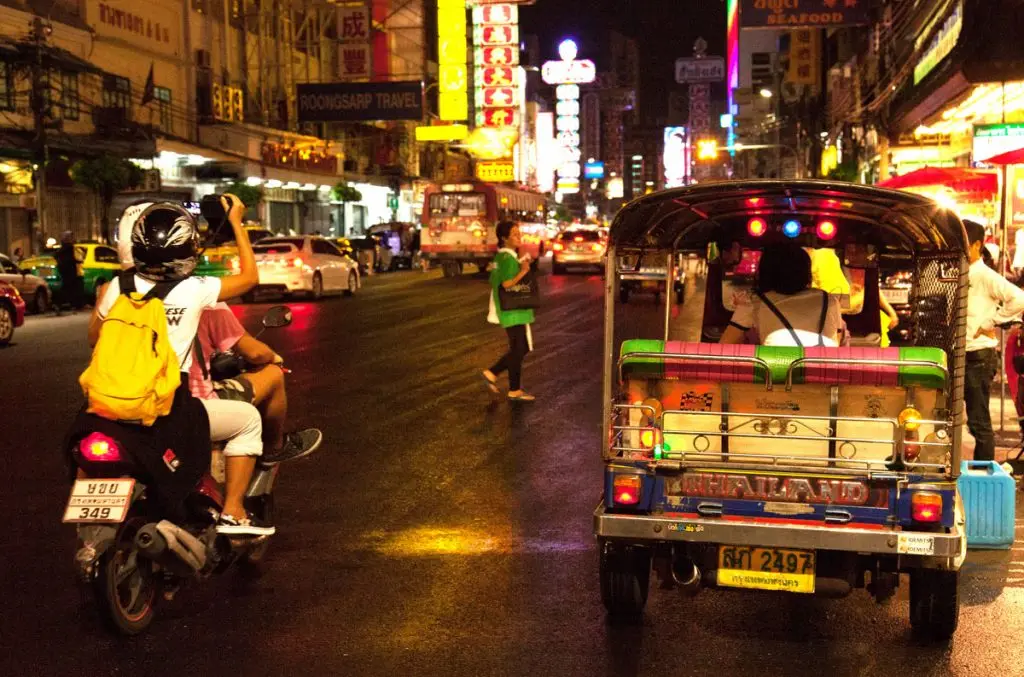
Bangkok, the "Great Mango," is a sprawling city, an ancient yet modern capital that has grown without a fixed center. Depending on your interests—shopping, nightlife, history, or exploration—you'll find Bangkok's best neighborhoods. Guest writer John Borthwick introduces you to the best areas for eating, sleeping, and going out.
Sathorn
A section of South Sathorn Road (also known as Thanon Sathon Tai) has developed into an upscale street with numerous embassies (including the Australian one) and luxury hotels. It's pleasantly situated away from the main nightlife areas, yet still within easy reach of the shops and night markets of Silom Road (though Patpong should be avoided as it's crowded and noisy), as well as two stations: the Sala Daeng BTS Skytrain station and the Lumphini MRT subway station.
The river
Is there a more beautiful way to experience Krung Thep, the City of Angels, also known as Bangkok, with its countless temples, towers, shopping malls, and palaces, than from the Chao Phraya River, the River of Kings? Board a Chao Phraya Express boat with English-language commentary at Sathorn Pier near Saphan Taksin Skytrain station. You can hop on and off at any of the 20 stops, including Wat Arun (Temple of Dawn) and Wat Pho (home of the Reclining Buddha). On the west bank, visit Lhong 1919, a century-old building that evokes the era of steamships and maritime trade between Thailand and China. Tip: Also on the west bank is the Royal Barge Museum, with its impressive fleet of gilded boats used in the annual Royal Barge Procession.
Soi Itsara Nuphap, Chinatown. Copyright John Borthwick
Chinatown
The vibrant, bustling Yaowarat Road, with its Blade Runner-esque alleyways, shrines, pharmacies, and goldsmiths, is the heart of Bangkok's Chinatown, one of the oldest in the world. The energy of buying, selling, eating, drinking, and constantly repeating itself is inexhaustible and exhausting. In the evenings, the street food stalls along Yaowarat Road offer a veritable feast of seafood and other Chinese delicacies. However, it's best to avoid the two decidedly uncool, traditional "delicacies": shark fin soup and bird's nest soup. The Shanghai Mansion street bar serves "cool drinks and hot jazz" every evening. Here you can sit down, enjoy the music, and listen to the night's vibrant atmosphere. Tip: Soi Itsara Nuphap runs between Yaowarat Road and Charoenkrung Road. Stroll along this alleyway, past stalls, handcarts, grandmothers, and bargain hunters—it's a world unto itself.
Sukhumvit Road
Shopping malls, chaotic traffic, Skytrain stations, and a vibrant nightlife. No one goes hungry along Thanon Sukhumvit Road. Reserve a table at the legendary Bo.Lan on Sukhumvit Soi 53 (in the Thong Lo district) for excellent Thai cuisine, or at Rang Mahal in the Rembrandt Hotel (Soi 18) for upscale Indian fare. The Emporium shopping mall near the Phrom Phong Skytrain station boasts nearly 50 top-notch restaurants and eateries. The Soi Nana district (pronounced Naa-naa) in Sukhumvit comes alive at night, a place of exuberant revelry. Here, countless bars, go-go clubs, and must-see attractions line the streets. It's not all red-light district, but it's not for the faint of heart either.
Gold business. Copyright John Borthwick
Khao San Road
"The main function of the street was that of a relaxation space for travelers entering or leaving Thailand—a kind of stopover between East and West," wrote Alex Garland in his 1996 novel "The Beach," which begins on Khao San Road. Now a popular meeting place, the "KSR" remains Asia's capital for dropouts and travelers who have lost their way, found their place, or simply want to unwind. Guesthouses and lodges line the side streets, while the Sawasdee Inn and the Buddy Hotel offer more upscale accommodations at the heart of the action. At night, the street is closed to traffic, and the KSR transforms into a lively promenade where you can stroll, eat, and drink to your heart's content. Tip: Explore the side streets with their cozy restaurants.
Ratchaprasong
The Ratchprasong district is pretty much the central hub of Bangkok as it can be today. The adjacent Ratchadamri Road, between Ploenchit and Petchaburi, is a shopper's paradise, with huge department stores and malls like Zen, Isetan, Gaysorn, Platinum, and Siam Paragon. You can reach it via the Siam or Chidlom Skytrain stations. In the evening, try the street food stalls outside Central World Mall. High up on the 55th floor of the Centara Grand Hotel is the Red Sky Rooftop Bar. The enormous electronics store Panthip Plaza is just a few blocks away on Petchaburi Road in Pratunam. Tip: The Erawan Shrine, supposedly Bangkok's most wish-granting shrine, is located at the corner of busy Ratchadamri and Ploenchit Roads. Thais pray here before the four-faced golden statue of Brahma for health and prosperity. Traditional dances and music accompany the offerings.
Thonburi
Thonburi (pronounced "Tonbury") on the west bank of the Chao Phraya River was briefly the capital of Siam. Among the historic quarters, narrow alleyways (sois), and centuries-old teak houses, you'll find the domed Santa Cruz Church, built in 1770 by the Portuguese-Thai community, and nearby, the gleaming white stupa of Wat Prayurawongsawat. The old Chinese temple, Kuan An Keng, like the Catholic church, also dates back to the reign of the Siamese warrior king Taksin the Great (1767-1782), who established his new capital here. "Venice of the East" was an early European name for Bangkok, referring to the khlong canals that connected the city's districts. Take a ride on a rua hang yao—a longboat—along the canals and discover the heart of old Thonburi. On the Khlong Bang Luang canal, a visit to Baan Silapan, the Artists' House, is worthwhile – a traditional teakwood house right on the canal, which now houses a gallery with a theater and café. Tip: The 360 Bar on the roof of the Millennium Hilton Hotel in Thonburi offers fantastic views of the river.
Text and photos © John Borthwick 2020




Community
Comments 0
Start the conversation.