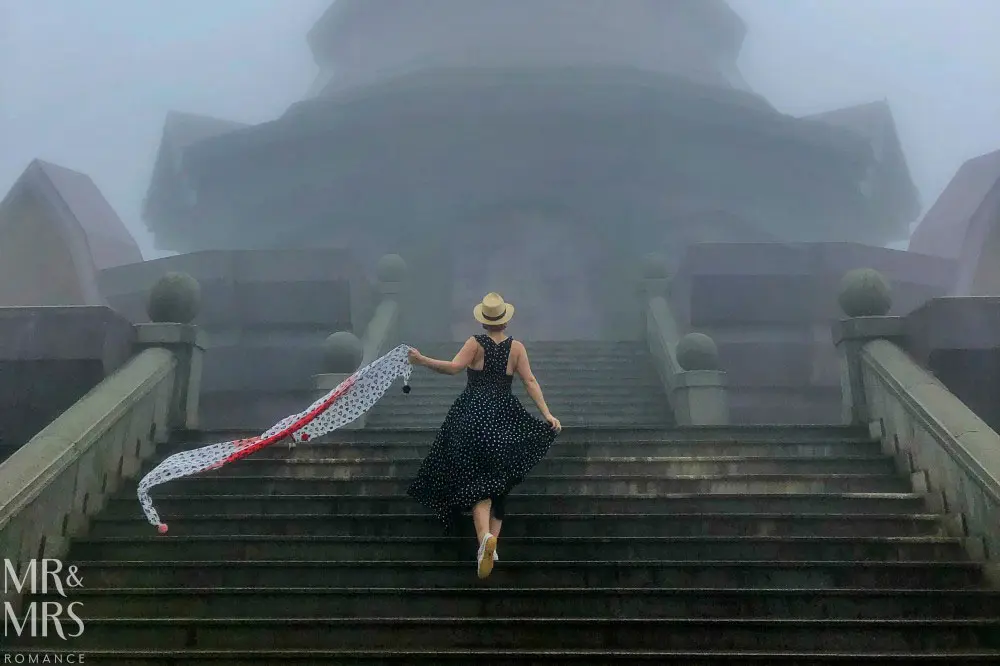
Travel bloggers Mr & Mrs Romance recently visited Chiang Mai and were thrilled with this hotspot for travel in Northern Thailand. Here they list eleven reasons to visit Chiang Mai.
1. The Temples
If Chiang Mai is famous for anything, it's for its temples. There are so many here, and each one has a special cultural significance.
Naturally, some are more important or photogenic than others. Therefore, by selecting the images you want to see, you avoid being left out of the selection. We recommend the following three:
Within the walls of the old city is the oldest surviving temple in Chiang Mai, built in 1296. The age-weathered white stone base and the shining golden roof of the pagoda are beautiful, as is the large assembly hall on the grounds.
Just outside the walls lies this 14th-century temple with a magnificent, stepped assembly hall adorned with imposing pillars and a huge golden Buddha inside. The hall's entrance is flanked by intricately carved dragons, and the reddish-brown pagoda is guarded by an impressive giant figure from Thai legend.
Wat Sri Suphan – the Silver Temple
South of the city lies Chiang Mai's old silver district. For this reason, this 14th-century temple—also known as the Silver Temple—is dedicated to the region's silversmiths. Its roof and walls are made of silver (or possibly aluminum), and the interior is entirely decorated with silverwork.
On the outside there are some very strange decorations featuring Marvel comic heroes and the names of foreign cities.
Due to some outdated traditions, women are not allowed to enter this temple. Nearby is another silver temple – Wat Muen San – which welcomes all visitors and is designed in a more traditional style.
2. The ancient walled city of Chiang Mai
The old town wall has a circumference of approximately 6 km and is surrounded by fortifications at most of the city gates. It consists of a wall encircled by an old, now mostly dry, moat.
Although Chiang Mai means "new city," it is anything but, despite being founded in 1296. It received this name when it replaced the neighboring city of Chiang Rai as the capital of the Lanna Kingdom in northern Thailand.
The locals, however, continue to identify themselves and their culture specifically as Lanna and, more broadly, as Thai. It is remarkable that the legacy of a kingdom that effectively collapsed in the 17th century still has a lasting impact.
3. The modern city of Chiang Mai
We were very impressed by how this ancient city has managed to retain a modern flair. This is particularly evident in parts of Chiang Mai – such as Nimmanhaemin Street east of the old city walls.
This is definitely the trendy neighborhood, with beautiful shopping centers and restaurants, quirky bookstores, and pop-up art installations appearing everywhere. Places like these clearly demonstrate the impact of the growing number of "digital nomads" and expats.
4. The climate
Thailand is known for its hot, tropical climate. It was therefore all the more pleasant to discover, after arriving in Chiang Mai from Bangkok, that it was significantly cooler and much less humid than in the capital.
I had always imagined Chiang Mai, nestled in the jungles of northern Thailand and far from the sea, as humid and unbearably hot. But this city, situated over 300 meters above sea level and near the alpine regions of Southeast Asia, has a very pleasant climate.
Don't get me wrong, it's hot here too, but you don't feel that oppressive, stifling feeling like in Bangkok.
However, if you are in the mountainous regions and the fog rolls in, it can get quite cold.
5. The food
We were very impressed by the local food scene. From simple street food stalls at the city markets to ultra-modern, sustainable and organic restaurants like Meena Rice-Based Cuisine and Be Organic Ohkajhu.
The latter is more in line with a European or Western style, which is also very interesting. Initially, we thought it was aimed at expats who had moved here, but since we were the only non-Thai guests, I don't think that's the case.
In general, the cuisine here is less spicy than in the south, and there is less seafood, but more pork and chicken. As in much of Thailand, it seems quite difficult to eat badly in Chiang Mai.
6. The markets
The Thais really know how to organize markets. Chiang Mai offers countless open-air shopping opportunities throughout the week.
Our favorite is the fascinating pedestrian zone that runs from east to west right through the old town.
Every Sunday, the city closes this kilometer-long street to car traffic and fills it (and I mean really fills it) with market stalls. The street is wide enough for two rows of stalls, so if you want to walk down one side and the other, you should allow at least an hour to see everything.
Here you will find everything from clothing and souvenirs to mysterious street food and the best opportunities for people-watching worldwide!
7. Thailand's highest point
Since the foothills of the Himalayas end west of Chiang Mai, it is reasonable to assume that the highest point in Thailand is located here.
The highest point of Doi Inthanon National Park lies (to be precise) at 2,565.3341 meters and is a place of exceptional beauty. Small shrines near the summit, which, incidentally, can be driven almost all the way to the top, are covered in moss and blend harmoniously into the trees.
When pagodas and stone elephants covered with vines and lichens emerge from the mist, you feel as if you are the first person to see them in a very long time.
One of Thailand's holiest sites is located here in Doi Inthanon National Park. Pra Ma Ha Tat Noppamethanedon and Pra Ma Ha Tat Nopphonphusiri are two temples dedicated to the former king and queen.
They are breathtaking and are located in such an incredible setting that it reflects how much the country still reveres King Bhumibol and Queen Sirikit.
8. The waterfalls
The waterfalls here, which interrupt the rivers flowing down from the mountains and foothills of Doi Inthanon and other national parks, are simply magnificent.
The Wachirathan Waterfall, which plunges into the Klang River, may not be the tallest waterfall we have seen, but it is definitely one of the most beautiful.
9. The Karen mountain tribes
The Karen, a hill people living in the hills of northern Thailand, were driven out of Myanmar and live as long-term refugees in the hills and mountains of northern Thailand.
Many of their villages are inaccessible to visitors, but some have specialized in tourism. Their handwoven fabrics, clothing, and bags are beautiful, and you can often watch someone making them in the shop.
It is fascinating to see these tribes and their villages, which seem quite primitive compared to the modern city of Chiang Mai. But this is the traditional way of life of the Karen.
10. The Culture of Northern Thailand
It is very interesting to see the cultural differences between the people in southern Thailand – in Bangkok and on the south coast – and here in the north.
Compared to hectic Bangkok, Chiang Mai naturally feels more relaxed and leisurely. Here, there's a sense of decorum and a strong connection to tradition that isn't as pronounced in the south.
Recent developments in the tourism sector may reveal a way of life previously unknown to both sides. The locals seem to treat tourists with more affection than the crowded beaches of the bay.
However, this doesn't mean that Chiang Mai is so remote that it's completely unprepared for visitors. On the contrary, the Khum Khantoke evening is, quite literally, a showcase of Lanna culture.
Experience a blend of traditional Thai dance and interpretive expressions of Lanna culture while enjoying local dishes served on a "Khantoke" – a traditional bamboo platter of the region.
11. The silver
Chiang Mai is considered the home of the much-praised Thai silver. The quality and purity of the silver here are very high, while the prices are supposedly low.
For a truly authentic experience, you can watch monks forging and carving silver using traditional methods at Wat Sri Suphan – the Silver Temple. You can also purchase their work directly from the monks, which is a truly wonderful experience.
We were very impressed by Chiang Mai. The culture, climate, food, and people showed us a side of Thailand that we hadn't expected.
Of course, we will be back in Thailand soon, but for the first time we will seriously consider returning to the north to explore more of the Lanna region – the Rose of the North.
Read the full article here.




Community
Comments 0
Start the conversation.