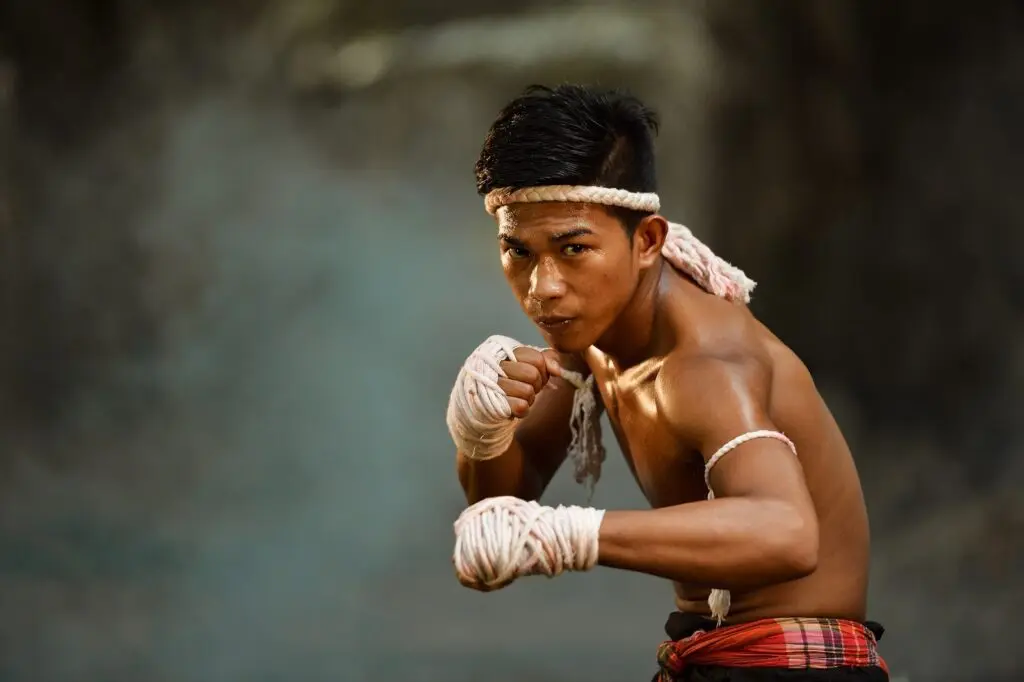
When it comes to sports in Thailand, Muay Thai immediately comes to mind. But do you know the origins of Thailand's national sport? The Thailand Insider team explains the history, key figures in Muay Thai, and where you can experience this exciting sport live in Thailand.
Muay Thai, also known as Thai boxing, is Thailand's national sport and the country's most popular sport. This martial art, which originated in the Siamese army, attracts people from all over the world who want to learn this traditional sport. Muay Thai is also called the "art of eight limbs" because of the eight contact points on the body, which resemble weapons.
In the ring, a Muay Thai fighter transforms his body into a weapon of war using eight contact points. The hands function as sword and dagger, the shins and forearms as armor, the elbow as a heavy club or hammer, and finally the legs and knees as an axe and staff.
Muay Thai is known for its authenticity and versatility and enjoys immense popularity in Thailand and worldwide. Hundreds of thousands train Muay Thai daily. Some of the world's most successful boxers practice Muay Thai, which is a fundamental part of their preparation for Mixed Martial Arts. Muay Thai training is safe, as pad work was developed to protect fighters between bouts.
Another reason for the great popularity of this sport is its widespread application outside the ring. Self-defense fighters, athletes, military personnel, and police officers all utilize Muay Thai training. Furthermore, the King of Thailand is an enthusiastic supporter of Muay Thai and has boosted its popularity like in no other historical period.
History of Muay Thai
The first Thai army was founded in 1238 in the northern Thai city of Sukhothai to protect the government and the population. Training included hand-to-hand combat, weapons handling, and the use of the body as a weapon. Muay Thai and Krabi Krabong both developed from this training.
The first Muay Thai camps arose due to the constant threat of war between Thailand, Burma, and Cambodia. These camps served as training centers and were established throughout the kingdom. Young Siamese men practiced Muay Thai for self-defense, physical fitness, and discipline, thus creating large armies to protect the Thai kingdom.
During the reign of King Narai, Muay Thai became a national sport. Fundamental traditions developed that would endure for the next 400 years. One of these traditions was the wrapping of hands and forearms with hemp bands and threads.
Weight, size, experience, and age played no role in the selection of fighters. The local champions represented their town or village. They often fought on behalf of wealthy businessmen or the nobility to settle disputes.
During the Thonburi era, peace finally returned to Thailand. Soldiers trained in Muay Thai, while others practiced it as a hobby. Due to its growing popularity and the peaceful state of Thailand, Muay Thai developed into a competitive sport, although still without fixed rules.
The rules and regulations of Muay Thai originated during the Ratanakosin era. The rounds of a fight were measured in an unusual but fascinating way: with coconuts. A small hole was pierced in a coconut, and it was placed in a barrel of water. As soon as the coconut filled with water and sank to the bottom of the barrel, the round was over.
Muay Thai arrived in France during World War I and from there became known throughout the world. Thai soldiers stationed in France used Muay Thai to boost their morale. Occasionally, they also fought against French boxers.
After returning from active duty, the Thai military continued to hold Muay Thai fights for entertainment and sport. Retired soldiers became "Kru Muay," or instructors. Over the centuries, Muay Thai became an integral part of Thai culture. The martial art was passed down from generation to generation. Enthusiasm for the sport grew steadily, as did Muay Thai's importance as an effective defense system for the kingdom.
Important figures in the history of Muay Thai
Nai Khanom Tom
During the invasion of the ancient capital Ayutthaya by Burmese troops in 1767, Nai Khanom Tom was one of the many Thai inhabitants who were taken prisoner.
A few years later, in 1774, the King of Burma held a seven-day festival in honor of the Buddhist pagoda. Royal combat demonstrations between Thai and Burmese fighters took place in front of the throne, where a boxing ring had been set up.
Nai Khanom Tom faced a Burmese boxer on the first day of the festivities. He astonished the spectators by beginning the fight with an elaborate dance performed around his opponent. This dance, known as Wai Kru, was a symbolic gesture of gratitude to the fighter's mentor.
When the fight officially began, Nai Khanom Tom quickly defeated his opponent with elbow strikes to the chest. However, the fight was declared unfair due to alleged "black magic." The referee claimed that the Wai Kru dance had distracted his opponent. As a result, Nai Khanom Tom had to fight nine more Burmese boxers.
It is not surprising that Nai Khanom Tom was able to defeat every one of the boxers, including a boxing instructor from Ya Kai City.
Every year, the Muay Thai World Championships (Wai Kru) take place in the ancient capital of Ayutthaya. Participants learn about the history of Muay Thai, pay tribute to great Muay Thai masters, witness live fights, and try out the techniques themselves.
King Prachao Sua
King Prachao Sua loved Muay Thai so much that he would disguise himself as a commoner and participate in tournaments in small towns and villages. He fought against and defeated renowned fighters, including Nai Klan Madthai, Nai Yai Madklek, and Nai Lek Madnok.
Apidej Sit-Hirun
In the 1960s, Apidej Sit-Hirun was one of the most powerful fighters in the history of Muay Thai. His success inspired the golden era of Muay Thai in the 1980s.
His kicks were so powerful that he could break his opponents' arms, forcing them to retire after the infamous fight. The late Rama IX described Apidej Sit-Hirun as the fighter of the century.
Where you can see Muay Thai
Now that you know everything you need to know about Muay Thai, it's time to experience the magic for yourself! There are many places throughout Thailand where you can experience Muay Thai. One of the most popular arenas is the Lumpinee Boxing Stadium in Bangkok. If you want to see one of the most historic and oldest boxing stadiums, you should visit the Rajadamnern Stadium in Bangkok, which was built in 1945.
Community
Comments 0
Start the conversation.