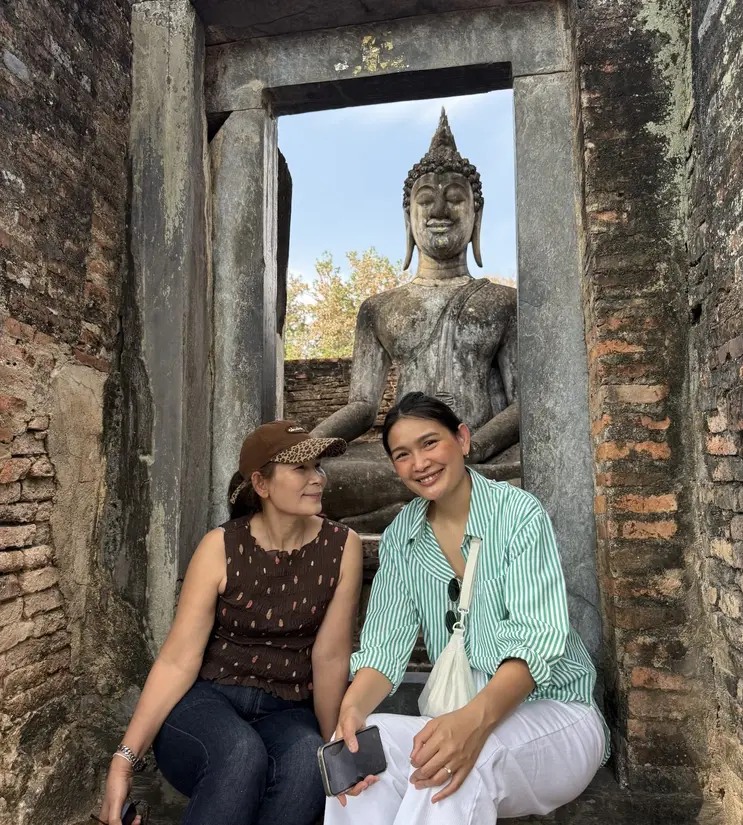
Kat's mother recently turned 60, and to celebrate, we decided to take her on a short trip to Sukhothai – a place that had been on our Thailand wish list for years. It was actually her first flight, so the excitement was palpable as soon as she boarded the Bangkok Airways plane.
The flight from Bangkok was smooth and quick, just over an hour in the air, and the view as we approached Sukhothai was breathtaking: lush landscapes, ritual ponds and palm trees that characterized the area, and temples that blended harmoniously into nature. Even just looking out the window, we knew we were arriving in a peaceful and special place!
Kat and her mother board the plane.
The rich history of Sukhothai
For those who don't know: Sukhothai is located in the south-northeast of Thailand, about 420 kilometers north of Bangkok. The city is famous for the Sukhothai Historical Park, a UNESCO World Heritage Site, which contains the ruins of Thailand's first capital – a kingdom founded in 1238 after a successful rebellion against the Khmer Empire.
King Ramkhamhaeng the Great led the kingdom to its golden age, created the Thai alphabet in 1283, and established Theravada Buddhism as the state religion. Because the region was frequently affected by drought, Sukhothai developed an innovative water management system, constructing trapangs (ritual ponds), canals, and dams for irrigation and flood control. Many of these trapangs can still be seen today.
In the 15th century, vassal states broke away, and the kingdom's power declined considerably. Eventually, it was annexed by the southern kingdom of Ayutthaya. Restoration work began in the 1970s, leading to its inscription on the UNESCO World Heritage List. Slowly but surely, the area has developed into a popular tourist destination – many travelers find it more peaceful and authentic than Ayutthaya or Chiang Mai.
How to get to Sukhothai
The best way to reach Sukhothai is with a direct flight from Bangkok Airways, a boutique airline specializing in connections between cultural attractions and natural wonders in Thailand. Sukhothai Airport (THS) is owned by Bangkok Airways itself, and all direct flights depart from Suvarnabhumi Airport (BKK). We paid around 4300 THB per person for the round trip – more than you would typically pay with budget airlines in Thailand, but excellent value for money considering the overall experience.
We love flying with Bangkok Airways because their customer service is first-class, their private airports are beautifully designed, and they even offer complimentary extras like a free breakfast. Cam was so excited about the Sukhothai trip that he forgot his passport in the overhead compartment upon arrival. Luckily, the staff kept it safe at the airport and returned it to him for his return flight! We have always received excellent service from Bangkok Airways, which is why we wholeheartedly recommend the airline.
Alternatively, you can fly with a low-cost carrier like Thai AirAsia to Phitsanulok Airport (PHS) and then take a taxi or bus to Sukhothai, a 60- to 90-minute journey. You could also take a bus or train from Bangkok, but this takes considerably longer (a total of 7 to 8 hours). If you can afford it, flying with Bangkok Airways is an unbeatable experience!
Accommodation in Sukhothai
Finding good accommodation in Sukhothai isn't easy, but we managed to book a lovely hotel called Midtown Sukhothai. We had two villas by the pool – one for Kat's mother and the other for us – and paid the equivalent of about 1300 baht per room per night. The hotel's location was fantastic, just a five-minute walk from the main street, where several street food stalls, restaurants, and bars awaited us.
The hotel also organized our airport taxis and the tuk-tuk driver who took us to Sukhothai Historical Park for the day. The Midtown is located in the city center, 12 km from the historical park. While there are other hotels and resorts closer to the main temples, their mixed reviews weren't particularly convincing. Overall, we were completely satisfied with the Midtown and found our two-day stay pleasant and relaxing.
Sunrise from the street in front of our hotel
Sukhothai Itinerary: How to Plan the Perfect Day
Transportation: Tuk-tuks vs. bicycle tours
To make the most of your temple visit in Sukhothai, choosing the right mode of transport is crucial. First, keep in mind that the distance between the old city and the historical park is 12 km. If you're staying overnight in the old city (like we did), you'll need a tuk-tuk, a rented scooter, a taxi, or a songthaew for transportation.
Next, you should consider how you will get around the central walled area of the park, as scooters and tuk-tuks are not allowed. Golf carts are a popular alternative to walking or cycling, as the distances between the temples are surprisingly large and the midday heat should not be underestimated. We found it unbearably hot from 12:00 pm onwards!
We opted for the simplest and most convenient option: we arranged a tuk-tuk driver for the day and then rented a golf cart to explore the historic park. This suited Kat's mother perfectly, as she prefers to stay in the shade. The golf cart was also equipped with sunshades, which proved to be a real blessing when we stepped out of the shade into the blazing sun.
This isn't to say that bike rides are a bad idea – they looked very tempting early in the morning – but the afternoon heat makes outdoor activities considerably more strenuous. Having your own tuk-tuk driver offers many advantages: you travel through the outer temple zone in the shade, can stop for lunch whenever you like, and get back to the hotel without waiting for a taxi. Our tuk-tuk driver was fantastic – he acted as both driver and unofficial tour guide.
Those who would prefer to take a bike tour can book one here: Bike tour through the historic park and the rural surroundings.
Take a tuk-tuk to the historic park
Early morning: Hidden treasures of the outer park
Wat Chang Lom
We were picked up from our hotel, made a quick coffee stop, and then drove to Wat Chang Lom, arriving at 9:00 AM. The soft light slowly bathed one side of the chedi in a warm glow, creating a beautiful early morning atmosphere. Thirty-six elephants encircled the temple, some of them missing their trunks and tusks. Despite this, it was a great first impression of Sukhothai. The temple is located about 1 km east of the park's main entrance, making it an ideal first stop of the day.
Wat Si Chum
Wat Si Chum was the place Cam had dreamed of visiting for years, and it didn't disappoint! It only took us 10 minutes to reach this famous temple, which—as mentioned—is located outside the old city walls. There, a massive, 15-meter-high Buddha statue sits majestically in an open-air shrine. We had to buy tickets—120 THB for foreigners and 20 THB for Thais—but it was worth every penny.
As we approached the temple, the face of Buddha gradually became more clearly visible through a small vertical crack in the structure—a sight that reminded Cam of the dramatic unveiling in Petra's Treasury. Known as the "Speaking Buddha" (Phra Achana), the Buddha has elegant, long fingers covered in gold leaf. Kat's mother prayed before the statue for a few minutes, touching its fingers to wish for good fortune—a special moment for us.
Phra Achana wasn't the only highlight of Wat Si Chum. We were amazed to discover a huge, 200-year-old mango tree right next to the temple ruins, as well as another seated Buddha statue decorated with gold leaf. The whole place exuded a mystical atmosphere that captivated not only Cam as a tourist, but also Kat and her mother as locals.
Read more: Wat Si Chum: How to visit Sukhothai's hidden giant Buddha
Kat's mother prays at Wat Si Chum
Wat Phra Phai Luang
Next on the agenda was Wat Phra Phai Luang, the largest archaeological site in the outer zone, showcasing a unique blend of Khmer and Sukhothai architecture. To be honest, we were still buzzing from Wat Si Chum and therefore didn't fully appreciate the temple. In retrospect, however, some of its ancient towers and the banyan trees (reclaiming the ruins) were quite impressive, almost reminiscent of the jungle temples of Angkor Wat.
Early lunch: Sukhothai noodles in the old town
Since we'd only had coffee for breakfast and had already visited three impressive temples, we were quite hungry and looking forward to an early lunch at 10:30 am. Kat asked the tuk-tuk driver to get us some authentic Thai food, and that's exactly what he did. We found a nice little restaurant outside the old city walls and ordered the famous Sukhothai noodles, spicy Som Tum (papaya salad), and a couple of refreshingly cold beers. Now fortified, we were ready to explore the temples in the historical park.
Early afternoon: Central zone of the Historical Park
Wat Mahathat
After waiting a while for our golf cart, our driver finally took us to the main entrance of Sukhothai Historical Park. There, we bought our tickets and entered the famous UNESCO World Heritage Site with its lush vegetation, ponds, waterways, and temples. We decided to visit Wat Mahathat first, as it was at the top of our list. We arrived at 11:30 a.m., and it was sweltering! Luckily, the golf cart driver had brought some lovely blue parasols for Kat and her mother.
Wat Mahathat turned out to be another highlight of the day. Here you can take the iconic photos of the seated Buddha statue, flanked by a palm tree and a chedi, reflected in a large ritual pool. We recommend visiting at sunrise or sunset if you're mainly interested in photography; otherwise, the temple is beautiful during the day as well. We enjoyed strolling along the red brick paths, praying before the many Buddha statues, and simply soaking up the atmosphere of Wat Mahathat (despite the heat).
Wat Sa Si
At 12:30 pm, we drove to Wat Sa Si – a temple on a small island in the middle of a beautiful pond filled with lotus flowers. To reach the temple, you cross a picturesque wooden bridge and are greeted by magnificent stupas and statues in the Sri Lankan style, reflecting the Ceylonese influences that played a significant role in early Buddhism in Sukhothai. This was another splendid spot that we were able to admire and photograph for half an hour before setting off in our golf cart to the last temple of the day.
Wat Si Sawai
After visiting five temples in quick succession, we were feeling a bit "temple-weary" (if that makes sense), but our golf cart driver recommended one last stop on the way back: Wat Si Sawai. There, three Khmer prangs stand, shaped almost like corn cobs and adorned with intricate carvings of mythical creatures. While the prangs were impressive, the absolute highlight was the ficus tree to the right of the temple walls. Hundreds of roots wind around its trunk, giving it a truly mystical, almost otherworldly appearance.
What are the most beautiful temples in Sukhothai?
As you can probably tell from our experience, temple visits in Thailand can be quite exhausting if you try to see too many in one day or head out in the midday heat (only crazy people and the English do that!). We think we found the right balance: three temples in the morning, three after lunch, and we finished around 1:30 pm before the sun got too strong. This allowed us to return to the hotel afterward, go for a swim, and cool off while reflecting on the impressive places we had visited.
Honestly, some temples start to look pretty similar after a while. In our opinion, the three most beautiful temples in Sukhothai are Wat Si Chum, Wat Mahathat, and Wat Si Sawai. The others were probably not worth visiting, but that's the thing about temple tours – you can't love them all. Does that diminish Sukhothai in any way? Not at all. It's one of the coolest places we visited in Thailand, not just because of the temples, but also because we thoroughly enjoyed our time in the city.
Sunshade at Wat Mahathat
Wat Si Chum, finger covered with gold leaf
Overview of the capital city: “New Sukhothai”
The capital is usually called "New Sukhothai," where we also stayed. There aren't any major tourist attractions, but there's a good selection of street food stalls, local markets, restaurants, and a few touristy bars where you can relax and unwind at the end of the day. The atmosphere is very authentic: you see children riding in the back of pickup trucks and families of four crammed onto motorbikes. We especially appreciated that we hardly saw any other tourists.
Just a five-minute walk from our hotel, we found these fantastic street food stalls with all sorts of delicious treats: Isan sausage, dumplings, fresh coconuts from Sukhothai, and much more. The street food was incredibly cheap; a banana roti cost only 20 baht. The restaurants were wonderful, too. We discovered a lovely spot on the main street that served extremely spicy but delicious tom yum noodles from Sukhothai. Sitting on plastic stools, eating spicy noodle soup, and drinking a cold beer while the birds chirped on the power lines at sunset—an unforgettable moment!
Fresh coconut juice from Sukhothai
Community
Comments 0
Start the conversation.