TL;DR
The first thing you notice at Patara Elephant Farm is what's missing.
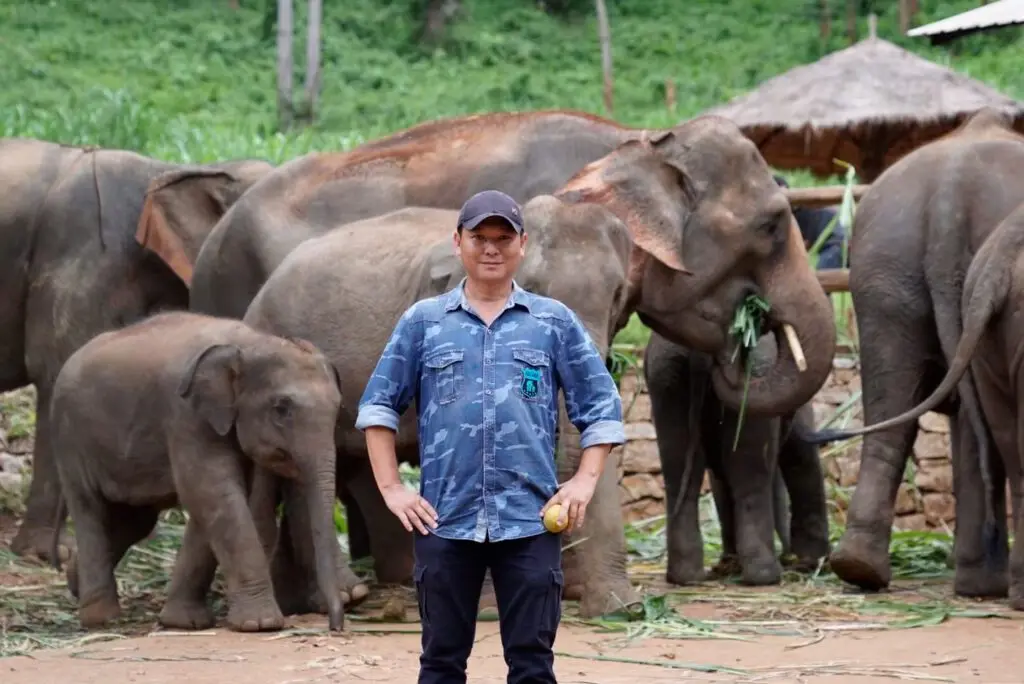
No concrete enclosures, no steel posts, no painted backdrops. Just a long, green valley in the mountains of Chiang Mai, and within it, a family of elephants spending their morning with the leisurely serenity of animals that know their own rhythm. An old bull—forty years old, if he is a day—has retreated alone to graze. A group of young bulls frolics at the distant edge of a tree. And in the distance, the nursery: calves under ten years old, surrounded by a constantly changing group of mothers and aunts who never take their eyes off them for long.
So it looks like wilderness. In reality, however, it is something rarer: a sanctuary that has spent two decades learning how to allow domesticated elephants to live almost wild.
The story of two elephants: What elephant conservation in Thailand really looks like
To understand why Patara is so important, you need a context that most visitors to Thailand never receive, and Mr. Theerapat Trungprakan (also known as Khun Pat), the founder and owner of the nature reserve, provides it with the patience of a man who has explained it ten thousand times and still believes it is the most important thing he can tell you.
Khun Pat explains that Thailand is actually home to two elephant populations that lead completely different lives.
The first category is wilderness. Around 4,000 elephants are protected under Thai law and monitored by the Department of National Parks, Wildlife and Plant Conservation. They move freely within national parks and mountain border regions along routes of their own choosing.
The second type is domestication. Around 3,800 elephants, each with its own ownership book documenting its microchip and health data, live with Thai families who have cared for them for generations.
Khun Pat suggests comparing it to the attitude of people in the American West towards horses. The mustang lives freely, and its survival depends on it keeping its distance from us. The ranch horse, on the other hand, thrives precisely because of us. Both are horses; both deserve a good life; but applying the rules for mustangs to ranch horses would be a category error. And it is precisely this confusion, according to Khun Pat, that is clouding the global debate about elephant tourism.
“The mistake,” he says, “is applying the management philosophy of wild elephants to the keeping of domesticated elephants.”
It is a quietly radical approach, compassionate, unglamorous and completely unsuitable for a slogan, and it shapes everything that happens in this valley.
Freedom, constructed
Elsewhere in the world, keeping elephants in enclosures is considered the gold standard: enormous sums are invested in concrete walls and specially built pools, the elephants are well-fed and safely housed. Khun Pat is careful not to reject this model outright, because he concedes that it can work for countries with small elephant populations and the corresponding financial resources. But an elephant that cannot roam freely cannot make its own decisions, and an elephant that cannot make its own decisions, he believes, cannot truly be healthy.
Patara's answer is land. On private property and in a community forest, the herd roams an open valley with over two hundred different native forage plants. This allows them to forage for themselves daily, instead of simply receiving what is thrown over the fence. Their 24-hour rhythm has been developed and refined over twenty years with two goals in mind: health and social interaction. The elephants wander, graze, drink, swim, rest, and socialize in many different locations throughout the day. Even the solitary ones are respected; the mature bulls who prefer solitude are given just that—like a grandfather with his armchair.
The result is a herd that organizes itself like wild herds: mothers and young in closely connected groups, young animals that travel long distances yet stay together, and each animal free to come and go. No one has staged this scene for you. You simply have to observe it.
The doctors are here
What makes Patara not just a beautiful place, but a truly significant one, is the fact that elephant health here is not just an empty phrase, but a lived reality. Professional veterinary care is firmly integrated into daily operations, and the elephants' health forms the basis of every visitor experience.
Guests learn how to approach elephants respectfully, how to introduce themselves, and how to gain their trust. And then comes the unexpected part: a lesson in assessing an elephant's health—how to tell if it's thriving or merely surviving. This knowledge, usually reserved for mahouts and veterinarians, is imparted to travelers in a single, muddy, but wonderful day.
The most promising idea in Thai tourism
Every great travel experience changes your journey. Patara aims to change every one of your future trips.
Whether you participate in the elephant observation safari, spend a day as an elephant keeper, or sign up for the calf rearing program, Khun Pat's goal for you is the same, and he states it without any irony: "Once you have completed your journey with us and continue your travels, you will no longer be traveling as tourists. You will be traveling the world as elephant health inspectors."
This is what meaningful tourism looks like. Not a day of entertainment, but a day of education.
If you go
Patara Elephant Farm is located in the mountains outside Chiang Mai in northern Thailand. Activities range from elephant observation safaris to hands-on care days and time spent with the young herd. Wear sturdy shoes and durable clothing, and bring the curiosity this place deserves.
Frequently Asked Questions
There are many places in Thailand where you can observe elephants. Patara teaches you to see them differently and provides an unforgettable experience. With on-site veterinarians, a herd of elephants roaming freely in a lush valley, and an educational program that empowers every guest to become a protector of the animals, Patara is more than just a gentler sanctuary.
This is exactly the kind of accommodation elephants would choose. To learn more about responsible tourism and conservation, click here.




Community
Comments 0
Start the conversation.