With the opening of new BTS Skytrain and MRT subway stations every year, Bangkok's districts are better connected than ever. However, this also has a downside: Bangkok's public transport is becoming increasingly overcrowded and uncomfortable.
For this reason, many first-time visitors and expats still opt for one of the simplest modes of transport: the taxi in Bangkok. Taxis in Bangkok are (sometimes) new, colorful, and (mostly) comfortable. The drivers are generally polite and helpful, making them an excellent and cost-effective way to get around.
Here are some tips to keep in mind when taking a taxi in Bangkok:
Take a taxi
In Bangkok, the sheer number of taxis makes it generally very easy to hail one, and they almost always stop (except in the rain – more on that later). However, their helpfulness often leads to dangerous traffic situations. Therefore, think carefully about where you hail a taxi and pay attention to the traffic conditions in the area.
Unlike in most Western countries, it is generally acceptable to hail a taxi at a bus stop, as long as no bus is expected, before or while getting into the vehicle.
You can recognize a free taxi by a bright red sign in the front window. This sign is the Thai word for "free".
Don't take the first taxi you see outside your hotel, pub, bar, or tourist attraction. Often, these drivers refuse to use the meter or try to take you to places you don't want to visit. It's much better to go out onto the street and hail a taxi.
Get out of the taxi
Remember your taxi. It is advisable to take a photo of the taxi sign on one of the rear doors or, if you are sitting in the front, a photo of the driver's license, which should be displayed on the passenger side above the dashboard.
Please check your personal belongings, such as your mobile phone and wallet, before leaving the taxi. If you have left something in the taxi, you can call the lost and found office at 1644 at any time.
When getting out of a taxi, watch out for motorcycles and motorcycle taxis. They are everywhere. Always use the door closest to the curb.
Prices and tips
Taxis in Thailand are very cheap compared to Western countries. The base fare is only 35 baht, and the meter increases relatively slowly according to the distance traveled.
Although tipping is not mandatory in Thailand, it is customary to round up the fare to the nearest 10 or 20 baht if you were satisfied with the ride. For longer journeys, such as to the airport, you should tip at least 10% of the total fare if you were happy with the service.
Before taking a taxi, check that you have smaller bills such as 20 or 50 baht notes. This will make it easier for the driver to give you change at the end of the ride.
If you only have large 500 and 1000 baht notes with you, ask to be taken to a nearby 7-Eleven or other convenience store (there are many), or better yet, visit one before getting into the taxi so you can exchange your large notes in case the taxi driver doesn't have any change, which is often the case.
If you are arriving at or driving to the airport, the toll booths on the motorway are a good place to exchange larger banknotes for smaller ones.
Use a taximeter
In Thailand, a law requires taxis to always use a meter and not to refuse passengers who hail a taxi, provided they are available. The government has established a hotline (1584) that customers can call with complaints about uncooperative taxi drivers.
Unfortunately, not all taxi drivers in tourist areas and nightlife districts adhere to this law. Sometimes they switch off the meter and demand cash. Since getting home is then the top priority, you often have no other option. The best thing to do is simply walk away and try to hail a passing taxi that isn't one of the disreputable drivers outside popular tourist attractions or bars and clubs. Even though it's unpleasant to be paid without a meter, the drivers usually honor their agreement and, after you agree to the – often inflated – fare, will take you to your destination.
In rainy weather, taxis are much harder to find, and many drivers forgo the meter, knowing they can charge higher fixed fares that way. There's little you can do about it except use the BTS/MRT if available, or wait until the rain stops, which usually happens quite quickly in Thailand.
When using the expressway, the toll will either be added to your bill or you can pay it directly at the toll booths. For journeys to or from the airport, you should also budget an additional 75–100 baht in toll fees.
It can happen (especially if you don't speak Thai) that a taxi driver tries to cover the meter with a towel or simply doesn't turn it on. Make sure the meter is switched on and clearly visible. Inform the driver if it's not working. If you don't speak Thai, you can simply point to the meter and say "meter." The driver will almost certainly understand.
Do you speak English or Thai?
A common problem when ordering a taxi is that many taxi drivers don't speak English. It's therefore helpful to learn a few Thai phrases, such as:
You can also use Google Translate on your mobile phone or various Thai language apps for common Thai expressions related to public transport. You can play the recording and let the driver hear what you want to say.
A little knowledge of Thai is very helpful and makes the driver think that you have been here longer, thus significantly reducing the likelihood of you being scammed.
Try imitating the Thai accent and finding the Thai word for your destination.
It's also worth noting that many taxi drivers in Bangkok are not from the city and may not be familiar with it. Therefore, it's advisable to use a GPS device, carry a map, a hotel map, or directions in Thai that explain your destination.
Why some taxis don't stop
You might be wondering why some taxi drivers ignore you and simply drive past you.
Keep in mind that this could be due to various reasons:
If a taxi driver refuses to take you somewhere, it's probably because he has to return the rented taxi before a certain time, and not because he doesn't like your appearance.
Whatever it is, don't take it personally. In no time at all, there will literally be hundreds of taxis lined up behind it.
Taxi from the airport
There are designated taxi ranks at the airport. Take a number from the machine, and a taxi will be assigned to you. The queues can be long, and it may take some time before you get a taxi. All taxis are metered, and a surcharge of 50 baht will be added to your final fare.
A toll is charged when driving into the city via the expressway. For larger groups and more luggage space, taxi vans are also available for an additional 40 baht.
Taxi drivers now charge extra for additional luggage. Look for the sign and take a photo to note the amount of the additional charges.
Using a mobile taxi app
Apps like GrabTaxi and AllThaiTaxi are now an effective way to order reliable taxis in Bangkok. More and more taxi drivers who operate their own businesses prefer to find passengers through the app, and it can also be safer for travelers, as they receive all relevant information about the driver.
On an evening when everything is planned and you want to avoid delays, reserving a taxi via a taxi app is just as useful as reserving a table in a restaurant.
If you are traveling to the airport at unusual times of night or with extra luggage, it is definitely advisable to book a taxi in advance.
Taxi tour guides and scams
Taxi drivers often have the best tips for sights and trendy clubs (mainly international). Perhaps it's due to the small commission they receive for the ride, but certainly also to their years of experience.
Don't dismiss a taxi driver's recommendations too quickly, especially if you asked for them. They drive their routes daily and know some of the newest and best places.
Beware of scammers. Most drivers are honest, but occasionally someone might try to cheat you. These individuals might lure you to gem shops, massage parlors, or other shady places where they collect a commission.
Don't argue with the driver.
Misunderstandings with your driver can happen, whether it's because he takes you to the wrong destination or on the wrong route, because of the taxi meter, because he doesn't have enough change, or because traffic is so heavy that you arrive late. Please bear in mind that Thai culture is essentially conflict avoidance. If you react aggressively or raise your voice excessively, the driver might feel offended, and the situation could escalate dangerously. Should you have a problem with the driver, it's advisable to file a complaint only after you arrive at your destination, or simply pay the fare, get out of the taxi, and then report the driver.
Be patient with the driver. Sometimes he'll stop to use the restroom and leave you alone in the taxi. Sometimes he'll refuel and leave you waiting with the meter running. Local customs and traditions can differ significantly from what you're used to; it's wise to take this into account.
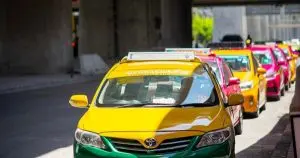
What's the deal with the colorful taxis?
The different colored taxis primarily serve to identify the respective taxi company. Taxi drivers obtain a license and rent a vehicle from a provider, which is identified by the color of the vehicle.
One distinguishing feature, for example, is that green and yellow taxis belong to private owners who have invested in and own the vehicle. They do not have to return the vehicle at a set time and can work whenever they want.
Another distinguishing feature is the blue taxis: they are equipped with GPS systems and can issue printed receipts, which are useful for claiming travel expenses.
There's no rule about what color a taxi should be. Just choose one in good condition, trust your judgment, and don't hesitate to look for another if you don't have a good feeling about it.
Keep in mind that taxi drivers have no control over Bangkok's notorious traffic. So stay calm and chat with your driver. You'll find that most Thai taxi drivers work hard and want to earn a living, and some of them are among the nicest people you'll ever meet.




Community
Comments 0
Start the conversation.