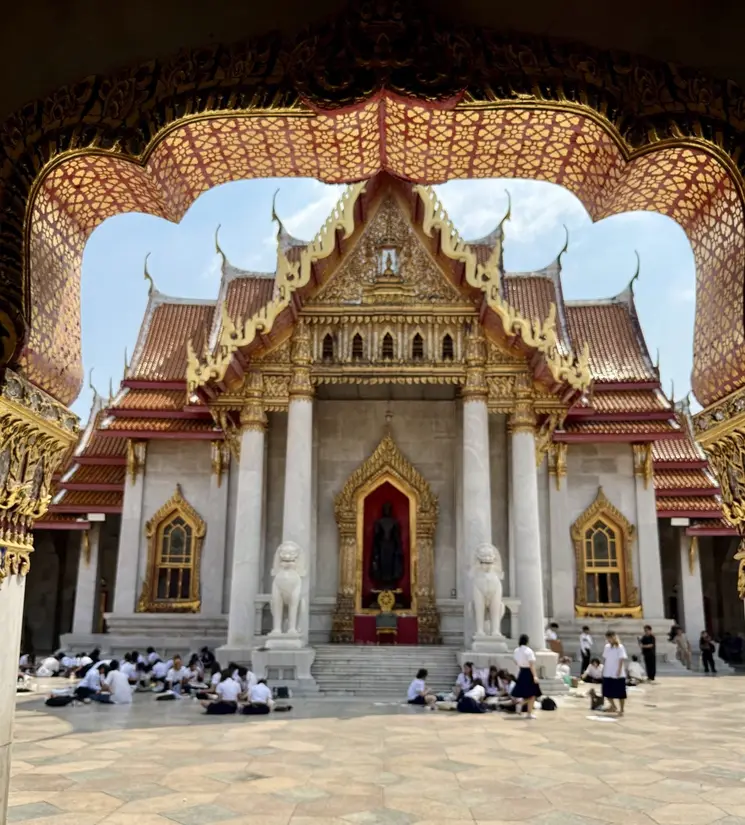
Anyone who's ever glanced at their change after a day in Bangkok might subconsciously recognize this temple. Turn over a 5-THB coin and you'll see the inscription "Wat Benchamabophit." Its nickname, of course, is "Marble Temple"—famous for the Italian Carrara marble used for its columns, facades, and staircases. These European elements harmonize beautifully with the Thai red and gold details, creating a stunning contrast with the orange roofs.
It's not only so significant that it's depicted on coins, but it also serves as inspiration for local artists. During our visit, we saw a group of art students with their sketchbooks in the courtyard, silently drawing the building. We didn't observe this at any other temple in Thailand, which underscores the deep reverence for the temple among the Thai people. The symmetry of the main ordination hall is immediately striking upon entering, but those who wander around a bit will discover much more.
Art students in Wat Benchamabophit
The story behind white Carrara marble
In 1899, King Chulalongkorn (Rama V) commissioned the construction of a new royal monastery in the rapidly developing Dusit district. A few years earlier, he had become the first Thai monarch to undertake a major tour of Europe, during which he fell in love with Italian architecture. With the support of his half-brother, he therefore decided to import Carrara marble for this temple, aiming to lend Bangkok a more elegant air.
Stained-glass windows were installed to complement the European marble, while traditional Thai details and roofs were added to give the monastery a harmonious blend of East and West. Today, Wat Benchamabophit is considered a royal monastery of the first rank. Part of the king's ashes is interred beneath the Buddha statue (a replica of Phra Phuttha Chinnarat) in the ordination hall.
What to see at Wat Benchamabophit
The ordination hall (Ubosot), flanked by two guardian lions, is undoubtedly the highlight of Wat Benchamabophit. It is the first thing one sees upon passing through the main gate, and one is immediately struck by the perfectly symmetrical, terraced roofs that cascade downwards and the golden window frames that stand out magnificently against the white marble. After admiring the Ubosot from the outside, one can enter the building and pay homage to the Buddha statue, which sits majestically against a blue backdrop.
Beyond that, the only thing left to explore is the courtyard. It curves around the back of the ubosot in a U-shape and is very peaceful: an open space where you can stroll leisurely through the cloister gallery, admire the more than 50 Buddha statues, and photograph the arched doorways decorated with red and gold patterns. As you've probably noticed, the marble temple is rather small, so don't expect a sprawling complex like Wat Pho. Nevertheless, we particularly like these intimate temples.
Buddha statues in the monastery gallery
Opening hours, admission prices & best time to visit
After our flight back from Sukhothai, we visited Wat Benchamabophit and therefore didn't arrive until 11:00 AM (later than planned). The timing was good, however, as the tourist buses started arriving around noon, giving us about an hour to enjoy the temple in peace. Kat's mother accompanied us, and it was lovely to show her a temple she had never seen before. It was touching to see her praying and doing good deeds in this inspiring atmosphere.
We strongly recommend arriving well before 11:00 AM. Officially, the temple is open from 6:00 AM to 6:00 PM, but we saw signs indicating that the grounds are accessible from 5:00 AM to 7:00 PM. A visit at sunrise or sunset is particularly recommended – the golden hour light hitting the marble is said to be spectacular. The great thing about the Marble Temple is that entry costs only 100 THB, much cheaper than, for example, the Grand Palace, which charges a hefty 500 THB per person.
Kat's mother in the Marble Temple
How to get to the Marble Temple
Unfortunately, the Marble Temple isn't near MRT or BTS stations, as it's located in Bangkok's Dusit district, which is somewhat isolated within the city's rail network. Therefore, Grab is the best way to get there. If you leave early in the morning, before 7:00 AM, you'll avoid most of the morning rush hour traffic, and the journey should be quite pleasant. Alternatively, you can take a bus from the Old City or the BTS Skytrain to Phaya Thai station and then a taxi or tuk-tuk (approximately 10 minutes).
Frequently asked questions about Wat Benchamabophit
What is the dress code for the Marble Temple?
The dress code for Wat Benchamabophit is the same as in most Bangkok temples: shoulders and knees must be covered – a rule that applies equally to men and women. Due to the heat, Cam showed up in knee-length shorts and got through the gates without any problems. However, this is risky, as the temple officially recommends modest clothing and may strictly enforce the dress code. It's best for men to wear long trousers or at least pack a pair in case you're asked.
What are the rules of conduct at Wat Benchamabophit?
If you want to take the perfect photo under the archways, please be sure to give others time to take their pictures as well. This is our biggest criticism when traveling in Thailand: tourists who don't observe basic rules of etiquette. Otherwise, you should simply follow the usual rules of conduct in a sacred Thai temple: be quiet, remove your shoes before entering the main hall, and don't point your feet directly at the Buddha statue.
Is the Marble Temple better than Wat Pho, Wat Arun and the Grand Palace?
Wat Pho, Wat Arun, and the Grand Palace are known as the "Big Three" due to their proximity and undeniable beauty. However, they suffer in many ways from their own success. Forget about experiencing a tranquil atmosphere like that of the Marble Temple at 11:00 AM. If you arrive early enough, though, a truly special experience awaits: the Reclining Buddha (Wat Pho) and the Temple of the Emerald Buddha (Grand Palace). We'd say the Marble Temple definitely surpasses Wat Arun, while the other three can be either beautiful or dreadful, depending on the crowds.

Community
Comments 0
Start the conversation.