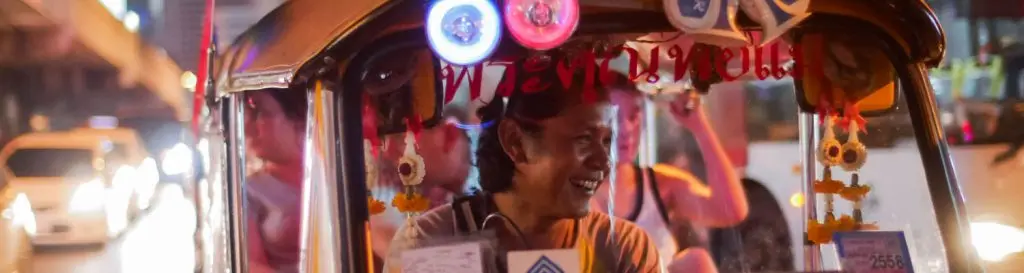
Three-wheeled tuk-tuks are Bangkok's most famous form of public transport and remain one of the best ways to explore the city, especially at night. Travel writer Deborah Dickson-Smith shares her experiences from a nighttime tuk-tuk tour of Bangkok.
Bangkok is best explored at night. It's cooler, less crowded, and the traffic is much more relaxed. Furthermore, some of Bangkok's most famous sights offer a particularly spectacular view at night, such as Wat Arun, the Temple of Dawn, located on the banks of the Chao Phraya River, which is illuminated in such a way that every golden stupa glows and is reflected in the water.
For those who don't know it yet: A tuk-tuk is essentially a motorcycle with a fully enclosed cabin that can accommodate two to three people.
It is a more intimate experience with the city than in a sterile, air-conditioned taxi, less complicated than using the BRT or MRT, and usually faster, as you can slip through alleys and side streets that are too narrow for cars, and occasionally even move onto the sidewalk.
Tuk-tuks originated during World War II, when presumably someone somewhere in Bangkok had the brilliant idea of attaching a motor to their rickshaw, and the idea caught on.
These days, if TripAdvisor is to be believed, you're likely to get ripped off by tuk-tuk drivers unless you're a local. Therefore, it's advisable to do your research beforehand and get a feel for what the usual price is.
In Bangkok, a short tuk-tuk ride costs around 30 baht (one Australian dollar). Hiring a tuk-tuk for the day or evening is easy, but you'll need to haggle. If you're unsure about negotiating or have concerns about the language barrier, ask someone at your hotel for help or, even better, book an organized tuk-tuk tour of the city.
Bangkok Food Tours offers a “Midnight Tuk-Tuk Tour” with a company called Smiling Tuk-Tuk, a recently established social enterprise that aims to reconnect travelers with safe and reliable tuk-tuk drivers.
The tour offers us a glimpse into Bangkok at night – a blend of sightseeing and culinary discoveries. Our first stop is Go Ang Pratunam, widely considered the best place for "Khao Mun Gai," the Thai version of chicken rice. It's an unassuming restaurant on the bustling Phetchaburi Road, not far from two of Bangkok's largest shopping malls, Central World and Siam Paragon.
Around 8:30 pm the restaurant is packed, and it is fascinating to watch how quickly each dish is prepared and distributed to the densely occupied tables that stretch from the small corner café to the edge of the wide sidewalk.
Our second leg takes us across the city, through a labyrinth of streets that flash by so fast I completely lose my bearings. This time we actually step onto the sidewalk and drive through an alleyway barely wider than our tuk-tuk until we reach our destination: Ann Guay Tiew Kua Gai.
After our noodle dish, we had another hair-raising drive across the city as we made our way to the Chao Phraya River and the flower market.
Evening is definitely the best time to stroll through these markets. Without the hustle and bustle of the day, it's a relaxed, fragrant walk through the third largest flower market in the world.
Just around the corner is our next destination, Wat Pho, the Temple of the Reclining Buddha, one of Bangkok's most famous landmarks. It's almost 11 p.m. now, and a stroll through the gardens of Wat Pho at this hour is quite different from a daytime visit. There's a peaceful atmosphere, exactly what you'd hope for – a visit to a religious monument, not a crowded tourist attraction.
From here, we take a short tuk-tuk ride to the riverbank. We climb about ten floors to a small rooftop bar that arguably offers the best view in all of Bangkok – and ice-cold beer. Sala Arun is an old guesthouse located directly opposite Wat Arun, the Temple of Dawn, on the other side of the Chao Phraya River.
It's after midnight and the streets are almost deserted. The tuk-tuks accelerate and speed across the city to our last destination for the evening, Thip Samai, for Pad Thai – supposedly the best in all of Bangkok. The restaurant is located on Maha Chai Road in Pranakorn.
Although it's past midnight, the restaurant is packed, and a long line is waiting for a table. But you don't have to wait long, because the food arrives lightning fast. Thanks to an efficient production line, dozens of plates are prepared every second, either served traditionally or wrapped in a thin omelet.
And since this is our last stop, we can take our time with this midnight snack and enjoy wondering whether the glamorous women at the next table are actually women. Ultimately, their deep voices give them away.
As I sit here on the sidewalk eating Pad Thai from a plastic bowl, I can't help thinking: I feel like a local. Surely a sign of a successful tour.
Bangkok Food Tours offers a "Best Eats Midnight Food Tour" by tuk-tuk, starting at the Chid Lom BTS station and ending at your hotel. Group sizes range from 2 to 16 people, and the tour costs 1700 Baht per person, including all meals. For more information, please visit Bangkokfoodtours.com.
Tour operator Expique offers a tuk-tuk tour of Bangkok at night, including Klong San Market, Wat Prayoon, Wat Pho, the flower market, and a few other surprises, such as dinner in Chinatown. The tours cost 1850 baht per person. Expique.com
Take Me Tour uses local guides for its tours and offers, among other things, a nighttime tuk-tuk tour that includes Chinatown and the flower market for approximately 1300 baht per person. Takemetour.com




Community
Comments 0
Start the conversation.