A travel guide to Ayutthaya
Since the 14th century, when Ayutthaya became the second capital of Siam (present-day Thailand), Siamese art and culture accumulated along the Chao Phraya River valley. With 35 kings and countless battles during its 471-year reign as capital, the ancient city was known to foreign traders as one of the largest and wealthiest in the East. As a major trading port in Southeast Asia, Ayutthaya was a cosmopolitan capital with great cultural diversity. It welcomed travelers and traders from all over the world, including Chinese, Greeks, Portuguese, French, Japanese, and Dutch.
Like many ancient cities, Ayutthaya experienced a rise and fall. Burmese conquerors plundered the old capital in the 18th century.
Today, Ayutthaya is an unforgettable travel destination thanks to its archaeological sites. The historic city of Ayutthaya is a UNESCO World Heritage Site. Here you'll find the ruins of palaces and temples, including some of the most important, such as Wat Phra Si Sanphet, Wat Ratchaburana, and Wat Mahathat. The now-ruined pagodas were once gilded and shone like gold. Among the towering ruins, it's easy to imagine how the ancient city once captivated people from all walks of life. Merchants, priests, poets, outcasts, mercenaries, and travelers from distant lands flocked to Ayutthaya.
Ayutthaya also has its share of contemporary history. The Bang Pa-In Palace and Wat Niwet Thammaprawat are worth visiting to discover traces of European influence on 19th-century architecture.
Most visitors take a day trip to Ayutthaya to see the main sights and historical sites. However, it takes two days or even a week to truly appreciate the city's splendor and beauty.
With spectacular museums, exquisite restaurants, boutique hotels, ancient pagodas, and fascinating marketplaces, Siam's old capital shines in new splendor. Ayutthaya enchants with its unique charm and magic – just as it did 500 years ago.
Arrival
Ayutthaya is located about 80 kilometers north of Bangkok and can be reached via expressways, waterways and the railway.
Minibuses run daily from Bangkok bus station (Mo Chit 2) to Ayutthaya.
The train journey is the cheapest and most scenic way to travel from Bangkok to Ayutthaya. Several trains depart daily from Bangkok (Hualamphong) station to Ayutthaya. The journey takes approximately one and a half to two hours, depending on the train type.
Cruises on the Chao Phraya River from Bangkok to Ayutthaya frequently stop in Bang Pa-In and at historical temples along the river. As there are no scheduled services, advance booking is required.
locomotion
Tuk-tuks, motorcycle taxis, boats, songthaews (shared taxis), and local buses transport visitors in and around Ayutthaya at fixed prices or by arrangement. Bicycles are ideal for exploring the historical park and temples.
Things to do in Ayutthaya
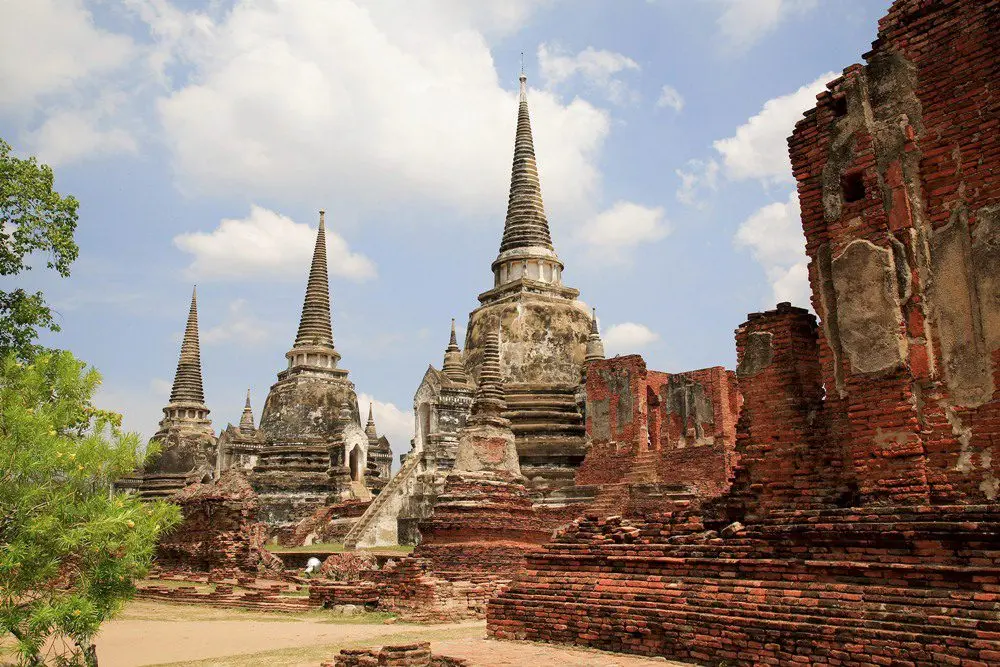
In this fascinating temple ruin in the historic city of Ayutthaya, three towering pagodas stand side by side, creating a picturesque scene. Built in 1448 on the site of the old royal palace, the temple served as a model for the Grand Palace and the Temple of the Emerald Buddha, constructed in Bangkok almost 350 years later. Three imposing stupas were erected at different times to house the ashes of the kings. This temple once contained a 16-meter-tall standing Buddha statue of Phra Si Sanphet, covered with at least 143 kilograms of gold. The Burmese invaders attacked and destroyed Ayutthaya in 1767, forcing the inhabitants to abandon the burned-out city. The sacred temple with its three pagodas stands as a testament to the wealth and wisdom of Ayutthaya.
Wat Phra Si Sanphet, at the northern end of Si Sanphet Road, Ayutthaya. Opening hours: 8:00 AM - 6:30 PM. Admission: 50 Baht.
In 1424, the historic Wat Ratchaburana temple was built on the site of the former crematorium of two princes of Ayutthaya, both of whom had fallen in battle for their dying father's throne. However, Wat Ratchaburana's main attraction is not the fratricidal conflict, but the treasures hidden in the crypt beneath the gigantic pagoda. In 1957, treasure hunters broke into the tomb and stole various gold artifacts. One of the thieves, wearing a golden crown and brandishing a golden sword, was apprehended in the local Ayutthaya market. According to records from the Ministry of Arts, the Wat Ratchaburana crypt contained approximately 100 kilograms of gold artifacts in various forms: royal regalia, the golden stupa, and Buddha statues. Unfortunately, officials were able to recover less than 20 percent of the stolen items. Many of the recovered artifacts are now on display at the Chao Sam Phraya National Museum. Inspired by Indiana Jones and the Holy Grail, visitors can follow the narrow stone path to the crypt.
Wat Ratchaburana (a 3-minute walk from Wat Mahathat), Chikun Road, Ayutthaya. Opening hours: 8:00 AM - 6:30 PM. Admission: 50 Baht.
The sandstone Buddha head, entwined with the gnarled roots of a Bodhi tree, is undoubtedly the most photographed sight in Ayutthaya at Wat Mahathat. The famous photograph of the gigantic Bodhi tree suggests that Wat Mahathat was once one of the oldest and most important Buddhist temples. Founded in 1374, the temple served for centuries as the seat of the Supreme Patriarch (head of Buddhist monks in Thailand). It was built in the Khmer style using laterite (instead of sandstone) and brick, and decorated with stucco. A walk around the central stupa, which once stood 43 meters tall, is well worth the effort. The temple's northwest pagoda is one of the few structures that still contains murals from the early Ayutthaya period.
Wat Mahathat, Chikun Road, Ayutthaya. Opening hours: 8:00 AM - 6:30 PM. Admission: 50 Baht.
The Chao Sam Phraya National Museum, built with donations and proceeds from the sale of votive tablets from Wat Ratchaburana, offers visitors a glimpse into Ayutthaya's rich history. On display are treasures such as royal gold and Buddha statues from the crypts beneath Wat Ratchaburana and Wat Mahathat. Highlights of the exhibition include golden artifacts from Ayutthaya, such as a jewel-encrusted golden royal elephant, a golden sword, royal regalia, and headdresses. Also exhibited are beautiful, intricately carved wooden temple doors and Buddha statues—some dating back to the 7th century.
Opening hours: Tuesday to Sunday, 9:00 AM to 4:00 PM. Admission: 150 Baht. Phone: +6635 241 587
Three rivers – the Lop Buri, the Pasak, and the Chao Phraya – surround the historic city of Ayutthaya. Geographically, the city has changed little since the 14th century, when it was the old capital. The best way to explore the city is on a leisurely boat trip around the island.
Departing from a local dock at Wat Phanan Choeng – the Temple of the Great Buddha – the slow boat travels upstream along the east coast of Ayutthaya. Once the boat has left the city behind, images of the river landscape pass by like a slideshow: Buddhist temples, traditional Thai houses, weathered wooden houses, a half-submerged rice barge, and villagers on small sampans.
In the far east of the island, the boat glides past the Royal Elephant Kraal Village, an elephant sanctuary. These animals once played a vital role as war elephants. Today, in this peaceful corner of Ayutthaya, the giants no longer have to go to battlefields. Every evening, they take turns bathing in the river. It's a beautiful sight to watch these gentle giants in the shallow water.
From the Pasak River, the boat travels to the northern part of the island and down to the Lop Buri River. This waterway winds past the ruins of the Royal Palace, the historic Wat Cheong Tha temple, and destroyed stupas.
The Lop Buri River flows into the Chao Phraya River on the west side of the island. From there, the majestic Chao Phraya flows past the ruins of Wat Chaiwatthanaram. From a boat, you can enjoy the sunset over the magnificent historical temple.
A cruise around the island of Ayutthaya is like a journey into the past.
Visitors can see historic Buddhist temples, a Roman Catholic church, mosques, and passing villages. The bright yellow St. Joseph's Church is impossible to miss, even from the tour boat. Founded in the late 17th century, it was the center of French Catholic missionaries until the sack of the ancient Siamese capital.
A boat trip is one of the most beautiful ways to explore Ayutthaya. A new surprise awaits around every bend in the river, including the old harbor of Pom Phetch Fort, where the journey ends. Hidden away in the far south, the fort was the first line of defense for Ayutthaya Island. This southern outpost is also the cradle of the Chakri Dynasty, the current royal house of Thailand. Before the fall of Ayutthaya, the founder of the Chakri Dynasty – King Rama I – was born and raised here.
Off the island in Ayutthaya
Multicultural foreign quarter
Ayutthaya was a cultural melting pot, home to over 400,000 Chinese, Greeks, Portuguese, French, Japanese, Dutch, and Persians living around the capital. A visit to Ayutthaya's foreign quarter offers the opportunity to experience the multicultural atmosphere of these historic settlements.
The international communities lived outside the city walls. Most of them settled around the Catholic Church of St. Joseph in the southern part of the city.
Founded in 1666, St. Joseph's Church served as a French Catholic mission station. It played a significant role in Ayutthaya's politics and economy until the Burmese invaded the city in 1767. Today, the Catholic church shines in its Romanesque splendor and attracts devout Christians for services on Saturday evenings and Sunday mornings. The Muslim community is just a short drive away.
Ayutthaya is home to Muslim communities whose roots trace back to Persian, Arab, Turkish, Malay, and Cham traders who settled there over centuries. Most Muslims who settled along the Chao Phraya River earned their living by making ship ropes and selling fabrics from India and the Middle East.
Your next stop is the Portuguese Village. On the west bank of the Chao Phraya River, you'll see the historic foundations of the Dominican Church of San Petro and the cemeteries along the riverfront. The Portuguese were the first European nation here, reaching Ayutthaya in the early 16th century. Their skills in trade, shipbuilding, and warfare contributed to the prosperity of the kingdom.
Opposite the Portuguese settlement lies the Japanese village on the east bank of the Chao Phraya river.
From the 1580s to the 1630s, Japanese traders, mercenaries, and Catholic exiles migrated to Ayutthaya, enriching the Siamese court with their knowledge and skills. Yamada Nagamasa, the most famous Japanese figure in Ayutthaya, became ruler of Nakhon Si Thammarat before being poisoned. Maria Guyomar de Pinha, a remarkable Siamese woman of Japanese descent, influenced the Portuguese-inspired cuisine at the Siamese court with her bittersweet tales. The Japanese settlement stretched for a kilometer along the eastern shore. The museum and its idyllic garden invite visitors to an exhibition illustrating the close connection between Siamese and Japanese peoples through sugar and rice wine.
About two kilometers north of the Japanese village lies Baan Hollanda, a historic Dutch settlement.
The Dutch followed the Portuguese to Ayutthaya in 1608, seeking new economic opportunities. They established a settlement with an imposing stone building, the so-called Red Building, not far from the Petch fortress. The Burmese invaders destroyed the Dutch settlement, and the famous Red Building was rebuilt to house artifacts from the historic settlement. After visiting the exhibitions, you can enjoy a Heineken in the on-site café. Relax at the harbor, once an important base for the Dutch East India Company, and reflect on the trade relations between Siam and the Netherlands – then and now.
The Hokkien Chinese community settled around Petch Fort and Wat Phanan Choeng Temple. Here, at the confluence of the Pa Sak and Chao Phraya rivers, the Chinese earned their living by having foreign ships and junks unload their cargo at the fort. The historic fort and the riverside promenade invite you to a leisurely stroll with picturesque river views before ending your day.
Masterpieces in the Museum of Art of the Kingdom
Under the patronage of Her Majesty Queen Sirikit, the Queen Mother, for Thai arts and crafts, the Kingdom Art Museum showcases masterpieces of Thai craftsmanship. Many of the magnificent and captivating pieces are unique, classic masterpieces created using ancient techniques dating back to the Ayutthaya period. Other impressive objects demonstrate the new methods explored during the reign of King Rama IX. Highlights include the gold niello Buddha throne, the gold damascened Buddha throne, the exquisite model of the royal barge Sri Suphannahongse from the first reign, the five-peaked Busabok wooden sculpture, the embroidered Himavan Forest screen, and the carved wooden screen depicting the legend of Benjaratana.
Museum of Arts of the Kingdom, Bang Pa-In, a 20-minute drive from Ayutthaya
Opening hours: Tuesday to Sunday, 10:00 AM to 3:30 PM. Admission: 75 Baht (students and seniors), 150 Baht (adults). Phone: +6635 352 995. Website: www.artsofthekingdom.com
Timeless small communities Koh Kerd
Nestled on the banks of the Chao Phraya River lies Koh Kerd, home to small communities surrounded by a network of smaller waterways. Koh Kerd exudes an unspoiled, timeless beauty. Imagine a wide, peaceful stretch of the Chao Phraya, fringed by marshes and floating gardens. Wooden houses and rustic terraces rise above the water. Locals warmly welcome day-trippers and weekend visitors eager to experience the local way of life. Visitors can participate in various activities, such as gathering native plants for traditional medicine or catching giant freshwater prawns for dinner. The homemade food is fresh, satisfying, and always served with a smile. Koh Kerd is situated in the most beautiful part of the Chao Phraya, where the river scenery is breathtaking. You can take a longtail boat to the temple and the local food market.
Koh Kerd, Bang Pa-In district, a 20-minute drive from Ayutthaya city. Tel.: +6681 372 6038
Magnificent Summer Bang Pa-In Palace
Bang Pa-In Palace, built in the 17th century as a summer residence for King Prasat Thong of Ayutthaya, fell into disrepair between the late 18th and early 19th centuries. It was revived in the 19th century by King Rama IV. Most of the European-style buildings were constructed between 1872 and 1889 under King Chulalongkorn (Rama V). The summer residence occasionally served as a home for foreign dignitaries such as Nicholas II of Russia, Queen Elizabeth II, and Crown Prince Akishino Fumihito. Bang Pa-In is well worth a visit for its unique beauty and variety of architectural styles, including the Chinese-style observatory, the traditional Thai pavilion, and the Swiss chalet. The palace grounds, with their trees and gardens, are perfect for a stroll. Please dress appropriately for your visit. A short walk from Bang Pa-In Palace is Wat Thammaprawat, a temple built in the late 19th century in the Gothic Revival style. The small ordination hall is striking with its pointed arches and windows, steep roofs, and intricate decorations. The temple grounds on the riverbank offer a tranquil garden and picturesque views of the Chao Phraya River. To reach the palace, take the train from Ayutthaya (15 minutes) to Bang Pa-In station and from there a tuk-tuk to the palace, which is about two kilometers away.
Bang Pa-In Palace, Bang Pa-In, a 30-minute drive from Ayutthaya. Opening hours: daily (8:00 AM–4:00 PM). Admission: 100 Baht. Phone: +66 35 261 044
Foodborne fever
In Ayutthaya, the local cuisine blends influences from various ethnic groups who arrived centuries ago. Dishes like the spicy soup "Tom Yam" are authentic and traditional, while Persian cuisine inspired the creamy and relatively sweet Massaman curry. The dessert Foi Thong is similar to the Portuguese Fios de Ovos.
Cozy cafes and irresistible street food await you. Indulge in Ayutthaya's specialties, such as the giant river prawn. A bowl of sensational Kuay Tiew Rua (boat noodles), Roti Sai Mai (thin roti filled with cotton candy), and egg yolk cakes like Thong Yip and Thong Yod should definitely be on your list when vacationing in the old town.
Drink at Wine Ayutthaya
With its elegant spiral staircase and breathtaking architecture, Wine Ayutthaya sets new standards in Ayutthaya's culinary scene. Here, exquisite wines such as Cabernet Sauvignon, Pinot Noir, Shiraz, Malbec, Riesling, and Sauvignon Blanc are offered. As part of the Grand Chao Phraya Ayutthaya restaurant, this winery allows discerning connoisseurs to enjoy a chilled Sauvignon Blanc while taking in the picturesque view of the Chao Phraya River. The atmosphere is relaxed and welcoming; laughter, lively conversation, and the clinking of glasses enhance the dining experience. The menu features the finest Ayutthaya specialties (such as giant, fresh river prawns and catfish).
The Wine Ayudhaya, 42/1 Ban Roon, a 20-minute drive from Ayutthaya city center. Opening hours: Open daily (11:00 AM - 10:00 PM). Phone: +6681 942 1666
An exceptional culinary experience at Busaba Cafe & Meal
This stylish and cozy restaurant in northern Ayutthaya offers the delicacies and specialties of the ancient city. With a modern touch, the restaurant gives each dish a unique character. Spaghetti with Pad Thai sauce and giant freshwater prawns are served. The wide noodles with spicy salsa and prawn salad are a delight. Roti Sai Mai, a typical street food—a burrito-style pancake filled with cotton candy—is given a modern twist here, served with an iced coffee. Busaba Cafe & Meal is the ideal spot for lunch near the historical park.
Busaba Café & Restaurant, Uthong Road, Ayutthaya. Opening hours: 9:00 AM - 8:00 PM. Phone: +6661 593 3836
Sweet treats at Baan Kao Nhom
The pastry chef at Baan Kao Nhom owes the creation of these auspicious Thai desserts for the royal court in the 17th century to Maria Guyomar de Pina (a Siamese woman with Japanese, Portuguese, and Bengali roots). Maria's sweets, such as Thong Yip (egg yolk cake with flowers), Thong Yod (round egg yolk cake), and Foi Thong (sweet, grated egg yolk), were a true delicacy at the Siamese royal court four centuries ago. These rich, sweet, creamy, and simply delicious treats can be found at Baan Kao Nhom. The small shop in the southern part of the historical park also offers good ice cream and drinks at fair prices.
Baan Khao Nhom, Pratu Chai, Ayutthaya Opening hours: 8am–6pm (Mon–Fri) 9am–7pm (Sat–Sun) Telephone: +6697 921 9465
Authentic Thai flavors from Ruen Tubtim
When it comes to authentic Thai cuisine served in a traditional Thai house on the riverbank, few restaurants in Ayutthaya can rival Ruen Tubtim. Located directly on the Pasak River in the northern part of the historical park, the restaurant is part of the floating community around the small island of Koh Loi. The Thai food here is flavorful and authentic. Be sure to try the pomelo salad (Yum Som-O), the sweet and sour soup with fried egg and shrimp (Kaeng Som Cha-Om Kung), and the steamed red snapper with spicy sauce (Kapong Rad Prik). Gourmets shouldn't miss the creamy, nutty chicken curry (Phanaeng Kai) and the crispy fried hard-boiled eggs in sweet and sour tamarind sauce (Khai Luk Khoei).
Ruen Tubtim, 24/2 Koh Loi, Ayutthaya Opening hours: Open for lunch and dinner Telephone: +6685 919 9054
Selected articles about Ayutthaya
Thailand celebrates its newest UNESCO World Heritage Site: Discover Wat Phra Mahathat Woramahawihan in Nakhon Si Thammarat
Discover inner peace: Meditation retreats throughout Thailand
In a fast-paced world, mental clarity can seem like a luxury. Meditation is...
A guide to traveling in Thailand during the cooler months
From November to February, Thailand experiences its cooler season – a time with blue skies and fresh mornings that appeals to travelers...
Do you need travel information?
Discover everything you need to know before your trip – from visa requirements and entry guidelines to essential travel tips and frequently asked questions.




Community
Comments 0
Start the conversation.