Besides Thailand's idyllic islands, beaches, and temples, there are many other aspects of Thai culture to discover. Thailand's rich agricultural heritage is particularly popular. Welcome to agritourism!
Thailand is, after all, a kingdom of farmers, famous worldwide for its rice, silk, and food products.
In response to the growing interest in immersive experiences, the Thai Ministry of Tourism and Sports, together with the Ministry of Agriculture and Co-operatives, has created a new tourism category: agritourism.
The collaboration began in August 2015 with four pilot destinations: Khlong Mahasawat in Nakhon Pathom; Pak Phanang in Nakhon Si Thammarat; Ban Khok Muang in Buri Ram and Khao Kho in Phetchabun.
This is a great new opportunity to experience Thailand's rural culture, meet locals, enjoy a homestay, and at the same time support these rural communities seeking new sources of income, which will contribute to their survival.
The area closest to Bangkok lies along the Khlong Mahasawat, a well-known canal in Nakhon Pathom. This canal is one of many that crisscross the province and was built 156 years ago to connect the Khlong Bangkok Noi with the Nakhon Chaisi River.
The construction, which took place from 1860 to 1862, was commissioned by King Rama IV, and with the opening of the waterway, almost 20,000 rai (32 square kilometers) of fertile farmland became accessible.
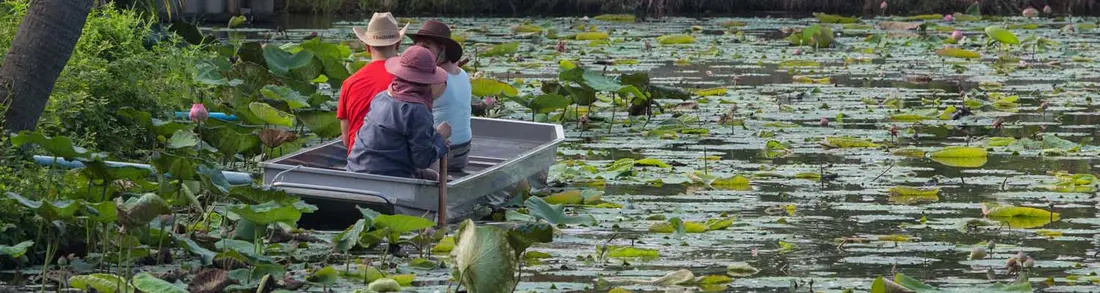
The tours here are best taken in the morning to avoid the midday heat. You travel by longboat along the canals, visiting orchards, lotus farms, and orchid plantations along the way.
The tours start at the local temple, Wat Suwannaram. While you wait, you can feed the catfish in the canal (all the vendors nearby sell bags of bait). Just toss a few pellets into the water, and it will splash and foam as the fish fight for their bellies. These river monsters are so numerous that with enough bait pellets, you'll feel like you could walk across a bridge of wriggling, silver bodies.
The first stop along the canal is the local lotus farms. Anyone who spends time in Thailand knows that the lotus is a flower of reverence and a symbol of spiritual purity. Lotus flowers are also used in cooking and medicine and grow year-round, making them a valuable crop for the region's farmers.
A rowboat will take you directly to the lotus ponds, where the morning dew glistens like mercury on the giant leaves as pickers harvest the lotus buds. These ponds are renowned for their pink and white blossoms, which are exported throughout Asia.
Mangoes, guavas, giant jackfruit, and award-winning pomelos grow in abundance along the banks of the Khlong Mahasawat. You'll have the chance to admire these fruits from a tractor-trailer driven by a wannabe race car driver. It's an unusual yet exhilarating ride through a sleepy orchard, and you'll be glad to sit down at the end and savor the sweet local produce.
The next stop is the Ban Saladin rice-growing region, where you can sample some delicacies, such as crispy rice crackers filled with pork or salted goose eggs, a local specialty. Most visitors take plenty of bags of treats home with them.
The last stop along the canal is the orchid farms. Thai orchids are famous for their beauty, and the country is the world's largest exporter of these flowers. They simply need enough water to grow, and many are sown in coconut shells or simply hung in baskets.
To conclude the day, all that remains is to enjoy the boat trip back to Wat Suwannaram and watch the storks foraging for food in the pondweed.
By car: Khlong Mahasawat is located about 50 km from Bangkok and is easily accessible via the Nakhon Chaisi Highway. Look for the Salaya Campus of Mahidol University. The canal is signposted at the end of Putthamonthon Sai 4 road.
By train: Trains stop directly at Wat Suwannaram and operate on the Thon Buri Lang Suan line.
In 2016, nine more agrotourism destinations will be introduced in other “12 Hidden Gems” provinces, including Lampang, Nan, Samut Songkram, Ratchaburi, Chanthaburi, Trat, Loei, Chumphon and Trang.
Community
Comments 0
Start the conversation.